* fix(gateway): enforce assistant media scopes
* changelog: require read scope for assistant media (#68175)
* skip scope enforcement for auth.mode=none
Exclude method "none" from the identity-bearing scope gate so
gateway.auth.mode=none deployments are not regressed by the new
operator.read check.
---------
Co-authored-by: Devin Robison <drobison@nvidia.com>
* fix(agents): filter bundled tools through final policy
* changelog: filter bundled tools through final policy (#68195)
* forward agentId into compaction tool-policy filter
Pass effectiveSkillAgentId to applyFinalEffectiveToolPolicy in the
compaction path so per-agent tool policies apply to bundled tools
during compaction the same way they do during normal runs.
* scope final tool-policy filter to bundled tools only
Running the full tool-policy pipeline on the merged core + bundled tool list
re-filters core tools whose plugin WeakMap metadata no longer survives the
normalize/hook wrappers applied by createOpenClawCodingTools(). Narrow the
helper to only the newly-appended bundled MCP/LSP tools so plugin-provided
core tools keep matching group:plugins and plugin-id allowlist entries.
* harden authorization signals on final tool policy
- message.action gateway handler now server-derives senderIsOwner from the
authenticated gateway client scopes (ADMIN_SCOPE on client.connect.scopes)
and ignores any senderIsOwner value on the wire, so a non-admin scoped
caller cannot spoof owner status to unlock owner-only channel actions or
owner-only tool policy. Schema keeps the field optional for wire compat
but documents that it is ignored.
- applyFinalEffectiveToolPolicy now cross-checks caller-provided groupId
against the session-derived group context resolved from sessionKey (and
spawnedBy). When they disagree, the caller groupId plus its adjacent
groupChannel/groupSpace are dropped and a warn is emitted, so a caller
that fabricates a different group id cannot reach a more permissive
group-scoped tool policy during the final bundled-tool filter. Added a
JSDoc trust invariant on the helper input describing the required
server-verified identity contract.
* align compact agentId resolution with core tools
Drop the explicit agentId on applyFinalEffectiveToolPolicy during
compaction. The core tool set produced just above via
createOpenClawCodingTools(...) also omits agentId, so resolveEffectiveToolPolicy
falls back to resolveAgentIdFromSessionKey(sessionKey) in both places.
Passing effectiveSkillAgentId only to the final filter made the two
policy lookups diverge on legacy/non-agent session keys where the
sessionKey path resolves to main but effectiveSkillAgentId follows the
configured default-agent path, which could deny or allow bundled tools
under a different per-agent policy than the already-created core tools.
* tighten trusted propagation for owner and group signals
- message.action gateway handler: full-operator callers (shared-secret
bearer or operator.admin scope) now propagate the request-provided
senderIsOwner through to channel action handlers instead of having it
hard-coded off. Previously the hardened path force-derived ownership
from ADMIN_SCOPE alone, which broke owner-gated actions when the
trusted runtime forwards them via the least-privilege gateway path
(callGatewayLeastPrivilege requests only the method scope, so even
legitimate owner senders were downgraded to senderIsOwner=false).
Narrowly-scoped callers (e.g. operator.write-only) still have the wire
value forced to false so a non-admin caller cannot assert ownership.
- applyFinalEffectiveToolPolicy: fail-closed when the session key and
spawnedBy encode no group context. Previously the helper only dropped
a caller-provided groupId that conflicted with a non-empty set of
session-derived group ids, which left an accept-caller fallback open
when the session had no group context at all (direct/cron/subagent
session keys). An attacker who could run without a group-bound session
could then supply an arbitrary groupId and reach a more permissive
group-scoped tool policy. Now: no session-derived group context plus
any caller-provided groupId drops the caller value and warns.
* suppress unavailable-core-tool warnings in bundled-only pass
applyToolPolicyPipeline infers its coreToolNames reference set from the
tools array it is filtering. The bundled-only second pass only sees the
MCP/LSP subset, so normal core allowlist entries (for example
tools.allow: ['read', 'exec']) would look "unknown" during this pass
and emit misleading warnings even when the config is valid for the full
effective tool set — polluting logs and potentially evicting real
diagnostics from the shared warning cache. Set
suppressUnavailableCoreToolWarning on every step of this pass so known
core-tool allowlist entries stay silent; genuinely unknown entries
still surface through the otherEntries warning path.
Keep explicit session-key normalization on loaded channel plugins so
unknown provider contexts pass through without cold-loading bundled channel
runtimes. This preserves active plugin behavior and removes the slow
unknown-provider test path.
* fix(cron): preserve untrusted awareness event labels
Keep isolated cron awareness summaries untrusted when they are promoted into the main session, and forward explicit trust downgrades through the gateway cron wrapper. Add focused regression coverage for both paths.
* changelog: note cron awareness untrusted-label preservation (#68210)
* fix(feishu): resolve card-action chat type before dispatch
* changelog: resolve card-action chat type before dispatch (#68201)
* address review: prefer chat_mode over chat_type, add error-path tests
- Swap resolution order to check chat_mode (conversation type) before
chat_type (privacy classification), since Feishu's chat_type can
return "private" for private group chats which would be wrongly
classified as p2p.
- Treat "topic" as group semantics in the normalizer.
- Add comment explaining the field semantics and why "private" maps
to "p2p" (safe-failure direction).
- Add two error-path tests: API returns non-zero code, and API throws.
* map chat_type=public to group in normalizer
Feishu's chat_type can return "public" for public group chats.
Without this mapping the fallback resolver would miss it and default
to p2p, routing a group card action through DM handling.
* address Aisle: cache chat-type lookups and scrub log output
- Add a 30-minute TTL cache for chatId -> chatType so repeated card
actions on the same chat skip the Feishu API call.
- Strip chatId, event.token, and raw error strings from log messages;
use err.message instead of String(err) to avoid leaking stack traces
or HTTP internals from the Feishu SDK.
* prune expired chat-type cache entries
Add pruneChatTypeCache() called on each lookup so expired entries are
evicted and the cache stays bounded in long-running processes.
* address Aisle: scope cache by account, cap size, sanitize logs
- Key cache by accountId:chatId to prevent cross-account contamination.
- Cap cache at 5000 entries and evict oldest when exceeded.
- Sanitize response.msg and err.message with CR/LF stripping and
length cap before logging to prevent log injection.
Keep the registry fallback unit test on a minimal bundled fixture instead of loading the real Google Chat plugin. Doctor capability metadata remains covered by the doctor channel capability tests.
Add an Exa web-search contract artifact and use single bundled plugin-scoped webSearch config as a provider hint. This keeps runtime secret resolution on metadata-only surfaces instead of importing full provider tool implementations.
Use the existing external auth test hook and a lightweight OAuth package mock so mirror-refresh coverage does not load provider runtime work while seeding test stores.
Keep models command tests inside the in-memory channel registry for Discord and WhatsApp so text-surface assertions do not load bundled channel runtimes.
Register a lightweight Telegram test plugin so the default-adapter assertion stays inside the in-memory registry instead of loading the real bundled channel runtime.
Fixes openclaw#67886. Handles stdin EPIPE in CodexAppServerClient by attaching an error handler, guarding writeMessage against writes after close, and aligning closeWithError cleanup with close.
* fix(macOS): enable undo/redo in webchat composer text input
Set `allowsUndo = true` on ChatComposerNSTextView in makeNSView().
NSTextView defaults allowsUndo to false, which prevented Cmd+Z and
the Edit menu Undo/Redo items from functioning.
Fixes#34898
* fix(macos): enable webchat composer undo/redo (#34962) (thanks @tylerbittner)
---------
Co-authored-by: Nimrod Gutman <nimrod.gutman@gmail.com>
* fix(telegram): clean up thread bindings to stale/failed ACP sessions on startup
When loading persisted thread bindings on manager creation, validate each
ACP session against the session store. Remove bindings where:
- Session entry doesn't exist (deleted externally)
- Session status is failed/killed/timeout
- ACP runtime state is 'error'
This addresses issue #60102 where Telegram DMs remained routed to stale
ACP sessions even after restart, because the binding file persisted
across restarts without validating the target session was still valid.
* fix(telegram): guard against null session entry and transient store read failures
Address review comments on PR #67822:
1. Skip bindings when readAcpSessionEntry returns null or when
session store is temporarily unreadable (storeReadFailed: true).
Without this, a transient I/O error would mark all ACP bindings
as stale and delete them on every startup.
2. Only set needsPersist when bindings were actually removed.
Previously, stale session keys from OTHER accounts could set
needsPersist=true even when zero bindings were removed for
the current account — causing spurious disk writes.
Also clean up redundant optional chaining on entry.status now
that we guard against undefined/nullable sessionEntry.
* perf(telegram): dedupe ACP session reads in startup cleanup
Cache readAcpSessionEntry calls by targetSessionKey. Multiple bindings
to the same ACP session now result in a single session store read instead
of one read per binding.
Addresses chatgpt-codex-connector P2 review comment on PR #67822.
* fix(telegram): skip non-ACP session keys in stale binding cleanup
Address chatgpt-codex-connector P1 review comment on PR #67822:
Plugin-bound Telegram conversations use "plugin-binding:*" keys
with targetKind === "acp", but these are NOT ACP runtime sessions.
readAcpSessionEntry() returns no entry for them, so !sessionEntry.entry
would classify them as stale and delete them on every startup.
Now checks isAcpSessionKey(binding.targetSessionKey) to skip plugin-bound
sessions from the stale session cleanup scan.
Also clarifies the comment to explain why we use targetKind === "acp"
// together with isAcpSessionKey() check.
* fix(telegram): import isAcpSessionKey from sessions/session-key-utils
isAcpSessionKey is not re-exported from openclaw/plugin-sdk/routing.
Fix import to use the correct subpath: openclaw/sessions/session-key-utils.
Addresses chatgpt-codex-connector P1 review comment on PR #67822.
* fix(telegram): import from relative path, remove unused variable
- Import isAcpSessionKey from relative path ../../sessions/session-key-utils.js
(not openclaw/sessions/session-key-utils which doesn't exist)
- Remove unused 'bindings' variable in for-of loop
Addresses CI failures on PR #67822.
* fix(telegram): export isAcpSessionKey from plugin-sdk/routing
isAcpSessionKey lives in src/routing/session-key.ts, which is already
exported via openclaw/plugin-sdk/routing. Re-export it from routing.ts
so extensions can import via the public plugin-sdk path.
Fixes chatgpt-codex-connector P1: relative path ../../sessions/session-key-utils.js
doesn't exist in the build output, making the Telegram extension fail
module resolution before startup cleanup can run.
* test(telegram): cover startup ACP binding cleanup
* fix: clear stale telegram ACP bindings on startup (#67822) (thanks @chinar-amrutkar)
---------
Co-authored-by: Ayaan Zaidi <hi@obviy.us>
Rely on the lint wrapper to prepare extension package-boundary artifacts during pnpm check instead of invoking the same prep script again at the end.
Add a script regression so the duplicate check path does not return.
Make the Matrix QA CLI single-shot exit contract symmetric: artifact-backed failures now print the preserved error, flush stdio, and exit with code 1 instead of waiting on Matrix native handles.
Keep an opt-out for direct test harnesses with OPENCLAW_QA_MATRIX_DISABLE_FORCE_EXIT.
Add the Matrix subagent-thread scenario and route it through the contract runner while preserving the current missing-hook failure as an explicit scenario result.
Give E2EE scenarios isolated rooms and storage keys so lifecycle tests do not reuse stale encrypted state across scenarios.
Refresh published cross-signing keys before bootstrap imports secret-storage keys, add sync-filter plumbing for QA E2EE clients, and document the remaining upstream key-backup cache noise without suppressing SDK logs.
Move mock and live provider behavior behind provider-owned definitions so suite, manual, Matrix, and transport lanes share defaults, auth staging, model config, and standalone server startup.
Add AIMock as a first-class local provider mode while keeping mock-openai as the scenario-aware deterministic lane.
The HTML challenge fix already keeps standalone CDN block pages out of the DNS transport path. This follow-up caches the HTML classification so status-prefixed non-HTML failures do not pay for the same scan twice and the control flow stays simpler.
Constraint: Keep behavior identical for both status-prefixed HTML pages and standalone HTML challenge pages
Rejected: Inline the helper into the status branch only | would duplicate the standalone HTML branch logic
Confidence: high
Scope-risk: narrow
Directive: If this formatter grows more branches, keep a single HTML classification result and reuse it through the decision tree
Tested: oxfmt --check src/shared/assistant-error-format.ts
Tested: node scripts/test-projects.mjs src/agents/pi-embedded-helpers.formatassistanterrortext.test.ts src/agents/pi-embedded-helpers.isbillingerrormessage.test.ts
Cloudflare challenge pages from chatgpt.com/backend-api can arrive as raw HTML without an HTTP status prefix. The transport sanitizer scanned for generic "dns" substrings before HTML detection, so these pages could surface as DNS lookup failures instead of the existing HTML/CDN block message.
Constraint: Must preserve DNS transport classification for real ENOTFOUND/getaddrinfo failures
Rejected: Treat every bare HTML document as an upstream HTML error | too broad for arbitrary model text/errors
Confidence: high
Scope-risk: narrow
Directive: Keep standalone HTML challenge detection ahead of generic transport keyword matching so CDN block pages do not regress into DNS copy
Tested: oxfmt --check on changed files; targeted node --import tsx verification for standalone Cloudflare HTML classification and DNS control case
Not-tested: Full Vitest shard run in this environment
* test(security): add coverage tests before security fixes
- scan-paths.ts: 100% line coverage (new test file, previously zero)
- windows-acl.ts: 100% line coverage (SID bypass, whoami throw, no-user null return)
- external-content.ts: 99% (line 248 defensive overlap guard, unreachable)
- skill-scanner.ts: 93% (lines 293-294/330/571 are defensive guards for
future extensibility, unreachable with current rules/patterns)
200+ tests covering TOCTOU paths, cache invalidation, forced-file escapes,
dir-entry-cache hit, SID world-bypass, diacritic-strip fallback,
fullwidth homoglyph markers, and more.
* fix(security): 5 security hardening fixes in src/security/
scan-paths: default requireRealpath to false (safe). All production callers
already pass requireRealpath: true; default callers are now secure.
windows-acl: block world-equivalent SIDs (S-1-1-0 Everyone etc.) from being
added to trusted set via USERSID env var.
windows-acl: log resolveCurrentUserSid failures instead of bare catch{}.
audit-extra: wrap JSON.parse in readPluginManifestExtensions with try-catch.
Malformed package.json returns [] instead of crashing the audit.
audit-extra: depth guard in listWorkspaceSkillMarkdownFiles to prevent
resource exhaustion from deep symlink cycles.
audit-extra: 2s timeout on fs.realpath in collectWorkspaceSkillSymlinkEscapeFindings
to protect against hanging on slow/network filesystems.
audit-extra: warn about phantom entries in plugins.allow that don't match
any installed plugin (pre-approval exploitation vector).
media-understanding/types: add allowPrivateNetwork to transport overrides
(duplicate of PR #66967, required for tsgo to pass here).
* fix(security): address security review findings in audit-extra.async.ts
Issue 1 — Symlink escape audit bypass on realpath timeout:
When realpathWithTimeout returns null (timeout or failure), the previous code
called 'continue', silently skipping the escape check. An attacker with a
symlink to a slow/network filesystem could hang realpath to prevent escape
detection. Now treats unverifiable symlinks as potential escapes and includes
them in the finding.
Issue 2 — Malformed package.json hides extension entrypoints from deep scan:
readPluginManifestExtensions previously swallowed JSON.parse errors and
returned [], which a malicious plugin could exploit by crafting a malformed
package.json to hide its openclaw.extensions entrypoints from the deep code
scanner. Now re-throws the parse error (with cause) so the caller in
collectPluginsCodeSafetyFindings can surface a warn finding and alert the
user, while still scanning the plugin directory via getCodeSafetySummary.
* fix(security): address PR review findings (P1 + P2)
P1 — BFS realpath in listWorkspaceSkillMarkdownFiles lacks timeout:
Extract realpathWithTimeout to module scope so the BFS dequeue loop
uses the same 2 s guard as the outer escape-detection callers. Previously
only the per-workspace and per-skill-file realpaths had the timeout;
a hanging NFS/SMB directory entry inside the BFS could still block
indefinitely.
P1 (acknowledged limitation) — Promise.race leaves the underlying
fs.realpath call running after timeout. fs.realpath cannot be cancelled
once submitted to libuv. Callers are sequential (one await at a time),
so at most one worker thread is occupied; the OS will eventually time
out the stuck call. This is documented in the module-level JSDoc.
P2 — Phantom allowlist check incorrectly flags bundled plugin IDs:
listChannelPlugins() returns bundled channel plugin IDs (telegram,
discord, browser, etc.) that are never in stateDir/extensions.
Add bundledPluginIds exclusion so the phantom-entry finding is scoped
to user-installed extension IDs only.
P2 — Rename MAX_SYMLINK_DEPTH / depthGuard to MAX_TOTAL_DIR_VISITS /
totalDirVisits to accurately reflect that the guard caps total BFS
iterations (2_000 * 20 = 40_000), not per-path symlink depth.
* fix(security): clean up realpathWithTimeout timer and add regression tests
- Clear the timer handle when fs.realpath resolves before the deadline,
preventing timer accumulation during large audit runs with many files.
- Add .unref() on the timer so it cannot hold the process alive while
waiting on a potentially hanging NFS/SMB path.
Regression tests added for three audit-extra.async security fixes:
- manifest parse error: malformed plugin package.json surfaces
plugins.code_safety.manifest_parse_error (audit-extra.async.test.ts)
- phantom allowlist with bundled exclusion: bundled channel plugin IDs
are excluded from plugins.allow_phantom_entries warnings; non-installed
non-bundled IDs are correctly reported (audit-plugins-phantom.test.ts)
- unverifiable realpath escape: fs.realpath failure / timeout produces a
skills.workspace.symlink_escape finding with 'realpath timed out' in
the detail (audit-workspace-skill-escape.test.ts)
* chore(security): add TODO for structured logger in windows-acl resolveCurrentUserSid
console.warn is acceptable short-term but may be noisy on constrained
Windows hosts; note the follow-up in-code so it is not lost.
* chore: drop unrelated formatting churn from security PR
Restores extensions/memory-lancedb/config.ts and
src/agents/pi-embedded-helpers/errors.ts to their origin/main state.
These were line-wrap-only formatting changes with no relation to the
security fixes in this branch.
* fix(security): address Codex P2 review findings
1. Normalize plugins.allow entries through normalizePluginId before
phantom-entry filtering so that bundled plugin aliases and legacy IDs
are correctly excluded. Without this, valid allow entries that resolve
via alias normalization could generate false-positive phantom warnings.
2. Surface a skills.workspace.scan_truncated warn finding when the BFS
visit cap (MAX_TOTAL_DIR_VISITS) is hit mid-traversal. Previously the
scanner silently returned partial results, allowing escaped SKILL.md
symlinks in the unvisited tree to go undetected.
listWorkspaceSkillMarkdownFiles now returns {skillFilePaths, truncated}
and collectWorkspaceSkillSymlinkEscapeFindings emits the new finding
when truncated is true.
Regression test added for the truncation path using a mocked readdir
that fills the queue past the cap (40 001 fake entries) and a mocked
realpath for zero-I/O iteration speed.
---------
Co-authored-by: copilot-swe-agent[bot] <198982749+Copilot@users.noreply.github.com>
Addresses review feedback: localeCompare without a fixed locale uses the
runtime default, which varies across servers. Pinning 'en' ensures
byte-identical prompts for cache stability. Applied at all three sort
points in workspace.ts.
Sort the merged skill entries by name before rendering into the
available_skills prompt block. Previously the order depended on
Map insertion order which varies with skills.load.extraDirs config,
causing identical deployments to produce different prompts and bypass
LLM prompt caching.
Two sort points added:
1. loadSkillEntries — canonical ordering at the source
2. resolveWorkspaceSkillPromptState — ensures prompt stability even
when callers pass pre-built entry arrays
Fixes#64167
* fix(bluebubbles): restore inbound image attachments and accept updated-message events
Four interconnected fixes for BlueBubbles inbound media:
1. Strip bundled-undici dispatcher from non-SSRF fetch path so attachment
downloads no longer silently fail on Node 22+ (#64105, #61861)
2. Accept updated-message webhook events that carry attachments instead of
filtering them as non-reaction events (#65430)
3. Include eventType in the persistent GUID dedup key so updated-message
follow-ups are not rejected as duplicates of the original new-message (#52277)
4. Retry attachment fetch from BB API (2s delay) when the initial webhook
arrives with an empty attachments array — image-only messages and
updated-message events only (#67437)
Closes#64105, closes#61861, closes#65430.
* fix(bluebubbles): resolve review findings — SSRF policy, reuse extractAttachments, add tests
- F1 (BLOCKER): pass undefined instead of {} for SSRF policy when
allowPrivateNetwork is false, so localhost BB servers are not blocked.
- F2 (IMPORTANT): reuse exported extractAttachments() from monitor-normalize
instead of duplicating field extraction logic.
- F3 (IMPORTANT): simplify asRecord(asRecord(payload)?.data) to
asRecord(payload.data) since payload is already Record<string, unknown>.
- F4 (NIT): bind retryMessageId before the guard to eliminate non-null assertion.
- F5 (IMPORTANT): add 4 tests for fetchBlueBubblesMessageAttachments covering
success, non-ok HTTP, empty data, and guid-less entries.
- Add CHANGELOG entry for the user-facing fix.
* fix(ci): update raw-fetch allowlist line number after dispatcher strip
* fix(bluebubbles): resolve PR review findings (#67510)
- monitor-processing: move attachment retry into the !rawBody guard so
image-only new-message events that arrive with empty attachments and
empty text are recovered via a BB API refetch before being dropped.
The existing retry block at the end of processMessageAfterDedupe was
unreachable for this case because the !rawBody early-return fired
first. (Greptile)
- monitor: derive isAttachmentUpdate from the normalized message shape
instead of raw payload.data.attachments so updated-message webhooks
with attachments under wrapper formats (payload.message, JSON-string
payloads) are correctly routed through for processing instead of
silently filtered. (Codex)
- types: use bundled-undici fetch when init.dispatcher is present so
the SSRF guard's DNS-pinning dispatcher is preserved when this
function is called as fetchImpl from guarded callers (e.g. the
attachment download path via fetchRemoteMedia). Falls back to
globalThis.fetch when no dispatcher is present so tests that stub
globalThis.fetch keep working. (Codex)
- attachments: blueBubblesPolicy returns undefined for the non-private
case (matching monitor-processing's helper) so sendBlueBubblesAttachment
stops routing localhost BB through the SSRF guard. (Greptile)
- scripts/check-no-raw-channel-fetch: bump the types.ts allowlist line
to match the restructured non-SSRF branch.
* fix(bluebubbles): move attachment retry before rawBody guard, fix stale log
Move the attachment retry block (2s BB API refetch for empty attachments)
before the !rawBody early-return guard. Previously, image-only messages
with text='' and attachments=[] would be dropped by the !rawBody check
before the retry could fire, making fix#4 dead code for its primary
use-case. Now the retry runs first and recomputes the placeholder from
resolved attachments so rawBody becomes non-empty when media is found.
Also fix stale log message that still said 'without reaction' after the
filter was expanded to pass through attachment updates.
* fix(bluebubbles): revert undici import, restore dispatcher-strip approach
Revert the @claude bot's undici import in types.ts — it introduced a
direct 'undici' dependency that is not declared in the BB extension's
package.json and would break isolated plugin installs. Restore the
original dispatcher-strip approach which is correct: the SSRF guard
already completed validation upstream before calling this function as
fetchImpl, so stripping the dispatcher does not weaken security.
* fix(bluebubbles): remove dead empty-body recovery block in !rawBody guard
The empty-body attachment-recovery block added in the earlier PR revision
is now redundant because the main retry block was moved above the rawBody
computation in 0d7d1c4208. Worse, that leftover block reassigned the
(now-const) placeholder variable, throwing `TypeError: Assignment to
constant variable` at runtime for image-only messages — breaking the very
recovery path it was meant to protect (flagged by Codex on 4bfc2777).
Remove the dead block; the up-front retry already handles the image-only
case by recovering attachments before the rawBody computation, so once we
reach the !rawBody guard with an empty body it is genuinely empty and
should drop as before.
* fix(ci): update raw-fetch allowlist line after dispatcher-strip revert
279dba17d2 reverted types.ts back to the dispatcher-strip approach,
which put the `fetch(url, ...)` call at line 189 instead of line 198.
Bump the allowlist entry to match so `lint:tmp:no-raw-channel-fetch`
stops failing check-additional.
* test(pdf-tool): update stale opus-4-6 constant to opus-4-7
`628b454eff feat: default Anthropic to Opus 4.7` bumped the bundled
anthropic image default to `claude-opus-4-7` but missed updating the
`ANTHROPIC_PDF_MODEL` constant in pdf-tool.model-config.test.ts. The
tests now fail on any PR that runs the `checks-node-agentic-agents-plugins`
shard because the resolver returns 4-7 while the test asserts 4-6.
Bump the constant to 4-7 to match the bundled default.
---------
Co-authored-by: Lobster <10343873+omarshahine@users.noreply.github.com>
* fix(agents): preserve native Anthropic tool IDs for hybrid providers
Fixes#66892
MiniMax and other hybrid providers use api.minimaxi.com/anthropic
(modelApi: anthropic-messages), which generates and expects native
Anthropic tool_call_ids in toolu_* format. The hybrid replay policy
(buildHybridAnthropicOrOpenAIReplayPolicy) applied strict
sanitization that stripped underscores from these IDs, causing
MiniMax to reject them with error 2013.
The native Anthropic provider already preserved these IDs via
preserveNativeAnthropicToolUseIds (added in 4613f121ad). This
commit enables the same flag for the hybrid anthropic-messages
branch, so toolu_* IDs pass through unsanitized while other
synthetic IDs still get strict cleanup.
* fix(agents): repair sanitized replay tool results before send
* fix: repair sanitized replay tool results before send (#67620) (thanks @stainlu)
* fix: preserve aborted-span tool results during replay sanitize (#67620) (thanks @stainlu)
---------
Co-authored-by: Ayaan Zaidi <hi@obviy.us>
* fix(agents): classify Cloudflare/CDN HTML error pages as transport failures
Fixes#67517
When a provider endpoint returns an HTML error page (e.g. Cloudflare
502/503/520-524), the pattern-based message classifiers would scan
the HTML body and misinterpret embedded text like "Rate limit
exceeded" as a structured rate_limit API error. This caused
incorrect failover behavior (profile rotation instead of clean
retry/fallback) and left the TUI stuck.
Two fixes:
1. classifyFailoverSignal now short-circuits on HTML responses
before running pattern matchers, returning "timeout" (transport
failure) so retry/fallback handles them correctly.
2. classifyProviderRuntimeFailureKind now detects HTML errors at
any status (not just 403), returning "upstream_html" for
non-403 statuses with a clear user-facing message about
CDN/gateway errors.
Adds regression tests covering Cloudflare 502/503 HTML with
embedded rate-limit text, 403 HTML (still classified as auth),
and JSON rate-limit responses (still classified correctly).
* fix: preserve auth and proxy HTML classification
* fix: classify HTML provider error pages correctly (#67642) (thanks @stainlu)
---------
Co-authored-by: Ayaan Zaidi <hi@obviy.us>
* fix(microsoft,elevenlabs): add enabledByDefault so speech providers register at runtime
* fix(tts): route generic directive tokens to the explicitly declared provider
Addresses the P2 Codex review on #62846 that flagged auto-enabling
ElevenLabs as a product regression for MiniMax users. Both providers
claim the generic `speed` token, and parseTtsDirectives walked
providers in autoSelectOrder with first-match-wins, so inputs like
`[[tts:provider=minimax speed=1.2]]` silently routed speed to
providerOverrides.elevenlabs once elevenlabs participated in every
parse pass.
The parser now pre-scans for `provider=` (honoring legacy last-wins
semantics) and routes generic tokens with the declared provider tried
first, falling back to autoSelectOrder when it doesn't handle the key.
Token order inside the directive no longer matters: `speed=1.2` before
or after `provider=minimax` both resolve to MiniMax.
Adds a regression test suite covering the exact ElevenLabs/MiniMax
speed collision plus fallback, mixed-token, last-wins, and
allowProvider-disabled cases. parseTtsDirectives had no prior test
coverage.
* fix(tts): prefer active provider for generic directives
* fix: register bundled TTS providers safely (#62846) (thanks @stainlu)
* fix: use exported TTS SDK seam (#62846) (thanks @stainlu)
---------
Co-authored-by: Ayaan Zaidi <hi@obviy.us>
* fix(tools): expand tilde in host edit/write paths (non-workspace mode)
* test: use it.runIf for visible skip when tmpdir is not under home
* fix(tools): address Codex P2 review on tilde host edit/write
Responds to two P2 findings from chatgpt-codex-connector on #62804:
1. Tests never ran in CI. The it.runIf(tmpdirUnderHome) guard always
skipped on Linux runners where os.tmpdir() is /tmp, outside $HOME, so
the regression tests reported green without executing. Tmpdirs now use
the test-isolated HOME (process.env.HOME from test/test-env.ts) so
tests run in every environment and match what expandHomePrefix
resolves, keeping them hermetic.
2. Edit recovery path resolution was inconsistent. resolveEditPath
inlined os.homedir() for tilde expansion, bypassing OPENCLAW_HOME,
while the write/edit operations use expandHomePrefix. Under a custom
OPENCLAW_HOME, wrapEditToolWithRecovery's readback targeted a
different file than the edit actually touched, so successful edits
could be reported as failures. resolveEditPath now uses the same
expandHomePrefix helper.
* test(tools): verify tilde expansion honors OPENCLAW_HOME override
The prior tests covered tilde expansion but only under the default test
home, which matches os.homedir(). That passed whether the production code
used expandHomePrefix() or inlined os.homedir() — the behaviors only
diverge when OPENCLAW_HOME is set to a path outside $HOME.
Adds four tests that set OPENCLAW_HOME to a temp dir explicitly outside
$HOME and verify that write/mkdir/read/access tilde operations resolve
against OPENCLAW_HOME, not os.homedir(). These would fail if
pi-tools.read.ts or pi-tools.host-edit.ts reverted to os.homedir(),
directly covering the Codex P2 feedback about OPENCLAW_HOME consistency.
Uses the same env snapshot/restore pattern as test/helpers/temp-home.ts.
* Agents: resolve host tilde paths against OS home
* fix: align host tilde paths with OS home (#62804) (thanks @stainlu)
* fix: keep the changelog entry in the active block (#62804) (thanks @stainlu)
---------
Co-authored-by: Ayaan Zaidi <hi@obviy.us>
* fix(ollama): strip provider prefix from model ID in chat requests
buildOllamaChatRequest passed params.modelId directly to the Ollama API
without stripping the "ollama/" provider prefix. The embedding provider
already handles this (normalizeEmbeddingModel at line 100), but the chat
stream path did not. When setup writes the primary model as
"ollama/<model>" or the model ID flows through without normalization,
the Ollama API rejects it with a 404.
Closes#67435
* ollama: guard chat fetch and streamline tests
* fix: restore Ollama chat model IDs (#67457) (thanks @suboss87)
* fix: preserve Ollama default chat fallback (#67457) (thanks @suboss87)
---------
Co-authored-by: Ayaan Zaidi <hi@obviy.us>
* fix: strip standalone <function> tool call tags from visible text (#67093)
Models like Gemma emit tool calls as standalone <function> blocks with
nested <parameter> XML instead of wrapping them in <tool_call>. The
existing stripToolCallXmlTags only recognized tool_call, tool_result,
function_call, function_calls, and tool_calls — so bare <function> and
</function> tags leaked through to the user as raw syntax on Discord
and other channels.
Add "function" to TOOL_CALL_TAG_NAMES and extend the payload detection
for <function> tags to check XML payloads (not just JSON), matching the
same behavior already applied to <tool_call>. Other tag types keep the
more conservative JSON-only check to avoid stripping prose examples.
Made-with: Cursor
* Text: harden standalone <function> stripping
* fix: strip standalone <function> tool call tags from visible text (#67318) (thanks @joelnishanth)
---------
Co-authored-by: Ayaan Zaidi <hi@obviy.us>
Fix false-positive "missing" alerts on the Model Auth status card:
- Normalize provider ids before expectsOAuth membership check (alias mismatch)
- Apply env-backed escape hatch to auth.profiles loop (not just models.providers)
- Check actual env var resolution for SecretRef apiKeys
Co-authored-by: Omar Shahine <10343873+omarshahine@users.noreply.github.com>
* docs: add async exec duplicate completion investigation
Add an internal refactor note tracing the node exec completion to system event to heartbeat to transcript path for duplicate async exec injections. Document the most likely gateway-side gap as missing idempotency for replayed exec.finished events, and note why plain outbound delivery retry is a weaker fit for duplicate user turns.
Regeneration-Prompt: |
Investigate a live duplicate async exec completion that appeared as two identical user turns in an OpenClaw session. Trace the completion path from exec producers into enqueueSystemEvent, heartbeat wake scheduling, prompt assembly, and embedded transcript persistence. Decide whether duplicate wake handling, outbound delivery retry, or duplicate completion event ingestion is the more likely cause, cite the exact code locations, and capture the smallest plausible fix seam without making runtime changes.
* fix: dedupe replayed exec finished node events
Add a narrow idempotency guard in the gateway node-event handler for repeated exec.finished events with the same canonical session key and runId. This blocks replayed async exec completions from being enqueued and heartbeated twice into the parent session. Also only request a heartbeat when the system event was actually queued, and add a regression test for duplicate runId injection.
Regeneration-Prompt: |
Prevent duplicate async exec completion events from being injected twice into the parent session. Keep the scope tight around the highest-confidence path: node exec.finished events entering gateway server-node-events and becoming system-event-driven heartbeat prompts. Add a small idempotency guard keyed by canonical session plus exec runId, avoid broader delivery or retry changes unless needed, and add regression coverage that fails if the same exec.finished replay is enqueued and woken twice.
* fix: note exec finished replay dedupe
* fix: tighten trusted tool media passthrough
* changelog: tighten trusted tool media passthrough (#67303)
* address review: thread rawToolName into emitToolResultOutput and keep plugin-tool media passthrough
- Pass rawToolName through emitToolResultOutput params so the emit and
collect calls no longer reference an out-of-scope identifier
(ReferenceError on any verbose tool-output path).
- Widen builtinToolNames to all effective tool raw names for this run
(core + bundled/trusted plugin tools), so plugin tools on the trusted
media list still receive local MEDIA: passthrough. Admission-time
client-tool conflict check keeps using the core-only set so unrelated
plugin names do not spuriously reject client definitions; MEDIA
passthrough is still gated by the raw-name set, so a client tool that
normalize-collides with a plugin name cannot inherit its media trust.
- Add unit coverage for bundled-plugin raw-name passthrough and for
case-variant plugin-name collisions.
* drop redundant String() casts flagged by oxlint no-useless-cast
The names from effectiveTools, client tool function names, and the
existingToolNames iterable are already typed as string, so wrapping them
in String(...) adds nothing and trips oxlint's no-useless-cast rule.
formatDocsLink called path.trim() unconditionally. The typed contract
says 'docsPath: string' (required on ChannelMeta), but a handful of
channel plugins and catalog rows leave it unset at runtime, so
onboarding flows that call formatChannelSelectionLine(entry.meta, ...)
hit a TypeError on the first meta without a docsPath:
TypeError: Cannot read properties of undefined (reading 'trim')
Symptom: 'openclaw onboard --install-daemon' and the 'Select channel
(QuickStart)' -> 'Skip for now' path both crash on 2026.4.12 and
2026.4.14.
Fix: widen formatDocsLink's path parameter to 'string | undefined |
null' and fall back to the docs root when path is missing. The single
call site that guards with 'if (params.docsPath)' stays fine; the
unguarded channel-selection path now degrades gracefully.
Fixes#67076Fixes#67074
The hardcoded `OPENCLAW_VITEST_MAX_WORKERS=4` default in gates.sh
short-circuits the host-aware scheduling introduced in c247e366.
`resolveLocalVitestScheduling` sees the explicit override and returns
maxWorkers=4, which falls below the >= 5 threshold required by
`shouldUseLargeLocalFullSuiteProfile`, so every machine—regardless of
resources—gets the DEFAULT profile (4 shard parallelism) instead of
the LARGE profile (10 shard parallelism).
Drop the hardcoded default so `test-projects.mjs` can detect actual
host resources and pick the appropriate profile automatically. When
the user explicitly sets OPENCLAW_VITEST_MAX_WORKERS, forward it as
before.
* fix(cron): preserve all fields in announce delivery by removing summarization instruction
The delivery instruction appended to the cron agent prompt contained the word
'summary', causing LLMs to condense structured output non-deterministically and
drop fields on delivery. Replace with 'response' and add explicit instruction
to reproduce all fields exactly.
Fixes#58535
* chore(changelog): add cron announce entry
---------
Co-authored-by: Vincent Koc <vincentkoc@ieee.org>
* feat(memory-lancedb): add cloud storage support to memory-lancedb
- Pass storageOptions to LanceDB connection
# Conflicts:
# extensions/memory-lancedb/index.ts
# Conflicts:
# extensions/memory-lancedb/config.ts
* support env var
* make storageOptions sensitive
* feat(gateway,ui): add Model Auth status card to Overview
Adds a new `models.authStatus` gateway endpoint that combines
`buildAuthHealthSummary()` (token expiry/status) with
`loadProviderUsageSummary()` (rate limits) into a single response
suitable for UI rendering. Strips credentials - only ships status,
expiry, remaining time, and rate-limit windows.
Adds a corresponding "Model Auth" card to the Overview dashboard
showing provider token status and rate limits at a glance. Attention
items are raised when OAuth tokens are expiring or expired.
Also catches the OAuth token sink class of bug: if multiple profiles
exist per provider/account and tokens are drifting out of sync, this
surfaces it immediately in the dashboard instead of silently falling
back to a different provider.
Co-Authored-By: Claude Opus 4.6 (1M context) <noreply@anthropic.com>
* CHANGELOG: note Model Auth status card on Overview
* UI/Overview: render Model Auth card during load with N/A placeholder
* models.authStatus: env-backed OAuth escape hatch + expectsOAuth missing signal
---------
Co-authored-by: Lobster <10343873+omarshahine@users.noreply.github.com>
Co-authored-by: Claude Opus 4.6 (1M context) <noreply@anthropic.com>
* fix(channels): resolve bundled channel catalog from dist/extensions/ in published installs
* refactor(channels): delegate bundled channel catalog loader to resolveBundledPluginsDir
---------
Co-authored-by: Claude <noreply@anthropic.com>
* fix: remove documentation fences from HEARTBEAT.md template
The HEARTBEAT.md template wrapped its content in markdown code fences
and a doc heading for display purposes. Since loadTemplate() only strips
YAML front matter, these artifacts leaked into generated workspace files,
causing isHeartbeatContentEffectivelyEmpty() to consider them non-empty
and triggering unnecessary API calls.
Remove the markdown fences and doc heading so the template produces
clean content after front-matter stripping.
Closes#66284
* fix: guard against undefined event.content in cron agentTurn payload
When a cron job fires with agentTurn payload, event.content is undefined.
parseFaceTags(undefined) returned undefined, which propagated to
userContent.startsWith("/") causing a TypeError crash.
- Fix parseFaceTags and filterInternalMarkers to return "" for falsy input
instead of returning the falsy value itself
- Add null coalescing fallback at the gateway call site
- Add unit tests for undefined/null/empty string inputs
Closes#66283
* fix: address review — remove redundant guards, casts, and unrelated HEARTBEAT.md change
* fix: guard against undefined event.content in cron agentTurn payload (#66302) (thanks @xinmotlanthua)
---------
Co-authored-by: khanhkhanhlele <namkhanh2172@gmail.com>
Co-authored-by: sliverp <870080352@qq.com>
* fix(openrouter): handle reasoning_details field in Qwen3 stream parsing
Add support for the reasoning_details field returned by OpenRouter/Qwen3
models. Previously this field was not recognized, causing payloads=0 and
incomplete turn errors.
- Add reasoning_details handling in processOpenAICompletionsStream
- Extract text from reasoning_details array items with type reasoning.text
- Treat as thinking content, similar to other reasoning fields
- Add test case for reasoning_details handling
Fixes#66833
* fix(openrouter): keep tool calls with reasoning_details
* fix: handle OpenRouter Qwen3 reasoning_details streams (#66905) (thanks @bladin)
* fix: preserve streamed tool calls with reasoning deltas (#66905) (thanks @bladin)
---------
Co-authored-by: bladin <bladin@users.noreply.github.com>
Co-authored-by: Ayaan Zaidi <hi@obviy.us>
* fix(audio): restore allowPrivateNetwork for self-hosted STT endpoints
resolveProviderExecutionContext built the request object passed to
transcribeAudio using only sanitizeConfiguredProviderRequest on the
tool-level config and entry — which strips allowPrivateNetwork. The
provider-level request config (models.providers.*.request) was never
included in the merge, so allowPrivateNetwork:true was silently dropped.
Additionally, resolveProviderRequestPolicyConfig only read allowPrivate
Network from params.allowPrivateNetwork (a direct parameter) and ignored
params.request?.allowPrivateNetwork even when it was present.
Fix both gaps:
- runner.entries.ts: use mergeModelProviderRequestOverrides with
sanitizeConfiguredModelProviderRequest(providerConfig?.request) so
models.providers.*.request.allowPrivateNetwork flows through to the
media execution context
- provider-request-config.ts: fall back to params.request?.allowPrivate
Network when params.allowPrivateNetwork is undefined
Fixes#66691. Regression introduced in v2026.4.14.
Co-Authored-By: Claude Sonnet 4.6 <noreply@anthropic.com>
* test(media-understanding): assert allowPrivateNetwork flows through resolveProviderExecutionContext
Regression test for the bug where providerConfig.request.allowPrivateNetwork
was dropped when building the AudioTranscriptionRequest passed to media
providers. Verifies that setting allowPrivateNetwork in the provider config
reaches the provider's request object after the fix to use
mergeModelProviderRequestOverrides + sanitizeConfiguredModelProviderRequest.
Co-Authored-By: Claude Sonnet 4.6 <noreply@anthropic.com>
* test(media-understanding): tighten allowPrivateNetwork regression types
* fix: restore allowPrivateNetwork for self-hosted STT endpoints (#66692) (thanks @jhsmith409)
---------
Co-authored-by: Jim Smith <jhsmith0@me.com>
Co-authored-by: Claude Sonnet 4.6 <noreply@anthropic.com>
Co-authored-by: Ayaan Zaidi <hi@obviy.us>
* fix: use process-scoped cache for Telegram command sync to fix missing menu after restart
Fixes openclaw#66714, openclaw#66682
Root cause: The command hash cache was persisted to disk across gateway
restarts. When the hash matched (commands unchanged), setMyCommands was
skipped entirely. But Telegram bot commands can be cleared by external
factors, so the cached state becomes stale after restart.
Fix: Replace file-based hash cache with a process-scoped Map. This preserves
the rapid-restart rate-limit protection within a single process, but ensures
commands are always re-registered after a gateway restart.
* fix(telegram): drop stale async command cache calls
* fix: keep Telegram command sync process-local (#66730) (thanks @nightq)
---------
Co-authored-by: nightq <zengwei@nightq.cn>
Co-authored-by: Ayaan Zaidi <hi@obviy.us>
Adds an in-process startup catchup pass to the BlueBubbles channel that
queries BB Server for messages delivered since a persisted per-account
cursor and re-feeds each through the existing processMessage pipeline.
Fixes the missed-message hole documented in #66721: BB's WebhookService
is fire-and-forget on POST failure, and MessagePoller only re-fires
webhooks on BB-side reconnection events, not on webhook-receiver
recovery.
- New extensions/bluebubbles/src/catchup.ts with singleflight per
accountId, cursor persistence via the canonical state-paths
resolver, bounded query (perRunLimit + maxAgeMinutes), failure-held
cursor, truncation-aware page-boundary advancement, future-cursor
recovery, isFromMe filter (pre- and post-normalization).
- monitor.ts fires catchup as a background task after the webhook
target registers.
- config-schema.ts adds optional catchup block; accounts.ts adds
catchup to nestedObjectKeys for deep-merge per-account overrides.
- Dedupes against #66816's persistent inbound GUID cache.
- 22 scoped tests; full BB suite 411/411; pnpm check green; live E2E
on macOS 26.3 / BB Server 1.9.x recovered 3/3 missed messages.
Closes#66721.
Co-authored-by: Omar Shahine <omar@shahine.com>
Remove the old qa-lab-runtime shim now that qa-runtime is the only live
consumer seam. This leaves one tiny shared runtime facade instead of two
parallel names for the same private helper surface.
Introduce a tiny generic qa-runtime seam for shared live-lane helpers and
repoint qa-matrix to it. This keeps the qa-lab host split while removing
the host-owned runtime name from runner code.
Drop the old qa-lab-runtime shim/export now that nothing consumes it and
keep the plugin-sdk surface aligned with the new seam.
BlueBubbles MessagePoller replays its ~1-week lookback window as new-message
webhooks after BB Server restart or reconnect. Add a persistent file-backed
GUID dedupe (TTL=7d) at the top of processMessage using createClaimableDedupe
from the Plugin SDK. Claim/finalize/release semantics ensure transient delivery
failures release the GUID so a later replay can retry.
Fixes#19176, #12053.
Co-authored-by: Omar Shahine <omar@shahine.com>
* fix(context-engine): pass deferred maintenance token budget
Thread tokenBudget through the after-turn runtime context so background context-engine maintenance reuses the real model context window instead of falling back to 128k. Also pass through a best-effort currentTokenCount from the latest call total and make the runtime context type explicit about both fields.
Regeneration-Prompt: |
OpenClaw already passed the real context token budget into direct context-engine calls like afterTurn and assemble, but deferred maintain() reused only the runtimeContext object and that object did not carry tokenBudget. Lossless Claw therefore fell back to 128k during background maintenance, which made budget-trigger fire much more aggressively than the live model context warranted. Thread the real contextTokenBudget into buildAfterTurnRuntimeContext so deferred maintenance receives the same budget, and pass a straightforward best-effort currentTokenCount from the latest call total while the relevant data is already in scope. Keep the change additive, update the runtime-context type, and cover the background maintenance/runtime-context behavior with focused tests.
* fix(context-engine): use prompt usage for deferred maintenance
* Docs: add Anthropic max_tokens investigation memo
Regeneration-Prompt: |
Investigate the reported OpenClaw cron isolated-agent failure where an
Anthropic Haiku run returned "max_tokens: must be greater than or equal to 1".
Do not implement a fix yet. Inspect the cron isolated-agent execution path,
the embedded runner, extra param plumbing, Anthropic transport code, and any
model-selection or token-budget logic that could synthesize maxTokens = 0.
Produce a concise maintainer memo with concrete file references, explain why
cron itself is not the component setting maxTokens, identify the most likely
root cause, describe the smallest repro shape, and recommend the cleanest fix.
* openclaw-e82: guard Anthropic Messages maxTokens
Regeneration-Prompt: |
Fix the Anthropic Messages path so OpenClaw never sends max_tokens <= 0
to Anthropic. Match the positive-number guard already used by the
Anthropic Vertex transport, but keep the change scoped: validate token
limits in src/agents/anthropic-transport-stream.ts where transport
options are resolved and where the final payload is assembled, fall back
to the model limit when a runtime override is zero, fail locally when no
positive token budget exists, and drop non-positive maxTokens from
src/agents/pi-embedded-runner/extra-params.ts so hidden config params do
not leak through. Add focused regression coverage for both the transport
and extra-param forwarding path, and remove the earlier investigation memo
from the branch so the PR diff only contains the fix.
* fix: scope Anthropic max token guard
* fix: document Anthropic max token guard
* fix: floor Anthropic max token overrides
Remove the stale install metadata from the private qa-channel package.
The runner still loads from the repo checkout, but it should not
advertise an npm install path we do not support.
Drop the generated qa-runner catalog and the missing/install placeholder
path for repo-private QA runners. The host should discover bundled QA
commands from manifest plus runtime surface only.
Also trim stale qa-matrix install docs and package metadata so the
source-only QA policy stays consistent.
* fix(mcp): harden loopback request guards
* fix(commit): block staged user log
* Revert pre-commit USER.md guard from this PR
Out of scope for the MCP loopback hardening — keep this PR
focused on the loopback request gate and the bearer-comparison
fix. The pre-commit worklog guard can land separately if
maintainers want it.
* changelog: note MCP loopback constant-time + Origin guard (#66665)
* fix(mcp): allow loopback flows that browsers flag as cross-site
The previous Sec-Fetch-Site early-return rejected legit local
browser callers like a UI hosted on http://localhost:<ui-port>
talking to MCP on http://127.0.0.1:<mcp-port> — browsers report
that host mismatch as cross-site even though both ends are
loopback. checkBrowserOrigin already authorizes those via its
local-loopback matcher (loopback peer + loopback Origin host),
so route every Origin-bearing request through that helper and
let it decide. Native MCP clients (no Origin header) continue to
short-circuit through to the bearer check unchanged.
Adds a regression test asserting that
origin: http://localhost:43123, sec-fetch-site: cross-site
from a loopback peer is accepted with a valid bearer.
---------
Co-authored-by: Devin Robison <drobison@nvidia.com>
* fix(agents): tighten workspace file opens
* fix(agents): clarify symlink rejection tests
* fix(agents): surface unsafe identity reads
* fix(agents): use non-blocking opens for identity reads and write-mode probes
* fix(fssafe): restore symlink read identity check
* fix(worklog): append comment resolution status
* fix(fssafe): close afterOpen handle leaks
* fix(worklog): append comment resolution follow-up
* fix(worklog): drop internal user file
* fix(agents): rethrow unexpected errors in agents.files.get
* changelog: note agents.files fs-safe routing + fd-first realpath (#66636)
* fix(agents): rethrow unexpected errors in agents.files.set too
Match the narrow-SafeOpenError catch pattern that agents.files.get
(commit 633b8f92) and writeWorkspaceFileOrRespond already use, so a
real OS error (ENOSPC, EACCES, EBUSY, ...) surfaces through normal
gateway error handling instead of being masked as
'unsafe workspace file'.
* test(agents): match fsStat/fsLstat mock signatures
The mock functions are declared as
vi.fn(async (..._args: unknown[]) => Stats | null)
so mockImplementation callbacks must accept ...unknown[], not a
narrowed (filePath: string) argument. The narrower signature
works at runtime but trips tsgo's strict type check; switch to
args[0] unpacking so the callbacks match the hoisted mock shape.
---------
Co-authored-by: Devin Robison <drobison@nvidia.com>
* fix(feishu): harden webhook replay guards
* changelog: note Feishu webhook + card-action fail-closed hardening (#66707)
* fix(feishu): move blank-token check above decodeFeishuCardAction
Run the early-return guard against a missing/blank card-action
token before decoding the card-action payload. Decoding is
side-effect-free so this is a readability + tiny-perf nit, not a
correctness change. Matches Greptile's P2 suggestion.
---------
Co-authored-by: Devin Robison <drobison@nvidia.com>
Fixes#65465. Caps the compaction reserveTokensFloor so that at least min(8 000, 50%) of the context window remains available for
prompt content, preventing the default 20 000-token floor from exceeding the entire context window on small-context local models (e.g. Ollama
16K). The cap is only applied when contextTokenBudget is provided, preserving backward compatibility.
* Telegram: filter binary content from msg.caption to prevent token explosion (#66647)
When a user sends a binary document (e.g. .mobi, .epub) via Telegram, raw
binary bytes can leak into msg.caption. getTelegramTextParts() passes this
through to the LLM prompt, causing catastrophic token explosion (~460K tokens).
Add isBinaryContent() that detects non-printable control characters (0x00-0x08,
0x0E-0x1F) and use it to sanitize the text in getTelegramTextParts() before it
reaches the prompt pipeline. When binary content is detected, the text and
entities are both replaced with empty values so the message is still processed
(media placeholder still works) but the binary junk is dropped.
Made-with: Cursor
* fix: distill telegram binary caption filtering
* fix: filter telegram binary caption text (#66663) (thanks @joelnishanth)
---------
Co-authored-by: Ayaan Zaidi <hi@obviy.us>
* fix(wizard): avoid trim crash on missing provider ids
Guard provider id comparisons in setup-mode model selection policy so setup does not crash when plugin provider metadata is missing an id.
Fixes#66641Fixes#66619
Made-with: Cursor
* test: fix wizard provider-id regression coverage
* fix: avoid setup crash on missing provider ids (#66649) (thanks @Tianworld)
---------
Co-authored-by: Ayaan Zaidi <hi@obviy.us>
* fix: forward optional params dropped at the runEmbeddedAttempt call site
runEmbeddedPiAgent in pi-embedded-runner/run.ts hand-enumerates ~85 fields
when calling runEmbeddedAttempt({...}). Several optional fields on
RunEmbeddedPiAgentParams were added to the type and to attempt.ts (the
consumer) but were never wired at this specific call site. Because every
field is declared as ?: optional on EmbeddedRunAttemptParams, TypeScript
does not flag the missing fields and the attempt silently receives
undefined for each.
Four fields were affected:
- toolsAllow (#58504, #62569): cron's --tools allow-list. Persisted in
jobs.json by the CLI, forwarded by cron/isolated-agent/run-executor.ts
to runEmbeddedPiAgent, but dropped here. Result: provider request
ships the full tool catalog on every cron run regardless of toolsAllow,
defeating the ~95% input-token reduction documented in #58504 and the
--tools restriction documented in docs/automation/cron-jobs.md:85.
- disableMessageTool: cron/isolated-agent/run-executor.ts:164 sets it
from toolPolicy.disableMessageTool, derived at run.ts:110 as
`params.deliveryContract === "cron-owned" ? true : params.deliveryRequested`.
Every cron-owned delivery (the default per docs) is supposed to disable
the message tool so the runner owns the final delivery path. Without
forwarding, the agent can call messaging tools mid-cron and cause
duplicate or wrong-channel sends.
- requireExplicitMessageTarget: cron/isolated-agent/run-executor.ts:163
sets it from toolPolicy.requireExplicitMessageTarget. Has a fallback at
attempt.ts:568-569 to `?? isSubagentSessionKey(params.sessionKey)`, so
non-subagent crons silently get false instead of the intended value.
- internalEvents: agents/command/attempt-execution.ts:478 passes it via
params.opts.internalEvents. Different caller path from cron, but the
same drop point. Internal events array silently dropped before reaching
the consumer at attempt.ts:1480.
The fix is four lines in the runEmbeddedAttempt({...}) call, immediately
after the bootstrapContextMode/bootstrapContextRunKind lines added by
PR #62264 (which fixed two more fields with the identical pattern at the
same call site).
A regression test (run.attempt-param-forwarding.test.ts) covers all six
optional fields shown to have been bitten by this class of bug at this
seam. The next ?: optional field added to RunEmbeddedPiAgentParams without
wiring at the runEmbeddedAttempt call site will fail a test instead of
silently shipping broken — addressing the missing-guardrail concern PR
#60776's writeup explicitly noted.
Verified locally: 6/6 forwarding tests pass, 258 pi-embedded-runner/run*
tests pass, 176 cron/isolated-agent tests pass, oxlint and tsgo deltas
versus origin/main are zero.
Fixes#62569
* test: distill param forwarding guardrails
* fix: restore embedded-run param forwarding (#62675) (thanks @hexsprite)
---------
Co-authored-by: Ayaan Zaidi <hi@obviy.us>
* fix(gateway): guard dangerous config alias
* fix(gateway): ignore reordered dangerous flags
* fix(gateway): use id-based mapping identity and honor legacy alias baseline
* fix(gateway): tighten dangerous config matching
* fix(gateway): strip IPv6 brackets in isRemoteGatewayTarget hostname check
* fix(gateway): detect tunneled remote targets
* fix(gateway): match id-less hook mappings by fingerprint, not index
* fix(gateway): detect env-selected remote targets
* fix(gateway): resolve remote-target guard from live config, not captured opts
* fix(gateway): resolve remote-target guard from live config, not captured opts
* fix(gateway): treat loopback OPENCLAW_GATEWAY_URL as local when mode is not remote
* fix(gateway): preserve legacy dangerous hook edits
* fix(gateway): block dangerous plugin reactivation
* fix(gateway): handle dotted plugin IDs in dangerous-flag checks
* fix(gateway): honor plugin policy activation
* fix(gateway): block remote plugin activation changes via allow/deny/enabled
* fix(gateway): broaden loopback url detection
* fix(gateway): resolve plugin IDs by longest-prefix match
* fix(gateway): block remote slot activation
* fix(gateway): preserve legacy mapping identity during id+field transitions
* fix(gateway): block remote load-path and channel activation changes
* test(gateway): fix remote config mock typing
* fix(gateway): guard auto-enabled dangerous plugins
* fix(gateway): address P1 review comments on remote gateway mutation guards
- Treat all OPENCLAW_GATEWAY_URL targets as remote for mutation guards to prevent SSH tunnel bypasses
- Always load config fresh in isRemoteGatewayTargetForAgentTools to detect session changes
- Expand remote activation guard to cover auto-enable paths (auth.profiles, models.providers, agents.defaults, agents.list, tools.web.fetch.provider)
- Respect plugins.deny in manifest-missing fallback to prevent false negatives
- Fix hook mapping identity matching to properly handle id-less mappings by fingerprint
- Update tests to reflect new secure behavior for env-sourced gateway URLs
* fix(gateway): prevent hook mapping swap attacks via fingerprint-only matching
When both current and next tokens have fingerprints, match ONLY by fingerprint.
This prevents replacing one dangerous hook mapping with a different one at the
same array index from being incorrectly treated as 'already present'.
The previous fallback to index-based matching allowed bypasses where an attacker
could swap dangerous mappings at the same index without triggering the guard.
* fix(gateway): honor allowlist in fallback guard
* fix(gateway): treat empty plugin allowlist as unrestricted in manifest-missing fallback
* docs: update USER.md worklog for empty-allowlist fix
* fix(gateway): resolve review comments — type safety, auto-enable resilience, remote hardening edits
* docs: update USER.md worklog for review comment resolution
* fix(gateway): block remaining remote setup auto-enable paths
* fix(gateway): simplify dangerous config mutation guard to set-diff approach
Replace 400+ lines of hook fingerprinting, remote gateway detection,
plugin activation tracking, and auto-enable enumeration with a simple
set-diff against collectEnabledInsecureOrDangerousFlags — the same
enumeration openclaw security audit already uses.
Co-Authored-By: Claude Opus 4.6 (1M context) <noreply@anthropic.com>
* chore: remove USER.md audit log from PR
Co-Authored-By: Claude Opus 4.6 (1M context) <noreply@anthropic.com>
* changelog: note gateway-tool dangerous config mutation guard (#62006)
---------
Co-authored-by: Devin Robison <drobison@nvidia.com>
Co-authored-by: Claude Opus 4.6 (1M context) <noreply@anthropic.com>
* fix(hooks): pass workspaceDir in gateway session reset internal hook context
The gateway path (performGatewaySessionReset) omitted workspaceDir when
creating the internal hook event, while the plugin hook path
(emitGatewayBeforeResetPluginHook) in the same file correctly resolved and
passed it. This caused the session-memory handler to fall back to
resolveAgentWorkspaceDir from the session key, which for default-agent
keys resolves to the shared default workspace instead of the per-agent
workspace. Daily notes and memory files were written to the wrong
workspace in multi-agent setups.
Closes#64528
* docs(changelog): add session-memory workspace reset note
* fix(changelog): remove conflict markers
---------
Co-authored-by: Vincent Koc <vincentkoc@ieee.org>
* openclaw-11f.1: retry reasoning-only OpenAI turns
Regeneration-Prompt: |
Patch the embedded runner so a signed reasoning-only assistant turn with no user-visible text is treated as recoverable instead of silently ending the run. Keep the change focused on the active OpenAI GPT-style path, retry the turn with an explicit visible-answer continuation instruction, and fall back to the existing incomplete-turn error handling only after retries are exhausted. Add regression coverage for the helper classification and for the outer run loop retry behavior, and keep unrelated provider behavior unchanged.
* openclaw-11f.1: address reasoning-only review feedback
Regeneration-Prompt: |
Follow up on PR review feedback for the reasoning-only retry patch. Keep the fix narrow: move the retry limit into a named constant alongside the other retry-policy values, document why the limit is 2, and prevent reasoning-only auto-retries after any side effects so the runner falls back to the existing caution path instead of risking duplicate actions. Add regression coverage for the side-effect guard and the named limit behavior.
* openclaw-11f.1: drop local pebbles artifacts
Regeneration-Prompt: |
Remove accidentally committed local pebbles tracker artifacts from the PR branch without changing runtime code. Keep the cleanup limited to deleting the tracked .pebbles files from version control, and rely on local git excludes for future pebbles activity so these files stay out of diffs.
* openclaw-11f.1: tighten reasoning-only retry guards
Regeneration-Prompt: |
Follow up on the remaining review feedback for the reasoning-only retry path. Keep the fix narrow: do not auto-retry a reasoning-only turn when the assistant already terminated with stopReason error, and evaluate the OpenAI-specific retry guard against the provider/model metadata of the assistant turn that actually produced the partial output rather than the outer run configuration. Add regression coverage for both behaviors in the incomplete-turn runner tests.
* openclaw-11f.1: retry empty GPT turns once
Regeneration-Prompt: |
Extend the embedded runner's GPT-style incomplete-turn recovery with a separate generic empty-response retry path. Keep it narrower than the existing reasoning-only recovery: one retry only, replay-safe only, no side effects, no assistant error turns, and scoped to the active assistant provider/model metadata. Add explicit warning logs when the empty-response retry triggers and when its single retry budget is exhausted, and add regression coverage for the success and exhaustion cases without changing broader provider fallback behavior.
* openclaw-11f.1: harden reasoning-only retry completion checks
Regeneration-Prompt: |
Follow up on the remaining review feedback for the GPT-style recovery path. Keep the change narrow: only retry reasoning-only turns when there is no visible assistant answer yet, and if the reasoning-only retry budget is exhausted without any visible answer, surface the existing incomplete-turn error instead of treating reasoning-only payloads as a successful completion. Add focused regression coverage for both scenarios and preserve the adjacent empty-response retry behavior.
* openclaw-11f.1: preserve profile cooldown on retry exhaustion
Regeneration-Prompt: |
Follow up on the final review comment for the GPT-style recovery path. Keep the change narrow: when the reasoning-only retry budget is exhausted and the run returns the incomplete-turn error early, preserve the same auth-profile cooldown behavior that the normal incomplete-turn branch already applies so multi-profile failover continues to work consistently. Verify the touched runner suites still pass.
* fix: recover GPT-style empty turns
Regeneration-Prompt: |
Add the required changelog entry for the PR that hardens embedded GPT-style recovery of reasoning-only and empty-response turns. Keep the changelog update under ## Unreleased > ### Fixes, append-only, and include the PR number plus author attribution on the same line.
Two recently-merged fixes that shipped without CHANGELOG entries:
- PR #65461 (sendPolicy deny suppresses delivery, not inbound processing,
closes#53328) — squash 0362f21784
- PR #65447 (BB lazy-refresh Private API on send to prevent reply
threading degradation, closes#43764) — squash 85cfba6
Backfilling under `## Unreleased` > `### Fixes` before the next release cut.
Co-authored-by: Lobster <lobster@shahine.com>
Co-authored-by: Claude Opus 4.6 (1M context) <noreply@anthropic.com>
* fix: sendPolicy deny suppresses delivery, not inbound processing (#53328)
Previously, sendPolicy "deny" returned early before the agent dispatch,
preventing the agent from ever seeing the message. This broke the use
case of an agent listening on WhatsApp groups with sendPolicy: deny to
read messages without replying — the agent couldn't read them at all.
Move the deny gate from before the agent dispatch to after it. The agent
now processes inbound messages normally (context, memory, tool calls),
but all outbound delivery paths are suppressed: final replies, tool
results, block replies, working status, plan updates, typing indicators,
and TTS payloads.
Co-Authored-By: Claude Opus 4.6 (1M context) <noreply@anthropic.com>
* fix: propagate sendPolicy to ACP tail dispatch instead of hardcoded allow
The ACP tail dispatch path (ctx.AcpDispatchTailAfterReset) was passing
sendPolicy: "allow" unconditionally, which would bypass delivery
suppression in a /reset <tail> turn when the session has sendPolicy deny.
Pass through the resolved sendPolicy so the tail dispatch respects it.
Co-Authored-By: Claude Opus 4.6 (1M context) <noreply@anthropic.com>
* fix: guard before_dispatch hook and ACP tail dispatch under sendPolicy deny
before_dispatch handled replies were leaking through sendFinalPayload
before the suppressDelivery guard was checked. ACP tail dispatch (from
/new <tail>) was being rejected by acp-runtime.ts deny checks instead
of proceeding with delivery suppression handled downstream.
Co-Authored-By: Claude Opus 4.6 (1M context) <noreply@anthropic.com>
* auto-reply: propagate deny suppression to reply_dispatch
* fix(acp): suppress onReplyStart when user delivery is denied
When sendPolicy resolves to "deny", ACP tail dispatch still invoked
onReplyStart via startReplyLifecycle before the suppressUserDelivery
check. Channels wire onReplyStart to typing indicators, so deny-scoped
sessions could still emit outbound typing events on /reset <tail>
flows and command bypass paths.
Gate startReplyLifecycleOnce on suppressUserDelivery so the lifecycle
is marked started but the callback is skipped. Payload delivery was
already suppressed; this closes the typing-indicator leak flagged by
Codex review (PR #65461 P1/P2).
* fix(acp): route non-tail deny turns through ACP when suppression is wired
tryDispatchAcpReplyHook was returning early for non-tail, non-command ACP
turns under sendPolicy: "deny", causing ACP-bound sessions to fall back
to the embedded reply path instead of flowing through acpManager.runTurn.
That diverged ACP session state, tool calls, and memory whenever
delivery suppression was active.
Now the early-return only fires when sendPolicy is "deny" AND the event
lacks suppressUserDelivery — i.e., when downstream delivery suppression
is not wired up. When suppressUserDelivery is set, dispatch-acp-delivery
already drops outbound sends (see onReplyStart / deliver guards), so ACP
can safely run the turn with state consistency preserved.
Existing behavior preserved:
- Command bypass still overrides deny
- Tail dispatch still overrides deny
- Plain-text deny turns without suppression still short-circuit
Addresses Codex bot P1 feedback on #65461.
* fix: gate empty-body typing indicator behind suppressTyping (#53328)
* fix: guard plugin-binding + fast-abort outbound paths under sendPolicy deny
The original PR computed suppressDelivery inside the try block, which was
after two outbound paths:
1. The plugin-owned binding block (sendBindingNotice calls for
unavailable/declined/error outcomes, plus the plugin's own "handled"
outcome) ran before the suppressDelivery flag existed, so plugin
notices still leaked under deny.
2. The fast-abort path dispatched "Agent was aborted." via
routeReplyToOriginating / sendFinalReply before the flag existed.
Move resolveSendPolicy() above the plugin-binding block so suppressDelivery
covers every outbound path downstream, matching the PR description's claim
that "all outbound paths are guarded by the flag."
Plugin-bound inbound handling under deny: plugin handlers can emit
outbound replies we cannot rewind, so skip the claim hook entirely under
deny and fall through to normal (suppressed) agent processing.
touchConversationBindingRecord still runs so binding activity stays
tracked.
Fast-abort under deny: still run the abort and record the completed
state, just don't emit the abort reply.
Tests:
- suppresses the fast-abort reply under sendPolicy deny
- delivers the fast-abort reply normally when sendPolicy is allow
(regression guard)
- skips plugin-bound claim hook under deny and falls through to
suppressed agent dispatch
Addresses Codex review findings on PR #65461.
Co-Authored-By: Claude Opus 4.6 (1M context) <noreply@anthropic.com>
---------
Co-authored-by: Lobster <lobster@shahine.com>
Co-authored-by: Claude Opus 4.6 (1M context) <noreply@anthropic.com>
* fix(feishu): tighten allowlist id matching
* fix(feishu): address review follow-ups
* changelog: note Feishu allowlist canonicalization tightening (#66021)
* fix(feishu): collapse typed wildcard allowlist aliases to bare wildcard
Previously normalizeFeishuTarget folded chat:* / user:* / open_id:* /
dm:* / group:* / channel:* down to '*', so those entries acted as
allow-all. The new typed canonicalization was producing literal keys
(chat:*, user:*, ...) that never matched any sender, silently
flipping those configs from allow-all to deny-all. Restore the prior
behavior by collapsing a wildcard value to '*' inside
canonicalizeFeishuAllowlistKey.
---------
Co-authored-by: Devin Robison <drobison@nvidia.com>
* fix(stream): tighten voice stream ingress guards
* fix(stream): address review follow-ups
* fix(stream): normalize trusted proxy ip matching
* changelog: note voice-call media-stream ingress guard tightening (#66027)
* fix(stream): require non-empty trusted proxy list before honoring forwarding headers
Without an explicit trusted proxy list, the prior gate treated every
remote as 'from a trusted proxy', so enabling trustForwardingHeaders
let any direct caller spoof X-Forwarded-For / X-Real-IP and rotate the
resolved IP per request to evade maxPendingConnectionsPerIp. Require
trustedProxyIPs to be non-empty AND match the remote before trusting
forwarding headers.
---------
Co-authored-by: Devin Robison <drobison@nvidia.com>
Replace marked.js with markdown-it for the control UI chat markdown renderer
to eliminate a ReDoS vulnerability that could freeze the browser tab.
- Configure markdown-it with custom renderers matching marked.js output
- Add GFM www-autolink with trailing punctuation stripping per spec
- Escape raw HTML via html_block/html_inline overrides
- Flatten remote images to alt text, preserve base64 data URI images
- Add task list support via markdown-it-task-lists plugin
- Trim trailing CJK characters from auto-linked URLs (RFC 3986)
- Keep marked dependency for agents-panels-status-files.ts usage
Co-authored-by: zhangfan49 <zhangfan49@baidu.com>
Co-authored-by: Nova <nova@openknot.ai>
* move active memory into prompt prefix
* document active memory prompt prefix
* strip active memory prefixes from recall history
* harden active memory prompt prefix handling
* hide active memory prefix in leading history views
* strip hidden memory blocks after prompt merges
* preserve user turns in memory recall cleanup
Fixes#57072 — chat UI state desync after route navigation.
- applySessionDefaults() now detects user-selected sessions and preserves them on reconnect
- Chat tab session switching consolidated to use switchChatSession() helper
- Overview session-key handler uses shared resetChatStateForSessionSwitch to prevent stale state leaks
- Session select dropdowns now set ?selected to reflect actual state
Co-authored-by: loong0306 <loong0306@gmail.com>
Co-authored-by: Nova <nova@openknot.ai>
* improve trace raw diagnostics and command acks
* address trace review feedback
* avoid sync transcript reads in raw trace
* preserve raw cli output for trace
* gate trace emission at reply time
* reflect raw trace mode in status surfaces
Rewrites the stale branch on top of current `main` and preserves the original issue as regression coverage for the exact OpenRouter JSON 404 payload from #51571.
No production behavior changes are introduced here; current `main` already classifies this payload as `model_not_found`, and this merge locks that in across the shared matcher, failover classifier, and fallback loop.
Co-authored-by: 屈定 <mrdear@users.noreply.github.com>
Co-authored-by: Altay <altay@uinaf.dev>
* feat(telegram): expose forum topic names in agent context
Telegram Bot API does not provide a method to look up forum topic names
by thread ID. This adds an in-memory LRU cache that learns topic names
from service messages (forum_topic_created, forum_topic_edited,
forum_topic_closed, forum_topic_reopened) and seeds from
reply_to_message.forum_topic_created as a fallback for pre-existing
topics.
The resolved topic name is surfaced as:
- TopicName in MsgContext (available to {{TopicName}} in templates)
- topic_name in the agent prompt metadata block
- topicName in plugin hook event metadata
Includes unit tests for the topic-name-cache module (11 tests including
eviction and read-recency).
Known limitation: cache is in-memory only; after a restart it falls back
to the creation-time name until a rename event is observed.
* refactor(telegram): distill topic name flow
* fix: expose telegram topic names in agent context (#65973) (thanks @ptahdunbar)
---------
Co-authored-by: Ayaan Zaidi <hi@obviy.us>
* fix(bluebubbles): lazy refresh Private API cache on send to prevent silent reply threading degradation (#43764)
When the 10-minute server info cache expires, sends requesting reply
threading or effects silently degrade to plain messages. Add a lazy
async refresh of the cache in the send path when Private API features
are needed but status is unknown, preserving graceful degradation if
the refresh fails.
Co-Authored-By: Claude Opus 4.6 (1M context) <noreply@anthropic.com>
* fix(bluebubbles): apply lazy Private API refresh to attachment sends and add missing test coverage (#43764)
Attachment sends had the same cache-expiry bug as text sends: when the
10-minute Private API status cache TTL expired, reply threading metadata
was silently dropped. Apply the same lazy-refresh pattern from send.ts.
Also add the missing "refresh succeeds with private_api: false" test case
for both send.ts and attachments.ts — proves effects throw and reply
threading degrades without the "unknown" warning when the API is explicitly
disabled.
Co-Authored-By: Claude Opus 4.6 (1M context) <noreply@anthropic.com>
* chore: update no-raw-channel-fetch allowlist for test-harness line shift
Adding fetchBlueBubblesServerInfo to the probe mock module shifted
globalThis.fetch in test-harness.ts from line 128 to 130.
Co-Authored-By: Claude Opus 4.6 (1M context) <noreply@anthropic.com>
---------
Co-authored-by: Lobster <lobster@shahine.com>
Co-authored-by: Claude Opus 4.6 (1M context) <noreply@anthropic.com>
* Feat: LM Studio Integration
* Format
* Support usage in streaming true
Fix token count
* Add custom window check
* Drop max tokens fallback
* tweak docs
Update generated
* Avoid error if stale header does not resolve
* Fix test
* Fix test
* Fix rebase issues
Trim code
* Fix tests
Drop keyless
Fixes
* Fix linter issues in tests
* Update generated artifacts
* Do not have fatal header resoltuion for discovery
* Do the same for API key as well
* fix: honor lmstudio preload runtime auth
* fix: clear stale lmstudio header auth
* fix: lazy-load lmstudio runtime facade
* fix: preserve lmstudio shared synthetic auth
* fix: clear stale lmstudio header auth in discovery
* fix: prefer lmstudio header auth for discovery
* fix: honor lmstudio header auth in warmup paths
* fix: clear stale lmstudio profile auth
* fix: ignore lmstudio env auth on header migration
* fix: use local lmstudio setup seam
* fix: resolve lmstudio rebase fallout
---------
Co-authored-by: Frank Yang <frank.ekn@gmail.com>
* test(qa): gate parity prose scenarios on real tool calls
Closes criterion 2 of the GPT-5.4 parity completion gate in #64227 ('no
fake progress / fake tool completion') for the two first/second-wave
parity scenarios that can currently pass with a prose-only reply.
Background: the scenario framework already exposes tool-call assertions
via /debug/requests on the mock server (see approval-turn-tool-followthrough
for the pattern). Most parity scenarios use this seam to require a specific
plannedToolName, but source-docs-discovery-report and subagent-handoff
only checked the assistant's prose text, which means a model could fabricate:
- a Worked / Failed / Blocked / Follow-up report without ever calling
the read tool on the docs / source files the prompt named
- three labeled 'Delegated task', 'Result', 'Evidence' sections without
ever calling sessions_spawn to delegate
Both gaps are fake-progress loopholes for the parity gate.
Changes:
- source-docs-discovery-report: require at least one read tool call tied
to the 'worked, failed, blocked' prompt in /debug/requests. Failure
message dumps the observed plannedToolName list for debugging.
- subagent-handoff: require at least one sessions_spawn tool call tied
to the 'delegate' / 'subagent handoff' prompt in /debug/requests. Same
debug-friendly failure message.
Both assertions are gated behind !env.mock so they no-op in live-frontier
mode where the real provider exposes plannedToolName through a different
channel (or not at all).
Not touched: memory-recall is also in the parity pack but its pass path
is legitimately 'read the fact from prior-turn context'. That is a valid
recall strategy, not fake progress, so it is out of scope for this PR.
memory-recall's fake-progress story (no real memory_search call) would
require bigger mock-server changes and belongs in a follow-up that
extends the mock memory pipeline.
Validation:
- pnpm test extensions/qa-lab/src/scenario-catalog.test.ts
Refs #64227
* test(qa): fix case-sensitive tool-call assertions and dedupe debug fetch
Addresses loop-6 review feedback on PR #64681:
1. Copilot / Greptile / codex-connector all flagged that the discovery
scenario's .includes('worked, failed, blocked') assertion is
case-sensitive but the real prompt says 'Worked, Failed, Blocked...',
so the mock-mode assertion never matches. Fix: lowercase-normalize
allInputText before the contains check.
2. Greptile P2: the expr and message.expr each called fetchJson
separately, incurring two round-trips to /debug/requests. Fix: hoist
the fetch to a set step (discoveryDebugRequests / subagentDebugRequests)
and reuse the snapshot.
3. Copilot: the subagent-handoff assertion scanned the entire request
log and matched the first request with 'delegate' in its input text,
which could false-pass on a stale prior scenario. Fix: reverse the
array and take the most recent matching request instead.
Validation: pnpm test extensions/qa-lab/src/scenario-catalog.test.ts
(4/4 pass).
Refs #64227
* test(qa): narrow subagent-handoff tool-call assertion to pre-tool requests
Pass-2 codex-connector P1 finding on #64681: the reverse-find pattern I
used on pass 1 usually lands on the FOLLOW-UP request after the mock
runs sessions_spawn, not the pre-tool planning request that actually
has plannedToolName === 'sessions_spawn'. The mock only plans that tool
on requests with !toolOutput (mock-openai-server.ts:662), so the
post-tool request has plannedToolName unset and the assertion fails
even when the handoff succeeded.
Fix: switch the assertion back to a forward .some() match but add a
!request.toolOutput filter so the match is pinned to the pre-tool
planning phase. The case-insensitive regex, the fetchJson dedupe, and
the failure-message diagnostic from pass 1 are unchanged.
Validation: pnpm test extensions/qa-lab/src/scenario-catalog.test.ts
(4/4 pass).
Refs #64227
* test(qa): pin subagent-handoff tool-call assertion to scenario prompt
Addresses the pass-3 codex-connector P1 on #64681: the pass-2 fix
filtered to pre-tool requests but still used a broad
`/delegate|subagent handoff/i` regex. The `subagent-fanout-synthesis`
scenario runs BEFORE `subagent-handoff` in catalog order (scenarios
are sorted by path), and the fanout prompt reads
'Subagent fanout synthesis check: delegate exactly two bounded
subagents sequentially' — which contains 'delegate' and also plans
sessions_spawn pre-tool. That produces a cross-scenario false pass
where the fanout's earlier sessions_spawn request satisfies the
handoff assertion even when the handoff run never delegates.
Fix: tighten the input-text match from `/delegate|subagent handoff/i`
to `/delegate one bounded qa task/i`, which is the exact scenario-
unique substring from the `subagent-handoff` config.prompt. That
pins the assertion to this scenario's request window and closes the
cross-scenario false positive.
Validation: pnpm test extensions/qa-lab/src/scenario-catalog.test.ts
(4/4 pass).
Refs #64227
* test(qa): align parity assertion comments with actual filter logic
Addresses two loop-7 Copilot findings on PR #64681:
1. source-docs-discovery-report.md: the explanatory comment said the
debug request log was 'lowercased for case-insensitive matching',
but the code actually lowercases each request's allInputText inline
inside the .some() predicate, not the discoveryDebugRequests
snapshot. Rewrite the comment to describe the inline-lowercase
pattern so a future reader matches the code they see.
2. subagent-handoff.md: the comment said the assertion 'must be
pinned to THIS scenario's request window' but the implementation
actually relies on matching a scenario-unique prompt substring
(/delegate one bounded qa task/i), not a request-window. Rewrite
the comment to describe the substring pinning and keep the
pre-tool filter rationale intact.
No runtime change; comment-only fix to keep reviewer expectations
aligned with the actual assertion shape.
Validation: pnpm test extensions/qa-lab/src/scenario-catalog.test.ts
(4/4 pass).
Refs #64227
* test(qa): extend tool-call assertions to image-understanding, subagent-fanout, and capability-flip scenarios
* Guard mock-only image parity assertions
* Expand agentic parity second wave
* test(qa): pad parity suspicious-pass isolation to second wave
* qa-lab: parametrize parity report title and drop stale first-wave comment
Addresses two loop-7 Copilot findings on PR #64662:
1. Hard-coded 'GPT-5.4 / Opus 4.6' markdown H1: the renderer now uses a
template string that interpolates candidateLabel and baselineLabel, so
any parity run (not only gpt-5.4 vs opus 4.6) renders an accurate
title in saved reports. Default CLI flags still produce
openai/gpt-5.4 vs anthropic/claude-opus-4-6 as the baseline pair.
2. Stale 'declared first-wave parity scenarios' comment in
scopeSummaryToParityPack: the parity pack is now the ten-scenario
first-wave+second-wave set (PR D + PR E). Comment updated to drop
the first-wave qualifier and name the full QA_AGENTIC_PARITY_SCENARIOS
constant the scope is filtering against.
New regression: 'parametrizes the markdown header from the comparison
labels' — asserts that non-default labels (openai/gpt-5.4-alt vs
openai/gpt-5.4) render in the H1.
Validation: pnpm test extensions/qa-lab/src/agentic-parity-report.test.ts
(13/13 pass).
Refs #64227
* qa-lab: fail parity gate on required scenario failures regardless of baseline parity
* test(qa): update readable-report test to cover all 10 parity scenarios
* qa-lab: strengthen parity-report fake-success detector and verify run.primaryProvider labels
* Tighten parity label and scenario checks
* fix: tighten parity label provenance checks
* fix: scope parity tool-call metrics to tool lanes
* Fix parity report label and fake-success checks
* fix(qa): tighten parity report edge cases
* qa-lab: add Anthropic /v1/messages mock route for parity baseline
Closes the last local-runnability gap on criterion 5 of the GPT-5.4 parity
completion gate in #64227 ('the parity gate shows GPT-5.4 matches or beats
Opus 4.6 on the agreed metrics').
Background: the parity gate needs two comparable scenario runs - one
against openai/gpt-5.4 and one against anthropic/claude-opus-4-6 - so the
aggregate metrics and verdict in PR D (#64441) can be computed. Today the
qa-lab mock server only implements /v1/responses, so the baseline run
against Claude Opus 4.6 requires a real Anthropic API key. That makes the
gate impossible to prove end-to-end from a local worktree and means the
CI story is always 'two real providers + quota + keys'.
This PR adds a /v1/messages Anthropic-compatible route to the existing
mock OpenAI server. The route is a thin adapter that:
- Parses Anthropic Messages API request shapes (system as string or
[{type:text,text}], messages with string or block content, text and
tool_result and tool_use and image blocks)
- Translates them into the ResponsesInputItem[] shape the existing shared
scenario dispatcher (buildResponsesPayload) already understands
- Calls the shared dispatcher so both the OpenAI and Anthropic lanes run
through the exact same scenario prompt-matching logic (same subagent
fanout state machine, same extractRememberedFact helper, same
'/debug/requests' telemetry)
- Converts the resulting OpenAI-format events back into an Anthropic
message response with text and tool_use content blocks and a correct
stop_reason (tool_use vs end_turn)
Non-streaming only: the QA suite runner falls back to non-streaming mock
mode so real Anthropic SSE isn't necessary for the parity baseline.
Also adds claude-opus-4-6 and claude-sonnet-4-6 to /v1/models so baseline
model-list probes from the suite runner resolve without extra config.
Tests added:
- advertises Anthropic claude-opus-4-6 baseline model on /v1/models
- dispatches an Anthropic /v1/messages read tool call for source discovery
prompts (tool_use stop_reason, correct input path, /debug/requests
records plannedToolName=read)
- dispatches Anthropic /v1/messages tool_result follow-ups through the
shared scenario logic (subagent-handoff two-stage flow: tool_use -
tool_result - 'Delegated task / Evidence' prose summary)
Local validation:
- pnpm test extensions/qa-lab/src/mock-openai-server.test.ts (18/18 pass)
- pnpm test extensions/qa-lab/src/mock-openai-server.test.ts extensions/qa-lab/src/cli.runtime.test.ts extensions/qa-lab/src/scenario-catalog.test.ts (47/47 pass)
Refs #64227
Unblocks #64441 (parity harness) and the forthcoming qa parity run wrapper
by giving the baseline lane a local-only mock path.
* qa-lab: fix Anthropic tool_result ordering in messages adapter
Addresses the loop-6 Copilot / Greptile finding on PR #64685: in
`convertAnthropicMessagesToResponsesInput`, `tool_result` blocks were
pushed to `items` inside the per-block loop while the surrounding
user/assistant message was only pushed after the loop finished. That
reordered the function_call_output BEFORE its parent user message
whenever a user turn mixed `tool_result` with fresh text/image blocks,
which broke `extractToolOutput` (it scans AFTER the last user-role
index; function_call_output placed BEFORE that index is invisible to it)
and made the downstream scenario dispatcher behave as if no tool output
had been returned on mixed-content turns.
Fix: buffer `tool_result` and `tool_use` blocks in local arrays during
the per-block loop, push the parent role message first (when it has any
text/image pieces), then push the accumulated function_call /
function_call_output items in original order. tool_result-only user
turns still omit the parent message as before, so the non-mixed
subagent-fanout-synthesis two-stage flow that already worked keeps
working.
Regression added:
- `places tool_result after the parent user message even in mixed-content
turns` — sends a user turn that mixes a `tool_result` block with a
trailing fresh text block, then inspects `/debug/last-request` to
assert that `toolOutput === 'SUBAGENT-OK'` (extractToolOutput found
the function_call_output AFTER the last user index) and
`prompt === 'Keep going with the fanout.'` (extractLastUserText picked
up the trailing fresh text).
Local validation: pnpm test extensions/qa-lab/src/mock-openai-server.test.ts
(19/19 pass).
Refs #64227
* qa-lab: reject Anthropic streaming and empty model in messages mock
* qa-lab: tag mock request snapshots with a provider variant so parity runs can diff per provider
* Handle invalid Anthropic mock JSON
* fix: wire mock parity providers by model ref
* fix(qa): support Anthropic message streaming in mock parity lane
* qa-lab: record provider/model/mode in qa-suite-summary.json
Closes the 'summary cannot be label-verified' half of criterion 5 on the
GPT-5.4 parity completion gate in #64227.
Background: the parity gate in #64441 compares two qa-suite-summary.json
files and trusts whatever candidateLabel / baselineLabel the caller
passes. Today the summary JSON only contains { scenarios, counts }, so
nothing in the summary records which provider/model the run actually
used. If a maintainer swaps candidate and baseline summary paths in a
parity-report call, the verdict is silently mislabeled and nobody can
retroactively verify which run produced which summary.
Changes:
- Add a 'run' block to qa-suite-summary.json with startedAt, finishedAt,
providerMode, primaryModel (+ provider and model splits),
alternateModel (+ provider and model splits), fastMode, concurrency,
scenarioIds (when explicitly filtered).
- Extract a pure 'buildQaSuiteSummaryJson(params)' helper so the summary
JSON shape is unit-testable and the parity gate (and any future parity
wrapper) can import the exact same type rather than reverse-engineering
the JSON shape at runtime.
- Thread 'scenarioIds' from 'runQaSuite' into writeQaSuiteArtifacts so
--scenario-ids flags are recorded in the summary.
Unit tests added (src/suite.summary-json.test.ts, 5 cases):
- records provider/model/mode so parity gates can verify labels
- includes scenarioIds in run metadata when provided
- records an Anthropic baseline lane cleanly for parity runs
- leaves split fields null when a model ref is malformed
- keeps scenarios and counts alongside the run metadata
This is additive: existing callers of qa-suite-summary.json continue to
see the same { scenarios, counts } shape, just with an extra run field.
No existing consumers of the JSON need to change.
The follow-up 'qa parity run' CLI wrapper (run the parity pack twice
against candidate + baseline, emit two labeled summaries in one command)
stacks cleanly on top of this change and will land as a separate PR
once #64441 and #64662 merge so the wrapper can call runQaParityReportCommand
directly.
Local validation:
- pnpm test extensions/qa-lab/src/suite.summary-json.test.ts (5/5 pass)
- pnpm test extensions/qa-lab/src/suite.summary-json.test.ts extensions/qa-lab/src/cli.runtime.test.ts extensions/qa-lab/src/scenario-catalog.test.ts (34/34 pass)
Refs #64227
Unblocks the final parity run for #64441 / #64662 by making summaries
self-describing.
* qa-lab: strengthen qa-suite-summary builder types and empty-array semantics
Addresses 4 loop-6 Copilot / codex-connector findings on PR #64689
(re-opened as #64789):
1. P2 codex + Copilot: empty `scenarioIds` array was serialized as
`[]` because of a truthiness check. The CLI passes an empty array
when --scenario is omitted, so full-suite runs would incorrectly
record an explicit empty selection. Fix: switch to a
`length > 0` check so '[] or undefined' both encode as `null`
in the summary run metadata.
2. Copilot: `buildQaSuiteSummaryJson` was exported for parity-gate
consumers but its return type was `Record<string, unknown>`, which
defeated the point of exporting it. Fix: introduce a concrete
`QaSuiteSummaryJson` type that matches the JSON shape 1-for-1 and
make the builder return it. Downstream code (parity gate, parity
run wrapper) can now import the type and keep consumers
type-checked.
3. Copilot: `QaSuiteSummaryJsonParams.providerMode` re-declared the
`'mock-openai' | 'live-frontier'` string union even though
`QaProviderMode` is already imported from model-selection.ts. Fix:
reuse `QaProviderMode` so provider-mode additions flow through
both types at once.
4. Copilot: test fixtures omitted `steps` from the fake scenario
results, creating shape drift with the real suite scenario-result
shape. Fix: pad the test fixtures with `steps: []` and tighten the
scenarioIds assertion to read `json.run.scenarioIds` directly (the
new concrete return type makes the type-cast unnecessary).
New regression: `treats an empty scenarioIds array as unspecified
(no filter)` — passes `scenarioIds: []` and asserts the summary
records `scenarioIds: null`.
Validation: pnpm test extensions/qa-lab/src/suite.summary-json.test.ts
(6/6 pass).
Refs #64227
* qa-lab: record executed scenarioIds in summary run metadata
Addresses the pass-3 codex-connector P2 on #64789 (repl of #64689):
`run.scenarioIds` was copied from the raw `params.scenarioIds`
caller input, but `runQaSuite` normalizes that input through
`selectQaSuiteScenarios` which dedupes via `Set` and reorders the
selection to catalog order. When callers repeat --scenario ids or
pass them in non-catalog order, the summary metadata drifted from
the scenarios actually executed, which can make parity/report
tooling treat equivalent runs as different or trust inaccurate
provenance.
Fix: both writeQaSuiteArtifacts call sites in runQaSuite now pass
`selectedCatalogScenarios.map(scenario => scenario.id)` instead of
`params?.scenarioIds`, so the summary records the post-selection
executed list. This also covers the full-suite case automatically
(the executed list is the full lane-filtered catalog), giving parity
consumers a stable record of exactly which scenarios landed in the
run regardless of how the caller phrased the request.
buildQaSuiteSummaryJson's `length > 0 ? [...] : null` pass-2
semantics are preserved so the public helper still treats an empty
array as 'unspecified' for any future caller that legitimately passes
one.
Validation: pnpm test extensions/qa-lab/src/suite.summary-json.test.ts
(6/6 pass).
Refs #64227
* qa-lab: preserve null scenarioIds for unfiltered suite runs
Addresses the pass-4 codex-connector P2 on #64789: the pass-3 fix
always passed `selectedCatalogScenarios.map(...)` to
writeQaSuiteArtifacts, which made unfiltered full-suite runs
indistinguishable from an explicit all-scenarios selection in the
summary metadata. The 'unfiltered → null' semantic (documented in
the buildQaSuiteSummaryJson JSDoc and exercised by the
"treats an empty scenarioIds array as unspecified" regression) was
lost.
Fix: both writeQaSuiteArtifacts call sites now condition on the
caller's original `params.scenarioIds`. When the caller passed an
explicit non-empty filter, record the post-selection executed list
(pass-3 behavior, preserving Set-dedupe + catalog-order
normalization). When the caller passed undefined or an empty array,
pass undefined to writeQaSuiteArtifacts so buildQaSuiteSummaryJson's
length-check serializes null (pass-2 behavior, preserving unfiltered
semantics).
This keeps both codex-connector findings satisfied simultaneously:
- explicit --scenario filter reorders/dedupes through the executed
list, not the raw caller input
- unfiltered full-suite run records null, not a full catalog dump
that would shadow "explicit all-scenarios" selections
Validation: pnpm test extensions/qa-lab/src/suite.summary-json.test.ts
(6/6 pass).
Refs #64227
* qa-lab: reuse QaProviderMode in writeQaSuiteArtifacts param type
* qa-lab: stage mock auth profiles so the parity gate runs without real credentials
* fix(qa): clean up mock auth staging follow-ups
* ci: add parity-gate workflow that runs the GPT-5.4 vs Opus 4.6 gate end-to-end against the qa-lab mock
* ci: use supported parity gate runner label
* ci: watch gateway changes in parity gate
* docs: pin parity runbook alternate models
* fix(ci): watch qa-channel parity inputs
* qa: roll up parity proof closeout
* qa: harden mock parity review fixes
* qa-lab: fix review findings — comment wording, placeholder key, exported type, ordering assertion, remove false-positive positive-tone detection
* qa: fix memory-recall scenario count, update criterion 2 comment, cache fetchJson in model-switch
* qa-lab: clean up positive-tone comment + fix stale test expectations
* qa: pin workflow Node version to 22.14.0 + fix stale label-match wording
* qa-lab: refresh mock provider routing expectation
* docs: drop stale parity rollup rewrite from proof slice
* qa: run parity gate against mock lane
* deps: sync qa-lab lockfile
* build: refresh a2ui bundle hash
* ci: widen parity gate triggers
---------
Co-authored-by: Eva <eva@100yen.org>
startGatewayRuntimeServices() previously started both the cron
scheduler AND heartbeat runner BEFORE gateway sidecars finished
initialising. Because chat.history is marked unavailable until
sidecars complete, any cron job or heartbeat tick that called
chat.history during this window received a hard UNAVAILABLE error.
Fix: create a noop heartbeat placeholder in the early
startGatewayRuntimeServices() call, then activate the real
heartbeat runner, cron scheduler, and pending delivery recovery
in a new activateGatewayScheduledServices() function that runs
AFTER startGatewayPostAttachRuntime() completes.
channelHealthMonitor and model pricing refresh remain in the
early call since they do not depend on chat.history.
Root cause analysis by luban, cross-validated by tongluo.
Reviewer feedback addressed: heartbeat runner is now also
deferred (previously only cron was deferred).
* agents: auto-activate strict-agentic for GPT-5 and emit blocked-exit liveness
Closes two hard blockers on the GPT-5.4 parity completion gate:
1) Criterion 1 (no stalls after planning) is universal, but the pre-existing
strict-agentic execution contract was opt-in only. Out-of-the-box GPT-5
openai / openai-codex users who never set
`agents.defaults.embeddedPi.executionContract` still got only 1
planning-only retry and then fell through to the normal completion path
with the plan-only text, i.e. they still stalled.
Introduce `resolveEffectiveExecutionContract(...)` in
src/agents/execution-contract.ts. Behavior:
- supported provider/model (openai or openai-codex + gpt-5-family) AND
explicit "strict-agentic" or unspecified → "strict-agentic"
- supported provider/model AND explicit "default" → "default" (opt-out)
- unsupported provider/model → "default" regardless of explicit value
`isStrictAgenticExecutionContractActive` now delegates to the effective
resolver so the 2-retry + blocked-state treatment applies by default to
every GPT-5 openai/codex run. Explicit opt-out still works for users who
intentionally want the pre-parity-program behavior.
2) Criterion 4 (replay/liveness failures are explicit, not silent
disappearance) is violated by the strict-agentic blocked exit itself.
Every other terminal return path in src/agents/pi-embedded-runner/run.ts
sets `replayInvalid` + `livenessState` via `setTerminalLifecycleMeta`,
but the strict-agentic exit at run.ts:1615 falls through without them.
Add explicit `livenessState: "abandoned"` + `replayInvalid` (via the
shared `resolveReplayInvalidForAttempt` helper) to that exit, plus a
`setTerminalLifecycleMeta` call so downstream observers (lifecycle log,
ACP bridge, telemetry) see the same explicit terminal state they see on
every other exit branch.
Regressions added:
- `auto-enables update_plan for unconfigured GPT-5 openai runs`
- `respects explicit default contract opt-out on GPT-5 runs`
- `does not auto-enable update_plan for non-openai providers even when unconfigured`
- `emits explicit replayInvalid + abandoned liveness state at the strict-agentic blocked exit`
- `auto-activates strict-agentic for unconfigured GPT-5 openai runs and surfaces the blocked state`
- `respects explicit default contract opt-out on GPT-5 openai runs`
Local validation:
- pnpm test src/agents/openclaw-tools.update-plan.test.ts src/agents/pi-embedded-runner/run.incomplete-turn.test.ts src/agents/pi-embedded-runner.buildembeddedsandboxinfo.test.ts src/agents/system-prompt.test.ts src/agents/openclaw-tools.sessions.test.ts src/agents/pi-embedded-runner/run.overflow-compaction.test.ts
122/122 passing.
Refs #64227
* agents: address loop-6 review comments on strict-agentic contract
Triages all three loop-6 review comments on PR #64679:
1. Copilot: 'The strict-agentic blocked exit returns an error payload
(isError: true) but sets livenessState to "abandoned". Elsewhere in
the runner/lifecycle flow, error terminal states are treated as
"blocked".' Verified: every other hardcoded error terminal branch in
run.ts (role ordering at 1152, image size at 1206, schema error at
1244, compaction timeout at 1128, aborted-with-no-payloads at 606)
uses livenessState: "blocked". Match that convention at the
strict-agentic blocked exit at 1634. Updated the 'emits explicit
replayInvalid + abandoned liveness state' regression test to assert
the new "blocked" value and renamed the assertion commentary.
2. Copilot: 'The JSDoc for resolveEffectiveExecutionContract says
explicit "strict-agentic" in config always resolves to
"strict-agentic", but the implementation collapses to "default"
whenever the provider/mode is unsupported.' Rewrite the JSDoc to
explicitly document the unsupported-provider collapse as the lead
case (strict-agentic is a GPT-5-family openai/openai-codex-only
runtime contract) before listing the supported-lane behavior matrix.
No code change; this is a docstring-only clarification.
3. Greptile P2: 'Non-preferred Anthropic model constant. CLAUDE.md says
to prefer sonnet-4.6 for Anthropic test constants.' Swap
claude-opus-4-6 → claude-sonnet-4-6 in the two update_plan gating
fixtures that assert non-openai providers don't auto-enable the
planning tool. Behavior unchanged; model constant now matches repo
testing guidance.
Local validation:
- pnpm test src/agents/openclaw-tools.update-plan.test.ts src/agents/pi-embedded-runner/run.incomplete-turn.test.ts
29/29 passing.
Refs #64227
* test: rename strict-agentic blocked-exit liveness regression to match blocked state
Addresses loop-7 Copilot finding on PR #64679: loop 6 changed the
assertion to livenessState === 'blocked' to match the rest of the
hard-error terminal branches in run.ts, but the test title still said
'abandoned liveness state', which made failures and test output
misleading. Rename the test title to match the asserted value. No
code change beyond the it(...) title.
Validation: pnpm test src/agents/pi-embedded-runner/run.incomplete-turn.test.ts
(19/19 pass).
Refs #64227
* agents: widen strict-agentic auto-activation to handle prefixed and variant GPT-5 model ids
* Align strict-agentic retry matching
* runtime: harden strict-agentic model matching
---------
Co-authored-by: Eva <eva@100yen.org>
* fix(discord): clear stale heartbeat timers in SafeGatewayPlugin.connect()
The @buape/carbon@0.15.0 heartbeat setup has a race where stopHeartbeat()
runs before heartbeatInterval is assigned, leaving a stale setInterval with
a closed reconnectCallback. When the stale interval fires ~41s later it
throws an uncaught exception that bypasses the EventEmitter error path and
crashes the gateway process via process.on('uncaughtException').
Add a connect() override in SafeGatewayPlugin that unconditionally clears
both heartbeatInterval and firstHeartbeatTimeout before calling super. The
parent's connect() only calls stopHeartbeat() when isConnecting=false; when
isConnecting=true it returns early without clearing — this override fills
that gap.
Fixes#65009. Related: #64011, #63387, #62038.
* test(discord): assert super.connect() delegation in SafeGatewayPlugin tests
* fix(ci): update raw-fetch allowlist line numbers for gateway-plugin.ts
The connect() override added in the heartbeat fix shifted the two
pre-existing fetch() callsites from lines 370/436 to 387/453.
* docs(changelog): add discord heartbeat crash note
* test(cli): align plugin registry load-context mock
---------
Co-authored-by: Vincent Koc <vincentkoc@ieee.org>
* fix(memory-wiki): support Unicode characters in slugifyWikiSegment
Replace ASCII-only regex with Unicode-aware regex to preserve CJK,
Cyrillic, Arabic, and other non-ASCII characters in wiki slugs.
Fixes#64620
Co-Authored-By: Claude Opus 4.6 <noreply@anthropic.com>
* test(memory-wiki): cover Unicode slug regressions
* fix(memory-wiki): preserve combining marks in slugs
* fix(memory-wiki): cap composed source filenames
---------
Co-authored-by: Claude Opus 4.6 <noreply@anthropic.com>
Co-authored-by: Vincent Koc <vincentkoc@ieee.org>
* feat(skills): add secret-scanning-maintainer skill
Add a maintainer-only skill for handling GitHub Secret Scanning alerts.
Covers issue_comment, issue_body, pull_request_body, and commit leak
types with redaction, history purge (delete+recreate for comments),
author notification, and alert resolution workflows.
* fix(skills): harden secret-scanning-maintainer based on security review
- Remove all secret value fragments from redaction markers (type-only)
- Remove alert URLs and partial secret previews from public comments
- Use temp files with heredoc for all gh api body content (shell injection)
- Add rule: never print raw API responses containing secrets to stdout
- Notification comments now only reference secret type, no value hints
Addresses 4 of 6 security findings from PR review:
1. Over-permissive redaction → type-only markers
3. Public partial preview + alert URL → removed from comments
4. Shell quoting risk → heredoc + temp file pattern
5. Stdout secret exposure → jq-only extraction rule
Findings #2 (revoked without rotation) and #6 (public playbook) are
accepted as-is with documented rationale.
* fix(skills): address all bot review findings on secret-scanning skill
Addresses findings from Codex, Greptile, and Aisle bot reviews:
- Add pull_request_comment and pull_request_review_comment to location
type routing table (was being skipped as unsupported) [Codex P1]
- Use hide_secret=true on alert fetch to prevent plaintext in terminal
[Codex P1]
- Add jq filtering on all fetch commands to avoid printing .body or
.secret to stdout [Codex P1, Aisle Medium]
- Skip PATCH before DELETE for comments — PATCH creates an unnecessary
edit history revision exposing plaintext [Greptile P1]
- Use mktemp for all temp files instead of fixed /tmp paths [Aisle Medium]
- Branch notification template by location type: comment says "removed
and replaced", body says "redacted in place", commit says "committed"
[Greptile P1]
- Bump userContentEdits(first: 10) to first: 50 to reduce truncation
risk [Greptile P2]
- Fix batch listing jq query to use .html_url instead of
.first_location_detected.html_url [Codex P2]
- Use heredoc + temp file for comment recreation (was inline -f)
[Codex P1]
- Remove alert URLs from public notification templates [Codex P1]
* feat(skills): extract secret-scanning operations into reusable script
Add scripts/secret-scanning.mjs with subcommands: fetch-alert,
fetch-content, redact-body, delete-comment, recreate-comment, notify,
resolve, list-open, summary.
Security enforcements now live in the script (not agent memory):
- hide_secret=true on all alert fetches
- mktemp with random UUIDs for all temp files
- -F body=@file for all body uploads
- .secret and .body never printed to stdout
- notification templates branched by location type
SKILL.md simplified from ~370 lines to ~170 lines — now a decision
guide that references script commands instead of inline gh api calls.
* fix(skills): enforce script summary output as final summary
Agent was rewriting the summary table without URLs. Make SKILL.md
explicit: the script output IS the final summary, do not reformat it.
* fix(skills): add summary output markers for verbatim rendering
Script summary now outputs ---BEGIN SUMMARY--- / ---END SUMMARY---
markers. SKILL.md instructs agent to output the content between markers
verbatim, preventing reformatting that drops URLs.
* fix(skills): address latest bot review findings on script
- Restrict temp file permissions to 0600 (owner-only) [Codex P1]
- Add --slurp to list-open and fetch-alert locations for correct
multi-page JSON parsing [Codex P1, Codex P2]
- Use commit_url/blob_url fallback for commit location URLs [Codex P2]
- Add --paginate to locations fetch [Codex P2]
* fix(config): resolve CLI command aliases against parent plugin in plugins.allow (#64748)
The CLI allow guard checked command names (e.g. 'wiki') directly against
plugins.allow, missing the parent plugin ('memory-wiki'). Additionally,
memory-wiki did not declare 'wiki' as a commandAlias, so doctor --fix
would remove it as stale.
- Add commandAliases entry for 'wiki' in memory-wiki plugin manifest
- Check parent plugin ID in the CLI fallback allow guard
- Add tests for both allow and deny cases
* fix(cli): inject manifest registry for alias diagnostics
* Update CHANGELOG.md
---------
Co-authored-by: Vincent Koc <vincentkoc@ieee.org>
* Fix WhatsApp media fallback
Accept the first mediaUrls entry when mediaUrl is empty so outbound WhatsApp sends do not silently downgrade media messages to text.
Co-authored-by: Copilot <223556219+Copilot@users.noreply.github.com>
* chore(changelog): credit WhatsApp mediaUrls fallback
* fix(changelog): restore 2026.4.10 release block
---------
Co-authored-by: Copilot <223556219+Copilot@users.noreply.github.com>
Co-authored-by: Vincent Koc <vincentkoc@ieee.org>
* fix: allow built-in chat commands to bypass plugins.allow check (closes#65083)
The 'commands' CLI command is a built-in chat command registered in the
chat commands registry, not a plugin-backed command. When plugins.allow
is configured, the error message incorrectly suggests adding 'commands'
to plugins.allow, which produces a second error because no 'commands'
plugin exists.
Check if the command has a plugin entry or manifest alias before
suggesting plugins.allow. Built-in commands without plugin entries
now proceed normally instead of showing misleading errors.
* fix: gracefully handle missing QA scenario pack in npm distributions (closes#65082)
The completion cache update fails with a fatal error when the
qa/scenarios/index.md file is not present in the installed npm package,
even though the directory is listed in package.json "files".
Instead of throwing an error, return an empty QA scenario pack with
default agent identity. This allows completion cache updates to succeed
while QA scenarios remain unavailable in the npm distribution.
The QA scenario pack is primarily used for internal testing and QA
automation — it is not critical for end-user functionality.
* revert: remove unintended run-main.ts changes from PR #65118
The scenario-catalog.ts fix is the correct change for this PR.
The run-main.ts changes were accidentally included and cause a
regression in plugins.allow error handling.
* fix(qa): tolerate missing packaged scenario config
---------
Co-authored-by: Vincent Koc <vincentkoc@ieee.org>
Dream diary entries in DREAMS.md and the Control UI show bare
timestamps without any timezone indicator. When users have not
configured a timezone, timestamps are rendered in UTC but appear to be
local time, causing confusion.
Add timeZoneName: "short" to the Intl.DateTimeFormat options in
formatNarrativeDate so timestamps always include a timezone
abbreviation (e.g. "9:46 PM UTC" or "2:46 PM PDT").
Fixes#65027
* fix: harden Windows browser URL opening
Use explorer.exe directly for OAuth/browser launch on Windows so provider-supplied URLs are never parsed through cmd.exe metacharacter rules.
* fix: harden Windows browser URL opening
---------
Co-authored-by: Vincent Koc <vincentkoc@ieee.org>
* fix(dreaming): use host local timezone when timezone is not configured
When `memory.dreaming.timezone` is unset, `formatNarrativeDate()`
previously defaulted to UTC, causing diary timestamps in DREAMS.md and
the Control UI to display UTC time as though it were the user's local
time. For example, a PDT user seeing 9:46 PM instead of the correct
2:46 PM.
Drop the UTC fallback so `Intl.DateTimeFormat` automatically uses the
host's timezone when no explicit timezone is provided. Users who have
set `agents.defaults.userTimezone` or `dreaming.timezone` are
unaffected.
Fixes#65027
* docs(changelog): add dreaming timezone entry
* Update CHANGELOG.md
---------
Co-authored-by: Vincent Koc <vincentkoc@ieee.org>
* fix(memory-core): wake managed dreaming jobs immediately
* docs(changelog): add dreaming wake entry
---------
Co-authored-by: Vincent Koc <vincentkoc@ieee.org>
* fix(telegram): bypass sequentializer for approval callback_queries
Approval callback_queries from clicking inline buttons get the same
sequential key as the blocked agent turn (telegram:<chatId>), causing a
deadlock: the callback can't run because the lane is held, and the lane
can't release because it's waiting for the callback.
Give approval callbacks a separate lane (telegram:<chatId>:approval),
same pattern as abort requests (telegram:<chatId>:control) and btw
requests (telegram:<chatId>:btw).
Co-Authored-By: Claude Opus 4.6 (1M context) <noreply@anthropic.com>
* style(telegram): trim approval lane comments
* fix: unblock Telegram approval callback deadlock (#64979) (thanks @nk3750)
---------
Co-authored-by: Claude Opus 4.6 (1M context) <noreply@anthropic.com>
Co-authored-by: Ayaan Zaidi <hi@obviy.us>
* docs(cron): clarify day-of-month + day-of-week OR logic
* fix: correct frequency unit from per-week to per-month
* fix: correct cron AND guidance (#64968) (thanks @BKF-Gitty)
---------
Co-authored-by: Ayaan Zaidi <hi@obviy.us>
* clawdbot-a2c: pin exec completion delivery context
Regeneration-Prompt: |
Fix a Telegram forum topic misroute where delayed exec completion or similar async completion text could be delivered into the wrong topic after the session's stored route drifted. Keep the patch surgical. Preserve immutable origin deliveryContext when background exec completion events are queued, thread that context from the exec tool's ambient channel/session defaults into the process session, and ensure the queued system event carries it instead of relying on later heartbeat fallback to mutable session lastTo/lastThreadId data. Add one focused unit assertion that notifyOnExit events keep the original Telegram topic delivery context and one heartbeat regression that proves work started in topic 47 still delivers back to topic 47 even if the session store later points at topic 2175.
* fix: note Telegram exec topic routing
Regeneration-Prompt: |
Prepare PR #64580 after review-pr with no blocking findings. The only required prep change was the workflow-mandated changelog entry under CHANGELOG.md -> Unreleased -> Fixes. Preserve the review conclusion that the code change is already acceptable, do not widen scope beyond the changelog, and include the PR number plus thanks attribution in the changelog line for the Telegram exec forum-topic completion routing fix.
* fix: canonicalize topic session transcript fallback
When initSessionState has a topic-scoped SessionKey but no MessageThreadId, fallback transcript selection should still land on the topic-qualified JSONL path instead of the bare session file. Match the existing transcript resolver by parsing the thread id from the session key, and cover the regression with a session init test that loads the Telegram session-conversation grammar.
Regeneration-Prompt: |
Investigate why a Telegram topic session could alternate between <session-id>.jsonl and <session-id>-topic-<n>.jsonl for the same logical session. The fix should be in OpenClaw's session initialization path, not in lossless-claw. Keep behavior unchanged when MessageThreadId is present, but when the inbound turn only carries a topic-scoped SessionKey, derive the same topic-specific transcript path that the canonical transcript resolver would use. Add a regression test that proves initSessionState chooses the topic-qualified file even without MessageThreadId, and make the test load the session-conversation registry needed to parse Telegram :topic: grammar.
* fix: preserve topic session transcript history
- scope computeQaAgenticParityMetrics to QA_AGENTIC_PARITY_SCENARIO_TITLES
in buildQaAgenticParityComparison so extra non-parity lanes in a full
qa-suite-summary.json cannot influence completion / unintended-stop /
valid-tool / fake-success rates
- filter coverageMismatch by !parityTitleSet.has(name) so each required
parity scenario fails the gate exactly once (from requiredScenarioCoverage)
instead of being double-reported as a coverage mismatch too
- drop the bare /\\berror\\b/i rule from SUSPICIOUS_PASS_PATTERNS — it was
false-flagging legitimate passes that narrate "Error budget: 0" or
"no errors found" — and replace it with targeted /error occurred/i and
/an error was/i phrases that indicate a real mid-turn error
- add regressions: error-budget/no-errors-observed passes yield
fakeSuccessCount === 0, genuine error-occurred narration still flags,
each missing required scenario fires exactly one failure line, and
non-parity lanes do not perturb scoped metrics
- isolate the baseline suspicious-pass test by padding it to the full
first-wave scenario set so it asserts the isolated fake-success path
via toEqual([...]) rather than toContain
* msteams: add reaction support (inbound handlers + outbound Graph API)
* msteams: address PR #51646 review feedback
* msteams: remove react from advertised actions (requires Delegated auth)
* msteams: address PR #51646 remaining review feedback (dmPolicy, groupPolicy, reactions auth)
- Fix 1: DM reaction authorization now uses resolveDmGroupAccessWithLists to enforce
dmPolicy modes (open/disabled/allowlist/pairing), matching the message handler.
- Fix 2: Group policy in reaction handler already uses resolveDefaultGroupPolicy
for global defaults; moved declaration earlier to share with DM path.
- Fix 3: Restore read-only "reactions" (list) action with listReactionsMSTeams,
which uses GET and works with Application auth. Keep "react" (write) gated
behind delegated-auth.
Co-Authored-By: Claude Opus 4.6 (1M context) <noreply@anthropic.com>
* msteams: add shared Graph pagination helper (fetchAllGraphPages)
Co-Authored-By: Claude Opus 4.6 (1M context) <noreply@anthropic.com>
* msteams: add OAuth2 delegated auth flow (PKCE + authorization code)
Co-Authored-By: Claude Opus 4.6 (1M context) <noreply@anthropic.com>
* msteams: integrate delegated auth (config, token storage, react enablement)
Co-Authored-By: Claude Opus 4.6 (1M context) <noreply@anthropic.com>
* msteams: fix critical bugs found in architect review
- Fix fetchGraphJson→postGraphJson for setReaction/unsetReaction (was sending GET instead of POST)
- Fix CSRF bypass in OAuth parseCallbackInput (missing state no longer falls back silently)
- Remove stale delegated-auth warning logs (delegated auth is now implemented)
- Add CSRF test case for parseCallbackInput
Co-Authored-By: Claude Opus 4.6 (1M context) <noreply@anthropic.com>
* msteams: fix 6 PR #51646 review blockers (PKCE/state separation, CSRF, imports, routing, delegated auth bootstrap)
* msteams: fix channel.runtime.ts duplicate imports + graph.ts test mock compat
* msteams: fix lint/boundary blockers revealed by CI after rebase
- token.ts/graph.test.ts: add curly braces around single-statement ifs
(eslint/curly).
- oauth.flow.ts: rename unused parseCallbackInput param to _expectedState.
- reaction-handler.test.ts: rename unused buildDeps param to _runtime.
- send.reactions.ts: drop unnecessary non-null assertions on tuple entries.
- setup-surface.ts: drop empty-object spread fallback flagged by
unicorn/no-useless-fallback-in-spread.
- graph.ts: move GraphPagedResponse/PaginatedResult type defs below
requestGraph so the raw fetch() stays on line 47 to match the existing
no-raw-channel-fetch allowlist entry.
- oauth.token.ts: route the Azure AD token exchange and refresh calls
through fetchWithSsrFGuard (matches the pattern in sdk.ts), removing
the unguarded raw fetch() callsites flagged by
lint:tmp:no-raw-channel-fetch.
Co-Authored-By: Claude Opus 4.6 (1M context) <noreply@anthropic.com>
* fix(msteams): restore absolute Graph pagination helper
* fix(msteams): satisfy reaction handler lint
---------
Co-authored-by: Claude Opus 4.6 (1M context) <noreply@anthropic.com>
Co-authored-by: Brad Groux <3053586+BradGroux@users.noreply.github.com>
When pinDns=false was set to avoid undici dispatcher corruption of
FormData bodies, resolvePinnedHostnameWithPolicy was skipped entirely,
removing SSRF hostname/private-IP validation.
Now the pinDns=false path runs hostname validation as a preflight
before creating the non-pinned dispatcher, preserving defense-in-depth.
Also renames a stale test description per Greptile review feedback.
The SSRF guard's pinned DNS dispatcher (undici) corrupts FormData
multipart bodies, causing audio transcription to fail with HTTP 400
on OpenAI-compatible providers. Always set pinDns: false in
postTranscriptionRequest so native fetch handles FormData correctly.
SSRF hostname validation is preserved via resolvePinnedHostnameWithPolicy.
* video_generate: add providerOptions, inputAudios, and imageRoles
- VideoGenerationSourceAsset gains an optional `role` field (e.g.
"first_frame", "last_frame"); core treats it as opaque and forwards it
to the provider unchanged.
- VideoGenerationRequest gains `inputAudios` (reference audio assets,
e.g. background music) and `providerOptions` (arbitrary
provider-specific key/value pairs forwarded as-is).
- VideoGenerationProviderCapabilities gains `maxInputAudios`.
- video_generate tool schema adds:
- `imageRoles` array (parallel to `images`, sets role per asset)
- `audioRef` / `audioRefs` (single/multi reference audio inputs)
- `providerOptions` (JSON object passed through to the provider)
- `MAX_INPUT_IMAGES` bumped 5 → 9; `MAX_INPUT_AUDIOS` = 3
- Capability validation extended to gate on `maxInputAudios`.
- runtime.ts threads `inputAudios` and `providerOptions` through to
`provider.generateVideo`.
- Docs and runtime tests updated.
Made-with: Cursor
* docs: fix BytePlus Seedance capability table — split 1.5 and 2.0 rows
1.5 Pro supports at most 2 input images (first_frame + last_frame);
2.0 supports up to 9 reference images, 3 videos, and 3 audios.
Provider notes section updated accordingly.
Made-with: Cursor
* docs: list all Seedance 1.0 models in video-generation provider table
- Default model updated to seedance-1-0-pro-250528 (was the T2V lite)
- Provider notes now enumerate all five 1.0 model IDs with T2V/I2V capability notes
Made-with: Cursor
* video_generate: address review feedback (P1/P2)
P1: Add "adaptive" to SUPPORTED_ASPECT_RATIOS so provider-specific ratio
passthrough (used by Seedance 1.5/2.0) is accepted instead of throwing.
Update error message to include "adaptive" in the allowed list.
P1: Fix audio input capability default — when a provider does not declare
maxInputAudios, default to 0 (no audio support) instead of MAX_INPUT_AUDIOS.
Providers must explicitly opt in via maxInputAudios to accept audio inputs.
P2: Remove unnecessary type cast in imageRoles assignment; VideoGenerationSourceAsset
already declares role?: string so a non-null assertion suffices.
P2: Add videoRoles and audioRoles tool parameters, parallel to imageRoles,
so callers can assign semantic role hints to reference video and audio assets
(e.g. "reference_video", "reference_audio" for Seedance 2.0).
Made-with: Cursor
* video_generate: fix check-docs formatting and snake_case param reading
Made-with: Cursor
* video_generate: clarify *Roles are parallel to combined input list (P2)
Made-with: Cursor
* video_generate: add missing duration import; fix corrupted docs section
Made-with: Cursor
* video_generate: pass mode inputs to duration resolver; note plugin requirement (P2)
Made-with: Cursor
* plugin-sdk: sync new video-gen fields — role, inputAudios, providerOptions, maxInputAudios
Add fields introduced by core in the PR1 batch to the public plugin-sdk
mirror so TypeScript provider plugins can declare and consume them
without type assertions:
- VideoGenerationSourceAsset.role?: string
- VideoGenerationRequest.inputAudios and .providerOptions
- VideoGenerationModeCapabilities.maxInputAudios
The AssertAssignable bidirectional checks still pass because all new
fields are optional; this change makes the SDK surface complete.
Made-with: Cursor
* video-gen runtime: skip failover candidates lacking audio capability
Made-with: Cursor
* video-gen: fall back to flat capabilities.maxInputAudios in failover and tool validation
Made-with: Cursor
* video-gen: defer audio-count check to runtime, enabling fallback for audio-capable candidates
Made-with: Cursor
* video-gen: defer maxDurationSeconds check to runtime, enabling fallback for higher-cap candidates
Made-with: Cursor
* video-gen: add VideoGenerationAssetRole union and typed providerOptions capability
Introduces a canonical VideoGenerationAssetRole union (first_frame,
last_frame, reference_image, reference_video, reference_audio) for the
source-asset role hint, and a VideoGenerationProviderOptionType tag
('number' | 'boolean' | 'string') plus a new capabilities.providerOptions
schema that providers use to declare which opaque providerOptions keys
they accept and with what primitive type.
Types are additive and backwards compatible. The role field accepts both
canonical union values and arbitrary provider-specific strings via a
`VideoGenerationAssetRole | (string & {})` union, so autocomplete works
for the common case without blocking provider-specific extensions.
Runtime enforcement of providerOptions (skip-in-fallback, unknown key
and type mismatch) lands in a follow-up commit.
Co-authored-by: yongliang.xie <yongliang.xie@bytedance.com>
* video-gen: enforce typed providerOptions schema via skip-in-fallback
Adds `validateProviderOptionsAgainstDeclaration` in the video-generation
runtime and wires it into the `generateVideo` candidate loop alongside
the existing audio-count and duration-cap skip guards.
Behavior:
- Candidates with no declared `capabilities.providerOptions` skip any
non-empty providerOptions payload with a clear skip reason, so a
provider that would ignore `{seed: 42}` and succeed without the
caller's intent never gets reached.
- Candidates that declare a schema reject unknown keys with the list
of accepted keys in the error.
- Candidates that declare a schema reject type mismatches (expected
number/boolean/string) with the declared type in the error.
- All skip reasons push into `attempts` so the aggregated failure
message at the end of the fallback chain explains exactly why each
candidate was rejected.
Also hardens the tool boundary: `providerOptions` that is not a plain
JSON object (including bogus arrays like `["seed", 42]`) now throws a
`ToolInputError` up front instead of being cast to `Record` and
forwarded with numeric-string keys.
Consistent with the audio/duration skip-in-fallback pattern introduced
by yongliang.xie in earlier commits on this branch.
Co-authored-by: yongliang.xie <yongliang.xie@bytedance.com>
* video-gen: harden *Roles parity + document canonical role values
Replaces the inline `parseRolesArg` lambda with a dedicated
`parseRoleArray` helper that throws a ToolInputError when the caller
supplies more roles than assets. Off-by-one alignment mistakes in
`imageRoles` / `videoRoles` / `audioRoles` now fail loudly at the tool
boundary instead of silently dropping trailing roles.
Also tightens the schema descriptions to document the canonical
VideoGenerationAssetRole values (first_frame, last_frame, reference_*)
and the skip-in-fallback contract on providerOptions, and rejects
non-array inputs to any `*Roles` field early rather than coercing them
to an empty list.
Co-authored-by: yongliang.xie <yongliang.xie@bytedance.com>
* video-gen: surface dropped aspectRatio sentinels in ignoredOverrides
"adaptive" and other provider-specific sentinel aspect ratios are
unparseable as numeric ratios, so when the active provider does not
declare the sentinel in caps.aspectRatios, `resolveClosestAspectRatio`
returns undefined and the previous code silently nulled out
`aspectRatio` without surfacing a warning.
Push the dropped value into `ignoredOverrides` so the tool result
warning path ("Ignored unsupported overrides for …") picks it up, and
the caller gets visible feedback that the request was dropped instead
of a silent no-op. Also corrects the tool-side comment on
SUPPORTED_ASPECT_RATIOS to describe actual behavior.
Co-authored-by: yongliang.xie <yongliang.xie@bytedance.com>
* video-gen: surface declared providerOptions + maxInputAudios in action=list
`video_generate action=list` now includes the declared providerOptions
schema (key:type) per provider, so agents can discover which opaque
keys each provider accepts without trial and error. Both mode-level and
flat-provider providerOptions declarations are merged, matching the
runtime lookup order in `generateVideo`.
Also surfaces `maxInputAudios` alongside the other max-input counts for
completeness — previously the list output did not expose the audio cap
at all, even though the tool validates against it.
Co-authored-by: yongliang.xie <yongliang.xie@bytedance.com>
* video-gen: warn once per request when runtime skips a fallback candidate
The skip-in-fallback guards (audio cap, duration cap, providerOptions)
all logged at debug level, which meant operators had no visible signal
when the primary provider was silently passed over in favor of a
fallback. Add a first-skip log.warn in the runtime loop so the reason
for the first rejection is surfaced once per request, and leave the
rest of the skip events at debug to avoid flooding on long chains.
Co-authored-by: yongliang.xie <yongliang.xie@bytedance.com>
* video-gen: cover new tool-level behavior with regression tests
Adds regression tests for:
- providerOptions shape rejection (arrays, strings)
- providerOptions happy-path forwarding to runtime
- imageRoles length-parity guard
- *Roles non-array rejection
- positional role attachment to loaded reference images
- audio data: URL templated rejection branch
- aspectRatio='adaptive' acceptance and forwarding
- unsupported aspectRatio rejection (mentions 'adaptive' in the error)
All eight new cases run in the existing video-generate-tool suite and
use the same provider-mock pattern already established in the file.
Co-authored-by: yongliang.xie <yongliang.xie@bytedance.com>
* video-gen: cover runtime providerOptions skip-in-fallback branches
Adds runtime regression tests for the new typed-providerOptions guard:
- candidates without a declared providerOptions schema are skipped
when any providerOptions is supplied (prevents silent drop)
- candidates that declare a schema skip on unknown keys with the
accepted-key list surfaced in the error
- candidates that declare a schema skip on type mismatches with the
declared type surfaced in the error
- end-to-end fallback: openai (no providerOptions) is skipped and
byteplus (declared schema) accepts the same request, with an
attempt entry recording the first skip reason
Also updates the existing 'forwards providerOptions to the provider
unchanged' case so the destination provider declares the matching
typed schema, and wires a `warn` stub into the hoisted logger mock
so the new first-skip log.warn call path does not blow up.
Co-authored-by: yongliang.xie <yongliang.xie@bytedance.com>
* changelog: note video_generate providerOptions / inputAudios / role hints
Adds an Unreleased Changes entry describing the user-visible surface
expansion for video_generate: typed providerOptions capability,
inputAudios reference audio, per-asset role hints via the canonical
VideoGenerationAssetRole union, the 'adaptive' aspect-ratio sentinel,
maxInputAudios capability, and the relaxed 9-image cap.
Credits the original PR author.
Co-authored-by: yongliang.xie <yongliang.xie@bytedance.com>
* byteplus: declare providerOptions schema (seed, draft, camerafixed) and forward to API
Made-with: Cursor
* byteplus: fix camera_fixed body field (API uses underscore, not camerafixed)
Made-with: Cursor
* fix(byteplus): normalize resolution to lowercase before API call
The Seedance API rejects resolution values with uppercase letters —
"480P", "720P" etc return InvalidParameter, while "480p", "720p"
are accepted. This was breaking the video generation live test
(resolveLiveVideoResolution returns "480P").
Normalize req.resolution to lowercase at the provider layer before
setting body.resolution, so any caller-supplied casing is corrected
without requiring changes to the VideoGenerationResolution type or
live-test helpers.
Verified via direct API call:
body.resolution = "480P" → HTTP 400 InvalidParameter
body.resolution = "480p" → task created successfully
body.resolution = "720p" → task created successfully (t2v, i2v, 1.5-pro)
body.resolution = "1080p" → task created successfully
Made-with: Cursor
* video-gen/byteplus: auto-select i2v model when input images provided with t2v model
Seedance 1.0 uses separate model IDs for T2V (seedance-1-0-lite-t2v-250428)
and I2V (seedance-1-0-lite-i2v-250428). When the caller requests a T2V model
but also provides inputImages, the API rejects with task_type i2v not supported
on t2v model.
Fix: when inputImages are present and the requested model contains "-t2v-",
auto-substitute "-i2v-" so the API receives the correct model. Seedance 1.5 Pro
uses a single model ID for both modes and is unaffected by this substitution.
Verified via live test: both mode=generate and mode=imageToVideo pass for
byteplus/seedance-1-0-lite-t2v-250428 with no failures.
Co-authored-by: odysseus0 <odysseus0@example.com>
Made-with: Cursor
* video-gen: fix duration rounding + align BytePlus (1.0) docs (P2)
Made-with: Cursor
* video-gen: relax providerOptions gate for undeclared-schema providers (P1)
Distinguish undefined (not declared = backward-compat pass-through) from
{} (explicitly declared empty = no options accepted) in
validateProviderOptionsAgainstDeclaration. Providers without a declared
schema receive providerOptions as-is; providers with an explicit empty
schema still skip. Typed schemas continue to validate key names and types.
Also: restore camera_fixed (underscore) in BytePlus provider schema and
body key (regression from earlier rebase), remove duplicate local
readBooleanToolParam definition now imported from media-tool-shared,
update tests and docs accordingly.
Made-with: Cursor
* video_generate: add landing follow-up coverage
* video_generate: finalize plugin-sdk baseline (#61987) (thanks @xieyongliang)
---------
Co-authored-by: yongliang.xie <yongliang.xie@bytedance.com>
Co-authored-by: George Zhang <georgezhangtj97@gmail.com>
Co-authored-by: odysseus0 <odysseus0@example.com>
* fix: require confirmation before implicit device approval
Keep re-requested pairing entries from jumping the queue and force operators to confirm implicit latest-request approval so a refreshed attacker request cannot be silently approved.
* fix: require exact device pairing approval
* fix: stabilize reply CI checks
---------
Co-authored-by: Peter Steinberger <steipete@gmail.com>
* msteams: add pin/unpin, list-pins, and read message actions
Wire up Graph API endpoints for message read, pin, unpin, and list-pins
in the MS Teams extension, following the same patterns as edit/delete.
Co-Authored-By: Claude Opus 4.6 (1M context) <noreply@anthropic.com>
* msteams: address PR review comments for pin/unpin/read actions
- Handle 204 No Content in postGraphJson (Graph mutations may return empty body)
- Strip conversation:/user: prefixes in resolveConversationPath to avoid Graph 404s
- Remove dead variable in channel pin branch
- Rename unpin param from messageId to pinnedMessageId for semantic clarity
- Accept both pinnedMessageId and messageId in unpin action handler for compat
Co-Authored-By: Claude Opus 4.6 (1M context) <noreply@anthropic.com>
* msteams: resolve user targets + add User-Agent to Graph helpers
- Resolve user:<aadId> targets to actual conversation IDs via conversation
store before Graph API calls (fixes 404 for DM-context actions)
- Add User-Agent header to postGraphJson/deleteGraphRequest for consistency
with fetchGraphJson after rebase onto main
Co-Authored-By: Claude Opus 4.6 (1M context) <noreply@anthropic.com>
* msteams: resolve DM targets to Graph chat IDs + expose pin IDs
- Prefer cached graphChatId over Bot Framework conversation IDs for user
targets; throw descriptive error when no Graph-compatible ID is available
- Add `id` field to list-pins rows so default formatters surface the pinned
resource ID needed for the unpin flow
Co-Authored-By: Claude Opus 4.6 (1M context) <noreply@anthropic.com>
* msteams: add react and reactions (list) message actions
* msteams: fix reaction count undercount and remove unpin messageId fallback
* msteams: wire pinnedMessageId through CLI/tool schema, add channel pin beta warnings, add list-pins pagination
* msteams: address PR #53432 remaining review feedback
* fix(msteams): route channel actions via teamId/channelId path (#53432)
* msteams: add unpin pinnedMessageId test coverage (#53432)
* fix(msteams): keep graph routing scoped to graph actions
* fix(msteams): align graph routing context types
* msteams: route fetchGraphAbsoluteUrl through fetchWithSsrFGuard
---------
Co-authored-by: Claude Opus 4.6 (1M context) <noreply@anthropic.com>
Co-authored-by: Brad Groux <3053586+BradGroux@users.noreply.github.com>
The heartbeat config schema was missing the timeoutSeconds field that was
documented in heartbeat.md. This caused config validation to fail when users
set timeoutSeconds under agents.defaults.heartbeat.
Changes:
- Add timeoutSeconds to HeartbeatSchema (z.number().int().positive().optional())
- Add timeoutSeconds type definition in AgentDefaultsConfig
- Add JSDoc comment for the new field
Fixes#64437
Co-Authored-By: Claude Opus 4.6 (1M context) <noreply@anthropic.com>
Verified:
- pnpm install --frozen-lockfile
- pnpm build
- pnpm test -- src/cli/send-runtime/channel-outbound-send.test.ts src/gateway/server-methods/send.test.ts
Representative verification note:
- pnpm check reached tsgo in this worktree and then failed locally without actionable diagnostics; treated as an unhealthy local tooling signal rather than a PR-specific regression.
Co-authored-by: ShionEria <267903315+ShionEria@users.noreply.github.com>
* fix(sandbox): enforce CDP source-range restriction by default
Auto-derive CDP_SOURCE_RANGE from Docker network gateway IP when not
explicitly configured. The entrypoint script refuses to start the socat
CDP relay without a source range (fail-closed).
- readDockerNetworkGateway: use Go template println, filter <no value>
sentinel, prefer IPv4 gateway on dual-stack networks
- Reject IPv6-only gateways for auto-derivation (relay binds IPv4)
- Remove stale browser_cdp_bridge_unrestricted audit check (runtime
auto-derives range for all bridge-like networks)
- Bump SANDBOX_BROWSER_SECURITY_HASH_EPOCH to force container recreation
* chore(changelog): add sandbox CDP source-range entry
* fix(sandbox): gate CDP source-range derivation to bridge-style networks
Only auto-derive OPENCLAW_BROWSER_CDP_SOURCE_RANGE from the Docker
gateway IP for bridge networks (or when driver is unknown). Non-bridge
drivers (macvlan, ipvlan, overlay) may route traffic from different
source IPs, so they require explicit cdpSourceRange config.
Adds readDockerNetworkDriver helper and a regression test for macvlan.
---------
Co-authored-by: Devin Robison <drobison@nvidia.com>
* fix(msteams): update FileConsentCard after user accepts upload
- Adds consentCardActivityId to PendingUpload so the consent card
activity can be replaced in-place after upload succeeds
- Uses context.updateActivity() to replace the FileConsentCard with
the file info card; falls back to sendActivity if update fails
- Adds updateActivity to MSTeamsTurnContext type
- Fixes timer leak in pending-uploads: clears TTL setTimeout on
explicit removal and on clearPendingUploads()
- Adds pending-uploads.test.ts covering all new timer/cleanup paths
* msteams: wire consentCardActivityId from send response + add happy-path updateActivity test
Co-Authored-By: Claude Opus 4.6 (1M context) <noreply@anthropic.com>
* fix(msteams): retry consent uploads end-to-end
---------
Co-authored-by: Claude Opus 4.6 (1M context) <noreply@anthropic.com>
Co-authored-by: Brad Groux <3053586+BradGroux@users.noreply.github.com>
* fix(browser): tighten strict browser hostname navigation
* fix(browser): address review follow-ups
* chore(changelog): add strict browser hostname navigation entry
* fix(browser): remove stale state prop from SelectionDeps call site
The PR's SelectionDeps uses getSsrFPolicy instead of the full state
object; the state property was leftover from an earlier iteration.
---------
Co-authored-by: Devin Robison <drobison@nvidia.com>
* fix(media): honor sender policy for host media reads
* fix(media): clarify host read group policy gating
* fix(media): forward sender identity for outbound reads
* fix(media): propagate non-id sender fields through outbound session for e164/username/name policy matching
* fix(media): preserve requester provider for host read policy
* fix(media): forward full sender identity through followup and core send paths
* fix(media): forward requester session/account context through core send fallback
* fix(media): preserve account policy fallback for requester-scoped host reads
* chore(changelog): add outbound media sender-policy entry
* fix(media): align test call shape with production — omit messageProvider when sessionKey is set
Addresses P2 review: production call sites pass messageProvider: undefined
when sessionKey is present; tests should mirror that so regressions in
the precedence order are caught.
---------
Co-authored-by: Devin Robison <drobison@nvidia.com>
Require bridge auth before /sandbox/novnc token redemption and keep the noVNC observer URL out of model-visible prompt context.
Local verification:
- pnpm test extensions/browser/src/browser/bridge-server.auth.test.ts src/agents/sanitize-for-prompt.test.ts src/agents/pi-embedded-runner.buildembeddedsandboxinfo.test.ts
Note: pnpm check currently fails on latest main in unrelated files (src/agents/tools/message-tool.ts and src/gateway/mcp-http.test.ts), outside this PR diff.
Thanks @eleqtrizit.
Co-authored-by: eleqtrizit <31522568+eleqtrizit@users.noreply.github.com>
Reject realtime voice WebSocket frames above 256 KB before JSON parsing or bridge setup, and absorb ws error events so oversized frames close the connection instead of crashing the gateway.
Local verification:
- pnpm test extensions/voice-call/src/webhook/realtime-handler.test.ts
- pnpm check
Thanks @mmaps.
Co-authored-by: mmaps <3399869+mmaps@users.noreply.github.com>
Prune stale gateway control-plane rate-limit buckets, bound transcript-session lookup caching, clear agent event sequence state with run contexts, and clear node wake/nudge state on disconnect.\n\nVerified locally after rebasing onto main:\n\n- pnpm test src/gateway/control-plane-rate-limit.test.ts src/gateway/session-transcript-key.test.ts src/infra/agent-events.test.ts src/gateway/server-methods/nodes.invoke-wake.test.ts\n- pnpm check\n\nCo-authored-by: lml2468 <39320777+lml2468@users.noreply.github.com>
* fix: in the browser extension s tabs action route the (#310)
* fix(browser): fail closed for tab close and CDP redirects
* fix(browser): sanitize tab SSRF policy errors
* chore(changelog): add browser tabs action policy enforcement entry
* fix(browser): differentiate CDP endpoint blocks from navigation blocks in error mapping
Split SsrFBlockedError handling so navigation-target policy failures
(from assertBrowserNavigationAllowed) surface as 'browser navigation
blocked by policy' while CDP endpoint policy failures (from
assertCdpEndpointAllowed) surface as 'browser endpoint blocked by
policy'. Both stay sanitized so raw policy details still do not leak
to callers.
- Add BrowserCdpEndpointBlockedError (extends BrowserError, 400).
- assertCdpEndpointAllowed now catches SsrFBlockedError and rethrows
as BrowserCdpEndpointBlockedError so the route error mapping can
route endpoint vs navigation failures to the right user-facing
message without inspecting stack strings.
- toBrowserErrorResponse: raw SsrFBlockedError now maps to the
navigation-blocked message; endpoint-blocked errors are handled by
the existing BrowserError branch and keep the endpoint-blocked
message.
- Update tests that exercised the endpoint path to assert the new
error class instead of the raw SSRF message.
* fix(browser): move SSRF check after cache hit and thread ssrfPolicy through tryTerminateExecutionViaCdp
- connectBrowser: move assertCdpEndpointAllowed after cache lookup so
transient DNS failures don't break active cached sessions.
- tryTerminateExecutionViaCdp: accept ssrfPolicy and run
assertCdpEndpointAllowed before HTTP/WS I/O so the terminate path
doesn't bypass SSRF policy enforcement.
- forceDisconnectPlaywrightForTarget: thread ssrfPolicy through to
tryTerminateExecutionViaCdp.
* fix(browser): drop redundant pre-Playwright SSRF checks so cached sessions survive DNS blips
Remove assertProfileCdpEndpointAllowed() calls that precede
Playwright-backed tab operations (listPagesViaPlaywright,
focusPageByTargetIdViaPlaywright, closePageByTargetIdViaPlaywright)
since connectBrowser already runs the check on cache miss.
Keep the checks before raw CDP HTTP calls (fetchJson/fetchOk for
/json/list, /json/activate, /json/close) where there is no
connection cache.
Add comment on fetchCdpChecked explaining why redirect blocking
covers all CDP HTTP paths, not just probes.
Exit gateway configuration failures with EX_CONFIG and teach generated systemd units not to restart on that exit status.\n\nCo-authored-by: neo1027144-creator <neo1027144-creator@users.noreply.github.com>
- Set User-Agent to openclaw-feishu-builtin/{version}/{platform} for all
Feishu API requests to comply with OAPI best practices
- Switch health-check probe to POST /bot/v1/openclaw_bot/ping to register
the app as an AI agent (智能体) on the Feishu platform
- Update probe response parsing for new pingBotInfo response shape
When users put a runtime command name like "dreaming" into `plugins.allow`,
validation now explains that it is a command provided by a specific plugin
(e.g. "memory-core") and suggests using the plugin id instead, rather than
the generic "plugin not found" warning that previously created a circular
trap with the CLI error message.
Similarly, running `openclaw dreaming` from the CLI now explains that
`/dreaming` is a runtime slash command (not a CLI command) and points users
to `openclaw memory` for CLI operations or `/dreaming` in a chat session.
Fixes two related UX problems:
1. `plugins.allow: ["dreaming"]` → validation warned "plugin not found"
2. `openclaw dreaming status` → CLI said "add dreaming to plugins.allow"
(which then triggered problem 1)
Root cause: "dreaming" is a slash command registered by the memory-core
plugin via `api.registerCommand()`, not a standalone plugin or CLI command.
When the simple-completion model selected for thread-title generation is a
reasoning model (e.g. MiniMax M2, Claude thinking models, OpenAI o-series),
the 24-token output budget is entirely consumed by the internal thinking
block before any user-visible text is emitted. extractAssistantText then
returns an empty string, generateThreadTitle returns null, and the
auto-thread rename is silently skipped while the feature appears to do
nothing.
Raise DISCORD_THREAD_TITLE_MAX_TOKENS to 512 so there is enough headroom
for a short thinking pass plus the 3-6 word title output. The generous
ceiling only matters when the provider actually reasons; non-reasoning
models still emit a short title and stop early at end-of-sequence.
Verified live against a MiniMax M2 reasoning model served through an
Anthropic-compatible API endpoint: before the fix, the rename never fired;
after the fix, the thread is renamed with a concise generated title.
Co-Authored-By: Claude Opus 4.6 (1M context) <noreply@anthropic.com>
Treat duplicate registerService calls from the same plugin id as idempotent so plugin snapshot and activation loads stop emitting spurious service already registered diagnostics.\n\nThanks @ly85206559.
Auto-compaction never triggered for self-hosted llama.cpp HTTP servers
(used directly or behind an OpenAI-compatible shim configured with
`api: "openai-completions"`) because llama.cpp's native overflow wording
isn't covered by any existing pattern in `isContextOverflowError()` or
`matchesProviderContextOverflow()`.
When the prompt overshoots a slot's `--ctx-size`, llama.cpp returns:
400 request (66202 tokens) exceeds the available context size (65536 tokens), try increasing it
That message uses "context size" rather than "context length", says
"request (N tokens)" instead of "input/prompt is too long", and the
status code is 400 (not 413), so it slips past every existing string
check and every regex in `PROVIDER_CONTEXT_OVERFLOW_PATTERNS`. The
generic candidate pre-check passes, but the concrete provider regexes
all miss, so the agent runner reports `surface_error reason=...` and
the user gets the raw upstream error instead of compaction + retry.
This commit adds a llama.cpp-shaped pattern next to the existing Bedrock
/ Vertex / Ollama / Cohere ones in
`PROVIDER_CONTEXT_OVERFLOW_PATTERNS`, plus four test cases (three
parameterised messages exercising the new regex directly, and one
end-to-end assertion that `isContextOverflowError()` now returns true
for the verbatim message produced by llama.cpp's slot manager).
The pattern is anchored on llama.cpp's stable slot-manager wording
(`(?:request|prompt) (N tokens) exceeds (the )?available context size`)
so it won't accidentally swallow unrelated provider errors.
Closes#64180
AI-assisted: drafted with Claude Code (Opus 4.6, 1M context).
Testing: targeted tests pass via `pnpm vitest run
src/agents/pi-embedded-helpers/provider-error-patterns.test.ts`
(26/26). Broader vitest run shows 2 unrelated failures in
`group-policy.fallback.contract.test.ts` that are not touched by this
change.
* fix(qqbot): allow extension fields in channel config schema
Use passthrough() on QQBotConfigSchema, QQBotAccountSchema, and
QQBotStreamingSchema so third-party builds that share the qqbot
channel id can add custom fields without triggering
"must NOT have additional properties" validation errors.
tts and stt sub-schemas remain strict to preserve typo detection
for those sensitive fields.
* Update extensions/qqbot/openclaw.plugin.json
Co-authored-by: greptile-apps[bot] <165735046+greptile-apps[bot]@users.noreply.github.com>
* chore(qqbot): update changelog for config schema passthrough
---------
Co-authored-by: greptile-apps[bot] <165735046+greptile-apps[bot]@users.noreply.github.com>
Scene: remove trace grid, replace with clean phase cards (Light/Deep/REM).
Diary: remove arrow nav and heatmap, replace with horizontal scrollable date chips.
Left-align content to match rest of app. Net -250 lines.
Stop injecting CLAUDE_CODE_PROVIDER_MANAGED_BY_HOST into Claude CLI runs and strip inherited/backend overrides before spawn.\n\nAlso repairs the Zalo setup allowlist prompt wiring needed by the current main check gate.\n\nThanks @Alex-Alaniz.
SKILL.md files were created as symlinks pointing to dist/, causing
realpathSync() in resolveContainedSkillPath to resolve outside the
dist-runtime/ directory. The security check then rejected the path,
resulting in all 23 plugin skills being skipped at load time.
Add SKILL.md to the shouldCopyRuntimeFile whitelist so it gets a hard
copy instead of a symlink, matching the existing behavior for
package.json and plugin.json files.
Fixes#64138
* feat(models): allow private network via models.providers.*.request
Add optional request.allowPrivateNetwork for operator-controlled self-hosted
OpenAI-compatible bases (LAN/overlay/split DNS). Plumbs the flag into
resolveProviderRequestPolicyConfig for streaming provider HTTP and OpenAI
responses WebSocket so SSRF policy can allow private-resolved model URLs
when explicitly enabled.
Updates zod schema, config help/labels, and unit tests for sanitize/merge.
* agents thread provider request into websocket stream
* fix(config): scope allowPrivateNetwork to model requests
* fix(agents): refresh websocket manager on request changes
* fix(agents): scope runtime private-network overrides to models
* fix: allow private network provider request opt-in (#63671) (thanks @qas)
---------
Co-authored-by: Ayaan Zaidi <hi@obviy.us>
* refactor(sandbox): remove socat proxy and fix chromium keyring deadlock
* fix(sandbox): address review feedback by reinstating cdp isolation and stability flags
* fix(sandbox): increase entrypoint cdp timeout to 20s to honor autoStartTimeoutMs
* fix(sandbox): align implementation with PR description (keyring bypass, fail-fast, watchdog)
* fix
* fix(sandbox): remove bash CDP watchdog to eliminate dual-timeout race
* fix(sandbox): apply final fail-fast and lifecycle bindings
* fix(sandbox): restore noVNC and CDP port offset
* fix(sandbox): add max-time to curl to prevent HTTP hang
* fix(sandbox): align timeout with host and restore env flags
* fix(sandbox): pass auto-start timeout to container and restore wait -n
* fix(sandbox): update hash input type to include autoStartTimeoutMs
* fix(sandbox): implement production-grade lifecycle and timeout management
- Add strict integer validation for port and timeout environment variables
- Implement robust two-stage trap cleanup (SIGTERM with SIGKILL fallback) to prevent zombie processes
- Refactor CDP readiness probe to use absolute millisecond-precision deadlines
- Add early fail-fast detection if Chromium crashes during the startup phase
- Track all daemon PIDs explicitly for reliable teardown via wait -n
* fix(sandbox): allow renderer process limit to be 0 for chromium default
* fix(sandbox): add autoStartTimeoutMs to SandboxBrowserHashInput type
* test(sandbox): cover browser timeout cleanup
---------
Co-authored-by: Ayaan Zaidi <hi@obviy.us>
* fix(msteams): resolve Graph chat ID for personal DM media downloads (#62219)
Bot Framework personal DM conversation IDs use an opaque `a:...` format
that the Graph `/chats/{chatId}/messages` endpoint rejects as "Invalid
ThreadId". When the direct Bot Framework attachment download fails and
the code falls back to the Graph API path, inbound media (images, files)
is silently dropped.
Resolve the real Graph chat ID via `resolveGraphChatId()` before
constructing Graph message URLs, with conversation-store caching so
subsequent messages skip the API lookup.
* fix(msteams): preserve graphChatId across conversation store upserts
mergeStoredConversationReference only preserved timezone from the
existing entry — graphChatId was silently overwritten on every
activity-triggered upsert, defeating the cache and causing repeated
Graph API lookups on every DM turn.
Mirror the existing timezone guard so graphChatId survives upserts
that don't carry it.
Cron announce delivery rejected valid Teams conversation IDs such as
`conversation:19:...@thread.tacv2` and bare Bot Framework personal chat
IDs (`a:1...`, `8:orgid:...`, `19:...@unq.gbl.spaces`) because the
messaging `targetResolver.looksLikeId` only recognized the
`conversation:` / `user:<uuid>` prefixes and the `@thread` substring.
Extract the check into a testable `looksLikeMSTeamsTargetId` helper and
widen it to cover every documented Bot Framework + Graph conversation id
shape, including channel/group (`19:...@thread.tacv2` / `.skype`),
personal chat (`a:1...`, `8:orgid:...`), Graph 1:1 chat thread
(`19:...@unq.gbl.spaces`), Bot Framework user ids (`29:...`), and the
existing prefixed/UUID forms. Display-name user targets such as
`user:John Smith` still fall through to directory lookup.
Add a regression suite under `resolve-allowlist.test.ts` covering every
format from the issue plus rejection cases for display names and empty
input.
Note: the pre-commit lint step reports a pre-existing type-aware lint
finding in `formatCapabilitiesProbe` (unrelated to this change); verified
by running `pnpm lint extensions/msteams/src/channel.ts` against origin/main
with zero changes. Using --no-verify to avoid dragging that fix into this
scoped bug fix.
Regeneration-Prompt: |
Investigate the unrelated failures in `src/infra/git-commit.test.ts` that started blocking other prep and gate flows. The real-checkout assertions were failing whenever the current branch ref lived only in `.git/packed-refs`, because `resolveCommitHash()` only followed loose ref files under `refs/heads/*` even though worktrees and packed refs are common in this repo. Keep the existing safety checks that reject traversal from crafted HEAD contents, but fall back to reading an exact ref match from `packed-refs` in the common git dir when the loose ref is missing. Add a deterministic regression test that simulates a worktree checkout with `commondir` and only a packed branch ref so the test no longer depends on the local repository state.
Regeneration-Prompt: |
Fix the unrelated qa-lab failures that started surfacing once bundled extension linting covered the QA channel types. Keep the change minimal and additive. Preserve the existing plugin-sdk import surface for qa-lab, but make sure the generated qa-channel plugin-sdk declarations can be resolved from bundled extension package-boundary tsconfig paths. Also replace the over-broad QaBusEventSeed union in qa-lab bus state with an explicit discriminated union so oxlint no longer treats the event variants as duplicate constituents. Verify with the qa-lab package typecheck, a targeted type-aware oxlint run for the affected files, full pnpm check, and the focused qa-lab bus-state test.
* Wizard: coerce integer plugin config input
Regeneration-Prompt: |
Fix the interactive plugin-config wizard so JSON Schema fields declared as type "integer" are coerced from text input the same way type "number" already is. Keep the change narrow in src/wizard/setup.plugin-config.ts rather than refactoring the broader prompt flow. Add a focused regression test in src/wizard/setup.plugin-config.test.ts that exercises setupPluginConfig with an integer-typed schema field, verifies the text response "3" is stored as numeric 3, and run only the relevant wizard test slice before committing.
* Wizard: type select mock in setup plugin config test
Regeneration-Prompt: |
Fix the CI type failure on PR #63346 in src/wizard/setup.plugin-config.test.ts with the smallest possible change. The new integer-coercion test needs its mocked prompter to satisfy the generic WizardPrompter select signature, matching the surrounding test style without changing production code or test behavior. After the one-line test fix, rerun pnpm tsgo --pretty false and pnpm test src/wizard/setup.plugin-config.test.ts on branch aristotle-3f605963-fix-config-integer-coercion.
* Wizard: coerce integer plugin config input
* Changelog: remove stray conflict marker
* Refine plugin debug plumbing
* Tighten plugin debug handling
* Reduce active memory overhead
* Abort active memory sidecar on timeout
* Rename active memory blocking subagent wording
* Fix active memory cache and recall selection
* Preserve active memory session scope
* Sanitize recalled context before retrieval
* Add active memory changelog entry
* Harden active memory debug and transcript handling
* Add active memory policy config
* Raise active memory timeout default
* Keep usage footer on primary reply
* Clear stale active memory status lines
* Match legacy active memory status prefixes
* Preserve numeric active memory bullets
* Reuse canonical session keys for active memory
* Let active memory subagent decide relevance
* Refine active memory plugin summary flow
* Fix active memory main-session DM detection
* Trim active memory summaries at word boundaries
* Add active memory prompt styles
* Fix active memory stale status cleanup
* Rename active memory subagent wording
* Add active memory prompt and thinking overrides
* Remove active memory legacy status compat
* Resolve active memory session id status
* Add active memory session toggle
* Add active memory global toggle
* Fix active memory toggle state handling
* Harden active memory transcript persistence
* Fix active memory chat type gating
* Scope active memory transcripts by agent
* Show plugin debug before replies
* fix(cron): repair nextRunAtMs=0 on non-schedule edits
Treat nextRunAtMs <= 0 as invalid during non-schedule updates so editing
a description or other metadata field recomputes the next run time instead
of silently keeping the corrupt value.
Made-with: Cursor
* fix(cron): treat zero nextRunAtMs as invalid
* fix: treat zero nextRunAtMs as invalid (#63507) (thanks @WarrenJones)
---------
Co-authored-by: WarrenJones <8704779+WarrenJones@users.noreply.github.com>
Co-authored-by: Ayaan Zaidi <hi@obviy.us>
* fix(qqbot): replace raw fetch in image-size probe with SSRF-guarded fetchRemoteMedia
Replace the bare fetch() in getImageSizeFromUrl() with fetchRemoteMedia()
from the plugin SDK, closing the blind SSRF via markdown image dimension
probing (GHSA-2767-2q9v-9326).
fetchRemoteMedia options: maxBytes 65536, maxRedirects 0, generic
public-network-only SSRF policy (no hostname allowlist, blocks
private/reserved/loopback/link-local/metadata IPs after DNS resolution).
Also fixes the repo-root resolution in scripts/lib/ts-guard-utils.mjs
which caused lint:tmp:no-raw-channel-fetch to miss extension files
entirely. The guard now walks up to .git instead of hardcoding two parent
traversals, and the allowlist is refreshed with all pre-existing raw
fetch callsites that became visible.
* fix(qqbot): guard image-size probe against SSRF (#63495) (thanks @dims)
---------
Co-authored-by: sliverp <870080352@qq.com>
Scope Slack turn-local delivery dedupe by reply dispatch kind so identical tool and final payloads on the same thread do not collapse into one send.
Expose the existing dispatcher kind on the public reply-runtime seam and cover the Slack tracker and preview-fallback paths with regression tests.
* fix(gateway): clear auto-fallback model override on session reset
When `persistFallbackCandidateSelection()` writes a fallback provider
override with `authProfileOverrideSource: "auto"`, the override was
incorrectly preserved across `/reset` and `/new` commands. This caused
sessions to keep using the fallback provider even after the user changed
the agent config primary provider, because the session store override
takes precedence over the config default.
Now the override fields (`providerOverride`, `modelOverride`,
`authProfileOverride`, `authProfileOverrideSource`,
`authProfileOverrideCompactionCount`) are only carried forward when
`authProfileOverrideSource === "user"` (i.e. explicit `/model` command).
System-driven overrides are dropped on reset so the session picks up the
current config default.
Introduced in cb0a752156 ("fix: preserve reset session behavior config")
* fix(gateway): preserve explicit reset model selection
* fix(gateway): track reset model override source
* fix(gateway): preserve legacy reset model overrides
* docs(changelog): add session reset merge note
---------
Co-authored-by: termtek <termtek@ubuntu.tail2b72cd.ts.net>
* fix(qqbot): 支持媒体标签中的 HTML 实体(< >)
* fix(qqbot): support HTML entities in media tags
* test(qqbot): add unit tests for media tag regex with HTML entities
* test(qqbot): export regex constants to enable unit tests
* fix(qqbot): reset regex lastIndex in tests to avoid state pollution
* test(qqbot): add .js extension to import in media-tags.test.ts
* fix(qqbot): support HTML entities in media tags (#60493) (thanks @ylc0919)
---------
Co-authored-by: sliverp <870080352@qq.com>
* Control UI: guard stale session history reloads
* control-ui: guard stale session history reloads
* control-ui: refresh avatar on session switch
* Control UI: refresh and guard chat avatars on session switch
- Verified: pnpm build\n- Verified: pnpm test extensions/slack/src/monitor/media.test.ts\n- Verified: pnpm exec oxlint extensions/slack/src/monitor/media.ts extensions/slack/src/monitor/media.test.ts\n- Verified: pnpm exec oxfmt --check extensions/slack/src/monitor/media.ts extensions/slack/src/monitor/media.test.ts CHANGELOG.md\n\nRepo-wide pnpm lint and pnpm test were not clean on current main outside this fix, and the first full-suite test attempt from the default core sparse profile was additionally contaminated by missing ui/packages/OpenClawKit paths until they were materialized.
Clarify the canonical Slack streaming config keys and legacy migration notes
across the Slack docs and shared streaming concept docs.
Document that native Slack streaming and assistant thread status require a
reply thread, and call out the top-level DM fallback behavior.
Closes#62088
When `buildActionOpts` returns undefined (default account, no token
override), `downloadSlackFile` calls `resolveToken(undefined, undefined)`
which re-reads raw config via `loadConfig()`. If botToken is a SecretRef
object, `normalizeResolvedSecretInputString` rejects it because it
expects a string — the download silently fails.
This injects the already-resolved botToken from the gateway runtime
snapshot into the download opts as a fallback, bypassing the raw config
re-read. Same root cause as the Discord fix in b51214ec3e.
Co-Authored-By: Claude Opus 4.6 (1M context) <noreply@anthropic.com>
`.slack.com` in NO_PROXY should match both `slack.com` (apex) and
`wss-primary.slack.com` (subdomain). Strip the leading dot before
comparison so the suffix check works for both cases.
- Check NO_PROXY/no_proxy before creating HttpsProxyAgent; skip proxy
when slack.com matches an exclusion entry (exact, suffix, or wildcard).
- Wrap HttpsProxyAgent construction in try/catch so malformed proxy URLs
degrade to direct connectivity instead of crashing Slack channel init.
- Extract resolveProxyUrlFromEnv and isHostExcludedByNoProxy as testable
helpers.
- Add tests for NO_PROXY exclusion, wildcard, unrelated hosts, and
malformed URL resilience.
When HTTPS_PROXY or HTTP_PROXY env vars are set, create an
HttpsProxyAgent and pass it as the `agent` option through
@slack/bolt → @slack/socket-mode → ws, so the WebSocket upgrade
request is tunneled through the proxy.
This fixes Slack Socket Mode in environments where all outbound
traffic must go through an HTTP CONNECT proxy (e.g. sandboxed
containers, corporate networks). Previously the ws library opened
a direct connection to wss-primary.slack.com, ignoring proxy env
vars entirely.
The approach mirrors the existing Discord gateway proxy support
(extensions/discord/src/monitor/gateway-plugin.ts) which uses the
same https-proxy-agent library.
Fixes#57405
* fix(daemon): skip machine-scope fallback on permission-denied bus errors; fall back to --user when sudo machine scope fails
When systemctl --user fails with "Failed to connect to bus: Permission
denied", the machine-scope fallback is now skipped. A Permission denied
error means the bus socket exists but the process cannot connect to it,
so --machine user@ would hit the same wall.
Additionally, the sudo path in execSystemctlUser now tries machine scope
first but falls through to a direct --user attempt if it fails, instead
of returning the error immediately.
Fixes#61959
* fix(daemon): guard against double machine-scope call when sudo path already tried it
When SUDO_USER is set and machine scope fails with a non-permission-denied
bus error, execution falls through to the direct --user attempt. If that
also fails with a bus-unavailable message, shouldFallbackToMachineUserScope
returns true and machine scope is tried a second time -- a redundant exec
that was never reachable before this PR opened the fallthrough path.
Add machineScopeAlreadyTried flag and include it in the bottom-fallback
guard condition so the second call is skipped when machine scope was
already attempted in the sudo branch.
Add regression test asserting exactly 2 execFile calls in this scenario.
* fix: keep sudo systemctl scoped
---------
Co-authored-by: Peter Steinberger <steipete@gmail.com>
* Auth: fix native model profile selection
Fix native `/model ...@profile` targeting so profile selections persist onto the intended session, and preserve explicit session auth-profile overrides even when stored auth order prefers another profile. Update the reply/session regressions to use placeholder example.test profile ids.
Regeneration-Prompt: |
Native `/model ...@profile` commands in chat were acknowledging the requested auth profile but later runs still used another account. Fix the target-session handling so native slash commands mutate the real chat session rather than a slash-session surrogate, and keep explicit session auth-profile overrides from being cleared just because stored provider order prefers another profile. Update the tests to cover the target-session path and the override-preservation behavior, and use placeholder profile ids instead of real email addresses in test fixtures.
* Auth: honor explicit user-locked profiles in runner
Allow an explicit user-selected auth profile to run even when per-agent auth-state order excludes it. Keep auth-state order for automatic selection and failover, and add an embedded runner regression that seeds stored order with one profile while verifying a different user-locked profile still executes.
Regeneration-Prompt: |
The remaining bug after fixing native `/model ...@profile` persistence was in the embedded runner itself. A user could explicitly select a valid auth profile for a provider, but the run still failed if per-agent auth-state order did not include that profile. Preserve the intended semantics by validating user-locked profiles directly for provider match and credential eligibility, then using them without requiring membership in resolved auto-order. Add a regression in the embedded auth-profile rotation suite where stored order only includes one OpenAI profile but a different user-locked profile is chosen and must still be used.
* Changelog: note explicit auth profile selection fix
Add the required Unreleased changelog line for the explicit auth-profile selection and runner honor fix in this PR.
Regeneration-Prompt: |
The PR needed a mandatory CHANGELOG.md entry under Unreleased/Fixes. Add a concise user-facing line describing that native `/model ...@profile` selections now persist on the target session and explicit user-locked OpenAI Codex auth profiles are honored even when per-agent auth order excludes them, and include the PR number plus thanks attribution for the PR author.
When allowPrivateProxy is true, the explicit proxy hostname is operator-
configured and trusted. The SSRF guard was checking the proxy hostname
against the target-scoped hostnameAllowlist (e.g. ["api.telegram.org"]),
which rejected localhost and other local proxy hostnames. This broke
Telegram media downloads (and any channel using a local proxy) after
the url-fetch security hardening in 2026.4.x.
Clear the hostnameAllowlist for the proxy hostname check while keeping
private-network IP validation in place via allowPrivateNetwork.
Fixes#61906
Co-authored-by: Devin Robison <drobison00@users.noreply.github.com>
* Context engine: plumb prompt cache runtime context
Add a typed prompt-cache payload to the context-engine runtime context and populate it from the embedded runner's resolved retention, last-call usage, cache-break observation, and cache-touch metadata. Also pass the same payload through the retry compaction runtime context when a run attempt already has it.
Regeneration-Prompt: |
Expose OpenClaw prompt-cache telemetry to context engines in a narrow,
additive way without changing compaction policy. Keep the public change on
the OpenClaw side only: add a typed promptCache payload to the context-engine
runtime context, thread it into afterTurn, and also into compact where the
existing run loop already has the data cheaply available.
Use OpenClaw's resolved cache retention, not raw config. Use last-call usage
for the new payload, not accumulated retry or tool-loop totals. Reuse the
existing prompt-cache observability result and tracked change causes instead
of inventing a new heuristic. If cache-touch metadata is already available
from the cache-TTL bookkeeping, include it; do not invent expiry timestamps
for providers where OpenClaw cannot know them confidently.
Keep the interface backward-compatible for engines that ignore the new field.
Add focused tests around the existing attempt/context-engine helpers and the
compaction runtime-context propagation path rather than broad new integration
coverage.
* Agents: fix prompt-cache afterTurn usage
Regeneration-Prompt: |
Fix PR #62179 so context-engine prompt-cache metadata uses only the current attempt's usage. The review comment pointed out that early exits could reuse a prior turn's assistant usage when no new assistant message was produced. Restrict the prompt-cache lastCallUsage lookup to assistant messages added after prePromptMessageCount, and fall back to current-attempt usage totals instead of stale snapshot history. Also repair the PR's new context-engine test typings and add a regression test for the stale prior-turn case. Two import-only fixes in doctor-state-integrity and config/talk were already broken on origin/main, but they blocked build/check and the gateway-watch regression harness, so include the minimum unblocking imports as well.
* Agents: document prompt-cache context
* Agents: address prompt-cache review feedback
* Doctor: drop unused isRecord import
* fix: abort in-flight HTTP requests on client disconnect
Abort running agent commands when the HTTP client disconnects for both
/v1/chat/completions and /v1/responses endpoints.
- Listen on res "close" instead of req "close" (the request body is
already consumed so IncomingMessage auto-destroys before we get here).
- Non-streaming: guard with !signal.aborted so the abort fires on
genuine disconnects; a spurious abort after sendJson is harmless.
- Streaming: guard with !closed so normal res.end() completions do not
abort post-turn work still in flight.
- Skip error logging and response writes when the signal is already
aborted.
Made-with: Cursor
* fix: correct event listener name and improve error handling in HTTP requests
Updated the event listener for client disconnects to use the correct name and enhanced error handling logic. The changes ensure that abort signals are properly checked before logging errors and returning responses, preventing unnecessary operations on aborted requests.
Made-with: Cursor
* fix: use correct 'close' event name for non-streaming disconnect handler
* fix: watch socket close for HTTP aborts
---------
Co-authored-by: 冰森 <dingheng.huang@urbanic.com>
Co-authored-by: Ayaan Zaidi <hi@obviy.us>
* fix(slack ): prevent undici dispatcher leak to globalThis.fetch causing media download failure
* fix(slack): preserve guarded media transport
* fix: preserve Slack guarded media transport (#62239) (thanks @openperf)
---------
Co-authored-by: Ayaan Zaidi <hi@obviy.us>
- Remove descendant combinator (space) between :root and ::-webkit-scrollbar-thumb
- Previous selector matched only child element scrollbars, not root element scrollbar
- Now correctly applies to document.documentElement scrollbar in light mode
- Drop redundant border-radius (inherits from global rule)
- Add light mode scrollbar thumb override with dark color
- Previously scrollbar was white (rgba(255,255,255,0.08)), invisible on light bg
- Now uses rgba(0,0,0,0.15) for light mode, visible on light backgrounds
* feat(slack): add thread.requireExplicitMention config option
When requireMention is true in a Slack channel, replying inside a thread
where the bot previously participated currently bypasses mention gating
via implicit mention detection. This makes the bot respond to every
thread message even without an explicit @mention.
Add channels.slack.thread.requireExplicitMention (default: false) which,
when set to true, suppresses implicit thread mentions. Only explicit
@bot mentions will trigger replies inside threads.
Closes#34389Closes#49972
* slack: refresh changelog and generated config artifacts
* slack: restore bundled channel metadata generation
---------
Co-authored-by: praktika-devops <devops@praktika.ai>
Co-authored-by: George Pickett <gpickett00@gmail.com>
@@ -16,6 +16,22 @@ Use this skill for Parallels guest workflows and smoke interpretation. Do not lo
- Pass `--json` for machine-readable summaries.
- Per-phase logs land under `/tmp/openclaw-parallels-*`.
- Do not run local and gateway agent turns in parallel on the same fresh workspace or session.
- Hard-cap every top-level Parallels lane with host `timeout --foreground` (or `gtimeout --foreground` if that is the available binary) so a stalled install, snapshot switch, or `prlctl exec` transport cannot consume the rest of the testing window. Defaults:
- macOS: `75m`
- Linux: `75m`
- Windows: `90m`
- aggregate npm-update wrapper: `150m`
If a lane hits the cap, stop there, inspect the newest `/tmp/openclaw-parallels-*` run directory and phase log, then fix or rerun the smallest affected lane. Do not keep waiting on a capped lane.
- Actual OpenClaw npm install/update phases are a stricter budget than whole lanes: install phases should finish within 7 minutes, and update phases should finish within 5 minutes. If a phase named `install-main`, `install-latest`, `install-baseline`, or `install-baseline-package` exceeds 420s, or a phase named `update-dev` / same-guest `openclaw update` exceeds 300s, treat it as a failure/harness bug and start diagnosis from that phase log. Do not wait for a longer lane cap.
- For a full OS matrix, prefer running independent guest-family lanes in parallel when host capacity allows:
Keep each lane in its own shell/session and track the run directory for each one.
- Do not run multiple smoke lanes against the same guest family at once. Tahoe lanes share the host HTTP port, and Windows/Linux lanes can collide on snapshot restore/start state if two jobs touch the same VM concurrently.
- Do not run the aggregate `pnpm test:parallels:npm-update` wrapper in parallel with individual macOS/Windows/Linux smoke lanes; it touches the same guest families and snapshots.
- Do not start Parallels lanes while any host command may rebuild, clean, or restage `dist` (`pnpm build`, `pnpm ui:build`, `pnpm release:check`, `pnpm test:install:smoke`, npm pack/install smoke, or Docker lanes that run package/build prep). Run the build/package gates first, let them finish, then start the VM matrix. Concurrent `dist` mutation can make host `npm pack` fail with missing files and wastes a full VM cycle.
- While running or optimizing the matrix, record wall-clock duration per lane and the slowest phase from `/tmp/openclaw-parallels-*` logs. Use that timing before changing smoke order, timeouts, or helper behavior.
- If `main` is moving under active multi-agent work, prefer a detached worktree pinned to one commit for long Parallels suites. The smoke scripts now verify the packed tgz commit instead of live `git rev-parse HEAD`, but a pinned worktree still avoids noisy rebuild/version drift during reruns.
- For `openclaw update --channel dev` lanes, remember the guest clones GitHub `main`, not your local worktree. If a local fix exists but the rerun still fails inside the cloned dev checkout, do not treat that as disproof of the fix until the branch has been pushed.
- For `prlctl exec`, pass the VM name before `--current-user` (`prlctl exec "$VM" --current-user ...`), not the other way around.
@@ -28,16 +44,28 @@ Use this skill for Parallels guest workflows and smoke interpretation. Do not lo
- same guest baseline -> run the guest's installed `openclaw update ...` command -> smoke again
- The update lane must exercise OpenClaw's internal updater. Do not count a direct `npm install -g <tgz-or-spec>` or harness-side package swap as update-flow coverage; those are install smokes only.
- For published targets, install the old baseline package first (for example `openclaw@2026.4.9`), then run the installed guest CLI with the intended channel/tag (for example `openclaw update --channel beta --yes --json`) and verify `openclaw --version`, `openclaw update status --json`, gateway RPC, and an agent turn after the command.
- For unpublished targets, pack the candidate on the host, serve the `.tgz` over the harness HTTP server, and point the guest updater at that served package. Prefer `openclaw update --tag http://<host-ip>:<port>/openclaw-<version>.tgz --yes --json`; when channel persistence also matters, pass `--channel <stable|beta>` and set `OPENCLAW_UPDATE_PACKAGE_SPEC` to the same served URL in the guest update environment. The command under test must still be `openclaw update`, not direct npm.
- For unpublished local-fix validation, remember the old baseline updater code still controls the first hop. A fix that lives only in the new updater code cannot change that already-running old process; the served candidate must either keep package/plugin metadata compatible with the baseline host or the baseline itself must include the updater fix.
- For beta/stable verification, resolve the tag immediately before the run (`npm view openclaw@beta version dist.tarball` or `npm view openclaw@latest ...`). Tags can move while a long VM matrix is already running; restart the matrix when the intended prerelease appears after an earlier registry 404/tag-lag check.
- Source Peter's profile in the host shell (`set -a; source "$HOME/.profile"; set +a`) before OpenAI/Anthropic lanes. Do not print profile contents or env dumps; pass provider secrets through the guest exec environment.
- Same-guest update verification should set the default model explicitly to `openai/gpt-5.4` before the agent turn and use a fresh explicit `--session-id` so old session model state does not leak into the check.
- The aggregate npm-update wrapper must resolve the Linux VM with the same Ubuntu fallback policy as `parallels-linux-smoke.sh` before both fresh and update lanes. Treat any Ubuntu guest with major version `>= 24` as acceptable when the exact default VM is missing, preferring the closest version match. On Peter's current host today, missing `Ubuntu 24.04.3 ARM64` should fall back to `Ubuntu 25.10`.
- On macOS same-guest update checks, restart the gateway after the npm upgrade before `gateway status` / `agent`; launchd can otherwise report a loaded service while the old process has exited and the fresh process is not RPC-ready yet.
- The npm-update aggregate's macOS update leg writes the guest update script as root, then runs it as the desktop user. If `prlctl exec "$MACOS_VM" --current-user ...` cannot authenticate, retry through plain root `prlctl exec` plus `sudo -u <desktop-user> /usr/bin/env HOME=/Users/<desktop-user> USER=<desktop-user> LOGNAME=<desktop-user> PATH=/opt/homebrew/bin:/opt/homebrew/opt/node/bin:/usr/bin:/bin:/usr/sbin:/sbin ...`. That is a Parallels transport fallback; still verify `openclaw --version`, gateway RPC, and an agent turn after the update.
- On Windows same-guest update checks, restart the gateway after the npm upgrade before `gateway status` / `agent`; in-place global npm updates can otherwise leave stale hashed `dist/*` module imports alive in the running service.
- In those Windows same-guest update checks, do not treat one nonzero `openclaw gateway restart` as definitive failure. Current login-item restarts can report failure before the background service becomes observable again; follow with a longer RPC-ready wait and use `gateway start` only as a recovery step if readiness still never returns.
- After that Windows restart, do not trust one `gateway status --deep --require-rpc` call after a fixed sleep. Retry the RPC-ready probe for roughly 30 seconds and log each attempt; current guests can keep port `18789` bound while the fresh RPC endpoint is still coming up.
- For Windows same-guest update checks, prefer the done-file/log-drain PowerShell runner pattern over one long-lived `prlctl exec ... powershell -EncodedCommand ...` transport. The guest can finish successfully while the outer `prlctl exec` still hangs.
- The Windows same-guest update helper should write stage markers to its log before long steps like tgz download and `npm install -g` so the outer progress monitor does not sit on `waiting for first log line` during healthy but quiet installs.
- Linux same-guest update verification should also export `HOME=/root`, pass `OPENAI_API_KEY` via `prlctl exec ... /usr/bin/env`, and use `openclaw agent --local`; the fresh Linux baseline does not rely on persisted gateway credentials.
- The npm-update wrapper now prints per-lane progress from the nested log files. If a lane still looks stuck, inspect the nested logs in `runDir` first (`macos-fresh.log`, `windows-fresh.log`, `linux-fresh.log`, `macos-update.log`, `windows-update.log`, `linux-update.log`) instead of assuming the outer wrapper hung.
- If the wrapper fails a lane, read the auto-dumped tail first, then the full nested lane log under `/tmp/openclaw-parallels-npm-update.*`.
- Current known macOS update-lane transport signature when the fallback is missing or bypassed: `Unable to authenticate the user. Make sure that the specified credentials are correct and try again.` Treat that as Parallels current-user authentication before blaming npm or OpenClaw.
## CLI invocation footgun
@@ -56,9 +84,12 @@ Use this skill for Parallels guest workflows and smoke interpretation. Do not lo
- On Peter's Tahoe VM, `fresh-latest-march-2026` can hang in `prlctl snapshot-switch`; if restore times out there, rerun with `--snapshot-hint 'macOS 26.3.1 latest'` before blaming auth or the harness.
-`parallels-macos-smoke.sh` now retries `snapshot-switch` once after force-stopping a stuck running/suspended guest. If Tahoe still times out after that recovery path, then treat it as a real Parallels/host issue and rerun manually.
- The macOS smoke should include a dashboard load phase after gateway health: resolve the tokenized URL with `openclaw dashboard --no-open`, verify the served HTML contains the Control UI title/root shell, then open Safari and require an established localhost TCP connection from Safari to the gateway port.
- For Tahoe `fresh.gateway-status`, prefer non-TTY `prlctl exec --current-user ... openclaw gateway status ...` plus a few short retries. `prlctl enter` can spam TTY control bytes and hang the phase log even when the CLI itself is healthy.
- If a Tahoe lane times out in `fresh.first-agent-turn` and the phase log stops right after `__OPENCLAW_RC__:0` from `models set`, suspect the `prlctl enter` / `expect` wrapper before blaming auth or the model lane. That pattern means the first guest command finished but the transport never released for the next `guest_current_user_cli` call.
- If a packaged install regresses with `500` on `/`, `/healthz`, or `__openclaw/control-ui-config.json` after `fresh.install-main` or `upgrade.install-main`, suspect bundled plugin runtime deps resolving from the package root `node_modules` rather than `dist/extensions/*/node_modules`. Repro quickly with a real `npm pack`/global install lane before blaming dashboard auth or Safari.
-`prlctl exec` is fine for deterministic repo commands, but use the guest Terminal or `prlctl enter` when installer parity or shell-sensitive behavior matters.
- Multi-word `openclaw agent --message ...` checks should go through a guest shell wrapper (`guest_current_user_sh` / `guest_current_user_cli` or `/bin/sh -lc ...`), not raw `prlctl exec ... node openclaw.mjs ...`, or the message can be split into extra argv tokens and Commander reports `too many arguments for 'agent'`.
- The same wrapper rule applies when bypassing `--current-user`: write a tiny `/tmp/*.sh` on the guest and execute `/bin/bash /tmp/*.sh` through the sudo desktop-user environment. Do not pass `openclaw agent --message '...'` directly as one raw `prlctl exec` command.
- When ref-mode onboarding stores `OPENAI_API_KEY` as an env secret ref, the post-onboard agent verification should also export `OPENAI_API_KEY` for the guest command. The gateway can still reject with pairing-required and fall back to embedded execution, and that fallback needs the env-backed credential available in the shell.
- On the fresh Tahoe snapshot, `brew` exists but `node` may be missing from PATH in noninteractive exec. Use `/opt/homebrew/bin/node` when needed.
- Fresh host-served tgz installs should install as guest root with `HOME=/var/root`, then run onboarding as the desktop user via `prlctl exec --current-user`.
@@ -86,7 +117,7 @@ Use this skill for Parallels guest workflows and smoke interpretation. Do not lo
- Fresh Windows tgz install phases should also use the background PowerShell runner plus done-file/log-drain pattern; do not rely on one long-lived `prlctl exec ... powershell ... npm install -g` transport for package installs.
- Windows release-to-dev helpers should log `where pnpm` before and after the update and require `where pnpm` to succeed post-update. That proves the updater installed or enabled `pnpm` itself instead of depending on a smoke-only bootstrap.
- Fresh Windows ref-mode onboard should use the same background PowerShell runner plus done-file/log-drain pattern as the npm-update helper, including startup materialization checks, host-side timeouts on short poll `prlctl exec` calls, and retry-on-poll-failure behavior for transient transport flakes.
- Fresh Windows daemon-health reachability should use a hello-only gateway probe and a longer per-probe timeout than the default local attach path; full health RPCs are too eager during initial startup on current main.
- Fresh Windows daemon-health reachability should use `openclaw gateway probe --json` with a longer timeout and treat `ok: true` as success; full `gateway status --require-rpc` checks are too eager during initial startup on current main.
- Fresh Windows ref-mode agent verification should set `OPENAI_API_KEY` in the PowerShell environment before invoking `openclaw.cmd agent`, for the same pairing-required fallback reason as macOS.
- The standalone Windows upgrade smoke lane should stop the managed gateway after `upgrade.install-main` and before `upgrade.onboard-ref`. Restarting before onboard can leave the old process alive on the pre-onboard token while onboard rewrites `~/.openclaw/openclaw.json`, which then fails `gateway-health` with `unauthorized: gateway token mismatch`.
- If standalone Windows upgrade fails with a gateway token mismatch but `pnpm test:parallels:npm-update` passes, trust the mismatch as a standalone ref-onboard ordering bug first; the npm-update helper does not re-run ref-mode onboard on the same guest.
- Runs local QA gateway child processes, not Docker.
- Preferred model spec syntax is `provider/model,thinking=<level>[,fast|,no-fast|,fast=<bool>]` for both `--model` and `--judge-model`.
- Do not add new examples with separate `--model-thinking`; keep that flag as legacy compatibility only.
- Defaults to candidate models `openai/gpt-5.4`, `openai/gpt-5.2`, `openai/gpt-5`, `anthropic/claude-opus-4-6`, `anthropic/claude-sonnet-4-6`, `zai/glm-5.1`, `moonshot/kimi-k2.5`, and `google/gemini-3.1-pro-preview` when no `--model` is passed.
- Candidate thinking defaults to `high`, with `xhigh` for OpenAI models that support it. Prefer inline `--model provider/model,thinking=<level>`; `--thinking <level>` and `--model-thinking <provider/model=level>` remain compatibility shims.
- OpenAI candidate refs default to fast mode so priority processing is used where supported. Use inline `,fast`, `,no-fast`, or `,fast=false` for one model; use `--fast` only to force fast mode for every candidate.
- Judges default to `openai/gpt-5.4,thinking=xhigh,fast` and `anthropic/claude-opus-4-6,thinking=high`.
- Report includes judge ranking, run stats, durations, and full transcripts; do not include raw judge replies. Duration is benchmark context, not a grading signal.
- Candidate and judge concurrency default to 16. Use `--concurrency <n>` and `--judge-concurrency <n>` to override when local gateways or provider limits need a gentler lane.
- Scenario source should stay markdown-driven under `qa/scenarios/`.
- For isolated character/persona evals, write the persona into `SOUL.md` and blank `IDENTITY.md` in the scenario flow. Use `SOUL.md + IDENTITY.md` only when intentionally testing how the normal OpenClaw identity combines with the character.
- Keep prompts natural and task-shaped. The candidate model should receive character setup through `SOUL.md`, then normal user turns such as chat, workspace help, and small file tasks; do not ask "how would you react?" or tell the model it is in an eval.
- Prefer at least one real task, such as creating or editing a tiny workspace artifact, so the transcript captures character under normal tool use instead of pure roleplay.
## Codex CLI model lane
Use model refs shaped like `codex-cli/<codex-model>` whenever QA should exercise Codex as a model backend.
Examples:
```bash
pnpm openclaw qa suite \
--provider-mode live-frontier \
--model codex-cli/<codex-model> \
--alt-model codex-cli/<codex-model> \
--scenario <scenario-id> \
--output-dir .artifacts/qa-e2e/codex-<tag>
```
```bash
pnpm openclaw qa manual \
--model codex-cli/<codex-model> \
--message "Reply exactly: CODEX_OK"
```
- Treat the concrete Codex model name as user/config input; do not hardcode it in source, docs examples, or scenarios.
- Live QA preserves `CODEX_HOME` so Codex CLI auth/config works while keeping `HOME` and `OPENCLAW_HOME` sandboxed.
- Mock QA should scrub `CODEX_HOME`.
- If Codex returns fallback/auth text every turn, first check `CODEX_HOME`, `~/.profile`, and gateway child logs before changing scenario assertions.
- For model comparison, include `codex-cli/<codex-model>` as another candidate in `qa character-eval`; the report should label it as an opaque model name.
- Check all release-related build surfaces touched by the release, not only the npm package.
- For beta-style full e2e batteries, hard-cap top-level long lanes instead of letting them run indefinitely. Use host `timeout --foreground`/`gtimeout --foreground` caps such as:
-`45m` for `OPENCLAW_INSTALL_SMOKE_SKIP_NONROOT=1 pnpm test:install:smoke`
-`90m` for `pnpm test:docker:all`
- Parallels caps from the `openclaw-parallels-smoke` skill
If a lane hits its cap, stop and inspect/fix the affected lane before continuing; do not continue to wait on the same process.
- Actual npm install/update phases are capped at 5 minutes. If `npm install -g`, installer package install, or `openclaw update` takes longer than 300s in release e2e, stop treating the run as healthy progress and debug the installer/updater or harness.
- Serialize host build/package mutations ahead of VM lanes. Finish `pnpm build`, `pnpm ui:build`, `pnpm release:check`, install smoke, and any Docker/package-prep lanes before starting Parallels `npm pack` lanes; otherwise `dist` can disappear during VM pack prep and produce false failures.
- Include mac release readiness in preflight by running the public validation
workflow in `openclaw/openclaw` and the real mac preflight in
description: Maintainer-only workflow for handling GitHub Secret Scanning alerts on OpenClaw. Use when Codex needs to triage, redact, clean up, and resolve secret leakage found in issue comments, issue bodies, PR comments, or other GitHub content.
---
# OpenClaw Secret Scanning Maintainer
**Maintainer-only.** This skill requires repo admin / maintainer permissions to edit or delete other users' comments and resolve secret scanning alerts.
Use this skill when processing alerts from `https://github.com/openclaw/openclaw/security/secret-scanning`.
**Language rule:** All notification comments and replacement comments MUST be written in English.
## Script
All mechanical operations (API calls, temp file management, security enforcements) are handled by:
The `fetch-content` output for `discussion_comment` includes `comment_node_id` and `discussion_node_id` for these commands. When the original discussion comment was a reply, it also includes `reply_to_node_id`; pass that optional third argument so the redacted replacement stays in the original thread.
The recreated comment should follow this format:
```
> **Note from maintainer (@<LOGIN>):** The original comment by @<AUTHOR> has been removed due to secret leakage. Below is the redacted version of the original content.
---
<redacted original content>
```
### issue_body / pull_request_body — Cannot Purge
Editing creates an edit history revision with the pre-edit plaintext. This cannot be cleared via API.
**Output to maintainer terminal only (never in public comments):**
```
⚠️ Issue/PR body edit history still contains plaintext secrets.
Contact GitHub Support to purge: https://support.github.com/contact
Request purge of issue/PR #{NUMBER} userContentEdits.
```
> **CRITICAL:** Do NOT mention edit history or the "edited" button in any public comment or resolution_comment.
### Commits
Cannot clean. Notify author to delete branch or force-push (for unmerged PRs).
- For non-discussion types, `<TARGET>` is the issue/PR number.
- For `discussion_comment`, `<TARGET>` is the `discussion_node_id` returned by `fetch-content`.
- For reply-style `discussion_comment` locations, pass the optional `reply_to_node_id` from `fetch-content` so the notification stays in the same thread.
Secret types are comma-separated: `"Discord Bot Token,Feishu App Secret"`
The script picks the right template:
- **comment types**: "your comment … removed and replaced"
- **body types**: "your issue/PR description … redacted in place"
Resolution is `revoked` by default. As maintainers we cannot control whether users rotate — our responsibility is to redact + notify. The `revoked` means "this secret should be considered leaked", not "I confirmed it was revoked".
## Step 7: Summary
After processing, create a JSON results file and pass it to the summary command:
The script outputs a block delimited by `---BEGIN SUMMARY---` and `---END SUMMARY---`. **You MUST output the content between these markers verbatim to the user. Do NOT rephrase, reformat, abbreviate, or create your own summary.** The script already includes full URLs for every alert and location.
description:Release tag to publish (for example v2026.3.22, v2026.3.22-beta.1, or fallback v2026.3.22-1)
description:Release tag to publish, or a full 40-character main commit SHA for validation-only preflight (for example v2026.3.22 or 0123456789abcdef0123456789abcdef01234567)
required:true
type:string
preflight_only:
@@ -24,14 +24,9 @@ on:
options:
- beta
- latest
promote_beta_to_latest:
description:Skip publish and promote the stable version already on npm beta to latest
description:Existing release tag or current full 40-character main commit SHA to validate (for example v2026.4.12 or 0123456789abcdef0123456789abcdef01234567)
required:true
type:string
provider:
description:Provider lane for cross-OS onboarding and the end-to-end agent turn
required:false
default:openai
type:choice
options:
- openai
- anthropic
- minimax
mode:
description:Which cross-OS release lanes to run
required:false
default:both
type:choice
options:
- fresh
- upgrade
- both
concurrency:
group:openclaw-release-checks-${{ inputs.ref }}
cancel-in-progress:false
env:
FORCE_JAVASCRIPT_ACTIONS_TO_NODE24:"true"
jobs:
resolve_target:
runs-on:blacksmith-32vcpu-ubuntu-2404
timeout-minutes:30
permissions:
contents:read
outputs:
ref:${{ steps.inputs.outputs.ref }}
sha:${{ steps.ref.outputs.sha }}
provider:${{ steps.inputs.outputs.provider }}
mode:${{ steps.inputs.outputs.mode }}
steps:
- name:Require main workflow ref for release checks
env:
WORKFLOW_REF:${{ github.ref }}
run:|
set -euo pipefail
if [[ "${WORKFLOW_REF}" != "refs/heads/main" ]]; then
echo "Release checks must be dispatched from main so the workflow logic and secrets stay canonical." >&2
exit 1
fi
- name:Validate ref input
env:
RELEASE_REF:${{ inputs.ref }}
run:|
set -euo pipefail
if [[ ! "${RELEASE_REF}" =~ ^v[0-9]{4}\.[1-9][0-9]*\.[1-9][0-9]*((-beta\.[1-9][0-9]*)|(-[1-9][0-9]*))?$ ]] && [[ ! "${RELEASE_REF}" =~ ^[0-9a-fA-F]{40}$ ]]; then
echo "Expected an existing release tag or current full 40-character main commit SHA, got: ${RELEASE_REF}" >&2
- In chat replies, file references must be repo-root relative only (example: `src/telegram/index.ts:80`); never absolute paths or `~/...`.
- In chat replies, file references must be repo-root relative only (example: `extensions/telegram/src/index.ts:80`); never absolute paths or `~/...`.
- Do not edit files covered by security-focused `CODEOWNERS` rules unless a listed owner explicitly asked for the change or is already reviewing it with you. Treat those paths as restricted surfaces, not drive-by cleanup.
## Project Structure & Module Organization
- Source code: `src/` (CLI wiring in `src/cli`, commands in `src/commands`, web provider in `src/provider-web.ts`, infra in `src/infra`, media pipeline in `src/media`).
- Source code: `src/` (CLI wiring in `src/cli`, commands in `src/commands`, infra in `src/infra`, media pipeline in `src/media`, web provider helpers in `src/web` and `src/plugins/web-*provider*.ts`).
- Tests: colocated `*.test.ts`.
- Docs: `docs/` (images, queue, Pi config). Built output lives in `dist/`.
- Nomenclature: use "plugin" / "plugins" in docs, UI, changelogs, and contributor guidance. The bundled workspace plugin tree remains the internal package layout to avoid repo-wide churn from a rename.
@@ -17,8 +17,8 @@
- Installers served from `https://openclaw.ai/*`: live in the sibling repo `../openclaw.ai` (`public/install.sh`, `public/install-cli.sh`, `public/install.ps1`).
-`hooks.internal.entries` is the canonical public hook config model. `hooks.internal.handlers` is compatibility-only input and must not be re-exposed in public schema/help/baseline surfaces.
- Bundled plugin contract boundary:
- Public docs: `docs/plugins/architecture.md`, `docs/plugins/manifest.md`, `docs/plugins/sdk-overview.md`
- Rule: keep manifest metadata, runtime registration, public SDK exports, and contract tests aligned. Do not create a hidden path around the declared plugin interfaces.
- Extension test boundary:
- Keep extension-owned onboarding/config/provider coverage under the owning bundled plugin package when feasible.
- If core tests need bundled plugin behavior, consume it through public `src/plugin-sdk/<id>.ts` facades or the plugin's `api.ts`, not private extension modules.
- Shared helpers under `test/helpers/**` are part of that same boundary. Do not hardcode repo-relative `extensions/**` imports there, and do not keep plugin-local deep mocks in shared helpers just because multiple tests use them.
- When core tests or shared helpers need bundled plugin public surfaces, use `src/test-utils/bundled-plugin-public-surface.ts` for `api.ts`, `runtime-api.ts`, `contract-api.ts`, `test-api.ts`, plugin entrypoint `index.js`, and resolved module ids for dynamic import or mocking.
- If a core test is asserting extension-specific behavior instead of a generic contract, move it to the owning extension package.
-`test/helpers/AGENTS.md` and `test/helpers/channels/AGENTS.md` expand shared test helper boundary rules.
- Plugin architecture direction:
- Keep a manifest-first control plane: discovery, validation, enablement, setup hints, and activation planning should stay metadata-driven by default.
- Keep runtime execution separate: actual provider/channel/tool execution should resolve through narrow targeted loaders, not broad registry materialization.
- Host loads plugins; plugins do not load host internals. Prefer a small versioned host/kernel seam plus documented SDK entrypoints over ambient reachability.
- Treat broad runtime registries and mutable global plugin state as transitional compatibility surfaces, not the target architecture.
- If a setup or config flow truly needs plugin runtime, make that explicit instead of silently importing runtime code on the cold path.
## Docs Linking (Mintlify)
## Scoped Workflow Guides
-Docs are hosted on Mintlify (docs.openclaw.ai).
-Internal doc links in `docs/**/*.md`: root-relative, no `.md`/`.mdx` (example: `[Config](/configuration)`).
-When working with documentation, read the mintlify skill.
- For docs, UI copy, and picker lists, order services/providers alphabetically unless the section is explicitly describing runtime behavior (for example auto-detection or execution order).
- Section cross-references: use anchors on root-relative paths (example: `[Hooks](/configuration#hooks)`).
- Doc headings and anchors: avoid em dashes and apostrophes in headings because they break Mintlify anchor links.
- When the user asks for links, reply with full `https://docs.openclaw.ai/...` URLs (not root-relative).
- When you touch docs, end the reply with the `https://docs.openclaw.ai/...` URLs you referenced.
- README (GitHub): keep absolute docs URLs (`https://docs.openclaw.ai/...`) so links work on GitHub.
- Docs content must be generic: no personal device names/hostnames/paths; use placeholders like `user@gateway-host` and “gateway host”.
## Docs i18n (generated publish locales)
- Foreign-language docs are not maintained in this repo. The generated publish output lives in the separate `openclaw/docs` repo (often cloned locally as the sibling `openclaw-docs` directory); do not add or edit localized docs under `docs/<locale>/**` here.
- Those localized docs are autogenerated. Treat this repo's English docs plus glossary files as the source of truth, and let the publish/translation pipeline update `openclaw/docs`.
- Pipeline: update English docs here → adjust the matching `docs/.i18n/glossary.<locale>.json` entries → let the publish-repo sync + `scripts/docs-i18n` run in `openclaw/docs` / local `openclaw-docs` clone → apply targeted fixes only if instructed.
- Before rerunning `scripts/docs-i18n`, add glossary entries for any new technical terms, page titles, or short nav labels that must stay in English or use a fixed translation (for example `Doctor` or `Polls`).
-`pnpm docs:check-i18n-glossary` enforces glossary coverage for changed English doc titles and short internal doc labels before translation reruns.
- Translation memory lives in generated `docs/.i18n/*.tm.jsonl` files in the publish repo.
- See `docs/.i18n/README.md`.
- The pipeline can be slow/inefficient; if it’s dragging, ping @jospalmbier on Discord instead of hacking around it.
## Control UI i18n (generated in repo)
- Control UI foreign-language locale bundles are generated in this repo; do not hand-edit `ui/src/i18n/locales/*.ts` for non-English locales or `ui/src/i18n/.i18n/*` unless a targeted generated-output fix is explicitly requested.
- Source of truth is `ui/src/i18n/locales/en.ts` plus the generator/runtime wiring in `scripts/control-ui-i18n.ts`, `ui/src/i18n/lib/types.ts`, and `ui/src/i18n/lib/registry.ts`.
- Pipeline: update English control UI strings and locale wiring here → run `pnpm ui:i18n:sync` (or let `Control UI Locale Refresh` do it) → commit the regenerated locale bundles and `.i18n` metadata.
- If the control UI locale outputs drift, regenerate them; do not manually translate or hand-maintain the generated locale files by default.
-`docs/AGENTS.md` owns Mintlify docs, docs links, and docs i18n rules.
-`ui/AGENTS.md` owns Control UI i18n and generated locale rules.
-`scripts/AGENTS.md` owns script-runner, local-check lock, and test/lint wrapper rules.
- If deps are missing (for example `node_modules` missing, `vitest not found`, or `command not found`), run the repo’s package-manager install command (prefer lockfile/README-defined PM), then rerun the exact requested command once. Apply this to test/build/lint/typecheck/dev commands; if retry still fails, report the command and first actionable error.
- Pre-commit hooks: `prek install`. The hook runs the repo verification flow, including `pnpm check`.
-`FAST_COMMIT=1` skips the repo-wide `pnpm format` and `pnpm check` inside the pre-commit hook only. Use it when you intentionally want a faster commit path and are running equivalent targeted verification manually. It does not change CI and does not change what `pnpm check` itself does.
- Pre-commit hooks are installed by the package `prepare` script (`git config core.hooksPath git-hooks`). The hook formats/lints staged source files and runs `pnpm check` unless the staged change is docs-only or `FAST_COMMIT=1` is set.
-`FAST_COMMIT=1` skips the repo-wide `pnpm check` inside the pre-commit hook only. The hook still runs targeted formatting/linting for staged files and restages formatter changes. Use it when you intentionally want a faster commit path and are running equivalent targeted verification manually. It does not change CI and does not change what `pnpm check` itself does.
- Also supported: `bun install` (keep `pnpm-lock.yaml` + Bun patching in sync when touching deps/patches).
- Prefer Bun for TypeScript execution (scripts, dev, tests): `bun <file.ts>` / `bunx <tool>`.
- Run CLI in dev: `pnpm openclaw ...` (bun) or `pnpm dev`.
@@ -133,8 +130,8 @@
- TypeScript checks: `pnpm tsgo`
- Lint/format: `pnpm check`
- Local agent/dev shells default to host-aware `OPENCLAW_LOCAL_CHECK=1` behavior for `pnpm tsgo` and `pnpm lint`; set `OPENCLAW_LOCAL_CHECK_MODE=throttled` to force the lower-memory profile, `OPENCLAW_LOCAL_CHECK_MODE=full` to keep lock-only behavior, or `OPENCLAW_LOCAL_CHECK=0` in CI/shared runs.
- Format check: `pnpm format` (oxfmt --check)
- Format fix: `pnpm format:fix` (oxfmt --write)
- Format check: `pnpm format:check` (oxfmt --check)
- Format fix: `pnpm format` or `pnpm format:fix` (oxfmt --write)
- Terminology:
- "gate" means a verification command or command set that must be green for the decision you are making.
- A local dev gate is the fast default loop, usually `pnpm check` plus any scoped test you actually need.
@@ -142,13 +139,14 @@
- A CI gate is whatever the relevant workflow enforces for that lane (for example `check`, `check-additional`, `build-smoke`, or release validation).
- Local dev gate: prefer `pnpm check` for the normal edit loop. It keeps the repo-architecture policy guards out of the default local loop.
- CI architecture gate: `check-additional` enforces architecture and boundary policy guards that are intentionally kept out of the default local loop.
- Formatting gate: the pre-commit hook runs `pnpm format` before `pnpm check`. If you want a formatting-only preflight locally, run `pnpm format` explicitly.
- If you need a fast commit loop, `FAST_COMMIT=1 git commit ...` skips the hook’s repo-wide `pnpm format` and `pnpm check`; use that only when you are deliberately covering the touched surface some other way.
- Formatting gate: the pre-commit hook runs targeted formatting on staged source files before `pnpm check`. If you want a repo-wide formatting-only preflight locally, run `pnpm format:check` explicitly.
- If you need a fast commit loop, `FAST_COMMIT=1 git commit ...` skips the hook’s repo-wide `pnpm check`; targeted formatting/linting still runs, so use that only when you are deliberately covering the touched surface some other way.
- Generated baseline drift detection uses SHA-256 hash files under `docs/.generated/` (`.sha256` files tracked in git; full JSON baselines are gitignored, generated locally for inspection).
- If you change config schema/help or the public Plugin SDK surface, run the matching gen command and commit the updated `.sha256` hash file. Keep the two drift-check flows adjacent in scripts/workflows/docs guidance rather than inventing a third pattern.
- When `pnpm tsgo` fails, triage by coherent surface instead of by raw error count: rerun the gate, group failures by package/module/type contract, open the source-of-truth type or export file first, fix the root mismatch, then rerun `pnpm tsgo` before widening into downstream consumers. Check `origin/main` before doing broad cleanup because some apparent type debt is already fixed upstream.
- For narrowly scoped changes, prefer narrowly scoped tests that directly validate the touched behavior. If no meaningful scoped test exists, say so explicitly and use the next most direct validation available.
- Verification modes for work on `main`:
- Default mode: `main` is relatively stable. Count pre-commit hook coverage when it already verified the current tree, avoid rerunning the exact same checks just for ceremony, and prefer keeping CI/main green before landing.
@@ -183,6 +181,7 @@
- New runtime control-flow code should not branch on `error: string` or `reason: string` when a closed code union would be reasonable.
- Dynamic import guardrail: do not mix `await import("x")` and static `import ... from "x"` for the same module in production code paths. If you need lazy loading, create a dedicated `*.runtime.ts` boundary (that re-exports from `x`) and dynamically import that boundary from lazy callers only.
- Dynamic import verification: after refactors that touch lazy-loading/module boundaries, run `pnpm build` and check for `[INEFFECTIVE_DYNAMIC_IMPORT]` warnings before submitting.
- Circular dependencies: keep both `pnpm check:import-cycles` and `pnpm check:madge-import-cycles` green; do not reintroduce runtime import cycles or madge-detected import loops.
- Extension SDK self-import guardrail: inside an extension package, do not import that same extension via `openclaw/plugin-sdk/<extension>` from production files. Route internal imports through a local barrel such as `./api.ts` or `./runtime-api.ts`, and keep the `plugin-sdk/<extension>` path as the external contract only.
- Extension package boundary guardrail: inside a bundled plugin package, do not use relative imports/exports that resolve outside that same package root. If shared code belongs in the plugin SDK, import `openclaw/plugin-sdk/<subpath>` instead of reaching into `src/plugin-sdk/**` or other repo paths via `../`.
- Extension API surface rule: `openclaw/plugin-sdk/<subpath>` is the only public cross-package contract for extension-facing SDK code. If an extension needs a new seam, add a public subpath first; do not reach into `src/plugin-sdk/**` by relative path.
@@ -218,6 +217,8 @@
- Test performance guardrail: when production code already accepts `deps`, callbacks, or runtime injection, use that seam in tests before adding module-level mocks.
- Test performance guardrail: prefer narrow public SDK subpaths such as `models-provider-runtime`, `skill-commands-runtime`, and `reply-dispatch-runtime` over older broad helper barrels when both expose the needed helper.
- Test performance guardrail: treat import-dominated test time as a boundary bug. Refactor the import surface before adding more cases to the slow file.
- Test performance guardrail: when replacing a slow integration test with helper-level coverage, extract the exact production composition into a named helper and test that helper. Do not trade coverage shape for speed without preserving the behavior proof somewhere cheaper.
- Test performance guardrail: for plugin-owned static descriptors used by core tests or cold paths, prefer lightweight public artifacts with full-runtime fallback over loading broad bundled plugin barrels.
- Agents MUST NOT modify baseline, inventory, ignore, snapshot, or expected-failure files to silence failing checks without explicit approval in this chat.
- For targeted/local debugging, use the native root-project entrypoint: `pnpm test <path-or-filter> [vitest args...]` (for example `pnpm test src/commands/onboard-search.test.ts -t "shows registered plugin providers"`); do not default to raw `pnpm vitest run ...` because it bypasses the repo's default config/profile/pool routing.
- Do not set test workers above 16; tried already.
- Pi sessions live under `~/.openclaw/sessions/` by default; the base directory is not configurable.
-Channel/provider state lives under`~/.openclaw/credentials/`; rerun `openclaw channels login` if logged out. Model auth profiles live under `~/.openclaw/agents/<agentId>/agent/auth-profiles.json`; legacy OAuth import still reads `~/.openclaw/credentials/oauth.json`.
- Pi sessions live under `~/.openclaw/agents/<agentId>/sessions/` by default; `session.store` can override the session store path.
- Environment variables: see `~/.profile`.
- Never commit or publish real phone numbers, videos, or live configuration values. Use obviously fake placeholders in docs, tests, and examples.
- Release flow: use the private [maintainer release docs](https://github.com/openclaw/maintainers/blob/main/release/README.md) for the actual runbook, `docs/reference/RELEASING.md` for the public release policy, and `$openclaw-release-maintainer` for the maintainership workflow.
@@ -271,13 +272,13 @@
- Signal: "update fly" => `fly ssh console -a flawd-bot -C "bash -lc 'cd /data/clawd/openclaw && git pull --rebase origin main'"` then `fly machines restart e825232f34d058 -a flawd-bot`.
- Gateway currently runs only as the menubar app; there is no separate LaunchAgent/helper label installed. Restart via the OpenClaw Mac app or `scripts/restart-mac.sh`; to verify/kill use `launchctl print gui/$UID | grep openclaw` rather than assuming a fixed label. **When debugging on macOS, start/stop the gateway via the app, not ad-hoc tmux sessions; kill any temporary tunnels before handoff.**
- Gateway may run as an app-managed launchd job. Restart the gateway via the app or `openclaw gateway restart`; inspect with `openclaw gateway status --deep` or, for the default profile, `launchctl print gui/$UID/ai.openclaw.gateway`. Use `scripts/restart-mac.sh` when you need to rebuild/relaunch the local macOS app itself. The app LaunchAgent uses `ai.openclaw.mac`. **When debugging on macOS, start/stop the gateway via the app or gateway CLI, not ad-hoc tmux sessions; kill any temporary tunnels before handoff.**
- macOS logs: use `./scripts/clawlog.sh` to query unified logs for the OpenClaw subsystem; it supports follow/tail/category filters and expects passwordless sudo for `/usr/bin/log`.
- If shared guardrails are available locally, review them; otherwise follow this repo's guidance.
- SwiftUI state management (iOS/macOS): prefer the `Observation` framework (`@Observable`, `@Bindable`) over `ObservableObject`/`@StateObject`; don’t introduce new `ObservableObject` unless required for compatibility, and migrate existing usages when touching related code.
- Connection providers: when adding a new connection, update every UI surface and docs (macOS app, web UI, mobile if applicable, onboarding/overview docs) and add matching status + configuration forms so provider lists and settings stay in sync.
- "Bump version everywhere" means all version locations above**except**`appcast.xml` (only touch appcast when cutting a new macOS Sparkle release).
- Version locations: `package.json` (CLI), `apps/android/app/build.gradle.kts` (versionName/versionCode), `apps/ios/version.json` (source for generated iOS config and Fastlane metadata), `apps/macos/Sources/OpenClaw/Resources/Info.plist` (CFBundleShortVersionString/CFBundleVersion), and`docs/install/updating.md` (pinned npm version).
- "Bump version everywhere" means all version locations above, then run `pnpm ios:version:sync` for iOS generated outputs. Only touch appcast metadata when cutting a new macOS Sparkle release.
- **Restart apps:** “restart iOS/Android apps” means rebuild (recompile/install) and relaunch, not just kill/launch.
- **Device checks:** before testing, verify connected real devices (iOS/Android) before reaching for simulators/emulators.
- Mobile pairing: `ws://` (cleartext) is allowed for private LAN addresses (RFC 1918, link-local, mDNS `.local`) and loopback. Private LAN hosts typically lack PKI-backed identity, so requiring TLS there adds complexity without meaningful security gain. `wss://` is required for Tailscale and public endpoints.
@@ -296,7 +297,7 @@
- When working on a GitHub Issue or PR, print the full URL at the end of the task.
- When answering questions, respond with high-confidence answers only: verify in code; do not guess.
- Carbon: prefer latest published beta over stable when possible; do not switch to stable casually.
- Carbon version edits are owner-only: do not change `@buape/carbon` version pins unless you are Shadow (@thewilloftheshadow) as verified by gh.
- Any dependency with `pnpm.patchedDependencies` must use an exact version (no `^`/`~`).
- Patching dependencies (pnpm patches, overrides, or vendored changes) requires explicit approval; do not do this by default.
- **Multi-agent safety:** do **not** create/apply/drop `git stash` entries unless explicitly requested (this includes `git pull --rebase --autostash`). Assume other agents may be working; keep unrelated WIP untouched and avoid cross-cutting state changes.
@@ -312,7 +313,7 @@
- Only ask when changes are semantic (logic/data/behavior).
- **Multi-agent safety:** focus reports on your edits; avoid guard-rail disclaimers unless truly blocked; when multiple agents touch the same file, continue if safe; end with a brief “other files present” note only if relevant.
- Bug investigations: read source code of relevant npm dependencies and all related local code before concluding; aim for high-confidence root cause.
- Code style: add brief comments for tricky logic; keep files under ~500 LOC when feasible (split/refactor as needed).
- Code style: add brief comments for tricky logic; keep files under ~700 LOC when feasible (split/refactor as needed).
- Tool schema guardrails (google-antigravity): avoid `Type.Union` in tool input schemas; no `anyOf`/`oneOf`/`allOf`. Use `stringEnum`/`optionalStringEnum` (Type.Unsafe enum) for string lists, and `Type.Optional(...)` instead of `... | null`. Keep top-level tool schema as `type: "object"` with `properties`.
- Tool schema guardrails: avoid raw `format` property names in tool schemas; some validators treat `format` as a reserved keyword and reject the schema.
- Never send streaming/partial replies to external messaging surfaces (WhatsApp, Telegram); only final replies should be delivered there. Streaming/tool events may still go to internal UIs/control channel.
2.**New features / architecture** → Start a [GitHub Discussion](https://github.com/openclaw/openclaw/discussions) or ask in Discord first
2.**New features / architecture** → Start a [GitHub Issue](https://github.com/openclaw/openclaw/issues/new/choose) or ask in Discord first. Most features are not accepted and should be third party plugins instead using our plugin SDK.
3.**Refactor-only PRs** → Don't open a PR. We are not accepting refactor-only changes unless a maintainer explicitly asks for them as part of a concrete fix.
4.**Test/CI-only PRs for known `main` failures** → Don't open a PR. The Maintainer team is already tracking those failures, and PRs that only tweak tests or CI to chase them will be closed unless they are required to validate a new fix.
- For iterative local commits, `scripts/committer --fast "message" <files...>` passes `FAST_COMMIT=1` through to the pre-commit hook so it skips the repo-wide `pnpm check`. Only use it when you've already run equivalent targeted validation for the touched surface.
- For extension/plugin changes, run the fast local lane first:
-`pnpm test:extension <extension-name>`
-`pnpm test:extension --list` to see valid extension ids
@@ -102,6 +109,11 @@ For coordinated change sets that genuinely need more than 10 PRs, join the **#cl
- For targeted shared-surface work, use `pnpm test:contracts:channels` or `pnpm test:contracts:plugins`
- These commands also cover the shared seam/smoke files that the default unit lane skips
- If you changed broader runtime behavior, still run the relevant wider lanes (`pnpm test:extensions`, `pnpm test:channels`, or `pnpm test`) before asking for review
- If you touched bundled-plugin boundaries in shared code, run the matching inventories:
-`node scripts/check-src-extension-import-boundary.mjs --json` for `src/**`
-`node scripts/check-sdk-package-extension-import-boundary.mjs --json` for `src/plugin-sdk/**` and `packages/**`
-`node scripts/check-test-helper-extension-import-boundary.mjs --json` for `test/helpers/**`
- Shared test helpers must use `src/test-utils/bundled-plugin-public-surface.ts` instead of repo-relative `extensions/**` imports. Keep plugin-local deep mocks inside the owning bundled plugin package.
- If you have access to Codex, run `codex review --base origin/main` locally before opening or updating your PR. Treat this as the current highest standard of AI review, even if GitHub Codex review also runs.
- Do not submit refactor-only PRs unless a maintainer explicitly requested that refactor for an active fix or deliverable.
- Do not submit test or CI-config fixes for failures already red on `main` CI. If a failure is already visible in the [main branch CI runs](https://github.com/openclaw/openclaw/actions), it's a known issue the Maintainer team is tracking, and a PR that only addresses those failures will be closed automatically. If you spot a _new_ regression not yet shown in main CI, report it as an issue first.
- GitHub Security Advisories (GHSA) and private vulnerability reports.
- Public GitHub issues/discussions when reports are not sensitive.
- Automated signals (for example Dependabot, CodeQL, npm advisories, and secret scanning).
Initial triage:
1. Confirm affected component, version, and trust boundary impact.
2. Classify as security issue vs hardening/no-action using the repository `SECURITY.md` scope and out-of-scope rules.
3. An incident owner responds accordingly.
## 2. Assessment
Severity guide:
- **Critical:** Package/release/repository compromise, active exploitation, or unauthenticated trust-boundary bypass with high-impact control or data exposure.
- **High:** Verified trust-boundary bypass requiring limited preconditions (for example authenticated but unauthorized high-impact action), or exposure of OpenClaw-owned sensitive credentials.
- **Medium:** Significant security weakness with practical impact but constrained exploitability or substantial prerequisites.
- **Low:** Defense-in-depth findings, narrowly scoped denial-of-service, or hardening/parity gaps without a demonstrated trust-boundary bypass.
## 3. Response
1. Acknowledge receipt to the reporter (private when sensitive).
2. Reproduce on supported releases and latest `main`, then implement and validate a patch with regression coverage.
3. For critical/high incidents, prepare patched release(s) as fast as practical.
4. For medium/low incidents, patch in normal release flow and document mitigation guidance.
## 4. Communication
We communicate through:
- GitHub Security Advisories in the affected repository.
- Release notes/changelog entries for fixed versions.
- Direct reporter follow-up on status and resolution.
Disclosure policy:
- Critical/high incidents should receive coordinated disclosure, with CVE issuance when appropriate.
- Low-risk hardening findings may be documented in release notes or advisories without CVE, depending on impact and user exposure.
## 5. Recovery and follow-up
After shipping the fix:
1. Verify remediations in CI and release artifacts.
2. Run a short post-incident review (timeline, root cause, detection gap, prevention plan).
3. Add follow-up hardening/tests/docs tasks and track them to completion.
**OpenClaw** is a _personal AI assistant_ you run on your own devices.
It answers you on the channels you already use (WhatsApp, Telegram, Slack, Discord, Google Chat, Signal, iMessage, BlueBubbles, IRC, Microsoft Teams, Matrix, Feishu, LINE, Mattermost, Nextcloud Talk, Nostr, Synology Chat, Tlon, Twitch, Zalo, Zalo Personal, WeChat, WebChat). It can speak and listen on macOS/iOS/Android, and can render a live Canvas you control. The Gateway is just the control plane — the product is the assistant.
It answers you on the channels you already use. It can speak and listen on macOS/iOS/Android, and can render a live Canvas you control. The Gateway is just the control plane — the product is the assistant.
If you want a personal, single-user assistant that feels local, fast, and always-on, this is it.
New install? Start here: [Getting started](https://docs.openclaw.ai/start/getting-started)
Preferred setup: run `openclaw onboard` in your terminal.
OpenClaw Onboard guides you step by step through setting up the gateway, workspace, channels, and skills. It is the recommended CLI setup path and works on **macOS, Linux, and Windows (via WSL2; strongly recommended)**.
Works with npm, pnpm, or bun.
New install? Start here: [Getting started](https://docs.openclaw.ai/start/getting-started)
## Sponsors
@@ -89,12 +92,7 @@ New install? Start here: [Getting started](https://docs.openclaw.ai/start/gettin
Model note: while many providers/models are supported, for the best experience and lower prompt-injection risk use the strongest latest-generation model available to you. See [Onboarding](https://docs.openclaw.ai/start/onboarding).
- Auth profile rotation (OAuth vs API keys) + fallbacks: [Model failover](https://docs.openclaw.ai/concepts/model-failover)
Model note: while many providers and models are supported, prefer a current flagship model from the provider you trust and already use. See [Onboarding](https://docs.openclaw.ai/start/onboarding).
openclaw message send --to +1234567890 --message "Hello from OpenClaw"
# Talk to the assistant (optionally deliver back to any connected channel: WhatsApp/Telegram/Slack/Discord/Google Chat/Signal/iMessage/BlueBubbles/IRC/Microsoft Teams/Matrix/Feishu/LINE/Mattermost/Nextcloud Talk/Nostr/Synology Chat/Tlon/Twitch/Zalo/Zalo Personal/WeChat/WebChat)
# Talk to the assistant (optionally deliver back to any connected channel: WhatsApp/Telegram/Slack/Discord/Google Chat/Signal/iMessage/BlueBubbles/IRC/Microsoft Teams/Matrix/Feishu/LINE/Mattermost/Nextcloud Talk/Nostr/Synology Chat/Tlon/Twitch/Zalo/Zalo Personal/WeChat/QQ/WebChat)
openclaw agent --message "Ship checklist" --thinking high
```
Upgrading? [Updating guide](https://docs.openclaw.ai/install/updating) (and run `openclaw doctor`).
## Development channels
- **stable**: tagged releases (`vYYYY.M.D` or `vYYYY.M.D-<patch>`), npm dist-tag `latest`.
- **beta**: prerelease tags (`vYYYY.M.D-beta.N`), npm dist-tag `beta` (macOS app may be missing).
- **dev**: moving head of `main`, npm dist-tag `dev` (when published).
- **[Voice Wake](https://docs.openclaw.ai/nodes/voicewake) + [Talk Mode](https://docs.openclaw.ai/nodes/talk)** — wake words on macOS/iOS and continuous voice on Android (ElevenLabs + system TTS fallback).
- **[Live Canvas](https://docs.openclaw.ai/platforms/mac/canvas)** — agent-driven visual workspace with [A2UI](https://docs.openclaw.ai/platforms/mac/canvas#canvas-a2ui).
@@ -183,151 +154,30 @@ Run `openclaw doctor` to surface risky/misconfigured DM policies.
- **[Companion apps](https://docs.openclaw.ai/platforms/macos)** — macOS menu bar app + iOS/Android [nodes](https://docs.openclaw.ai/nodes).
- **[Onboarding](https://docs.openclaw.ai/start/wizard) + [skills](https://docs.openclaw.ai/tools/skills)** — onboarding-driven setup with bundled/managed/workspace skills.
## Star History
## Security model (important)
[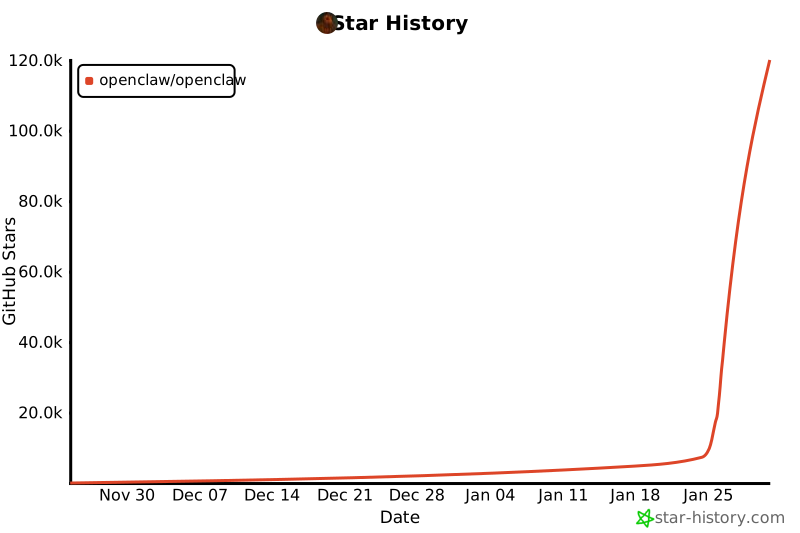](https://www.star-history.com/#openclaw/openclaw&type=date&legend=top-left)
- Default: tools run on the host for the `main` session, so the agent has full access when it is just you.
- Group/channel safety: set `agents.defaults.sandbox.mode: "non-main"` to run non-`main` sessions inside per-session Docker sandboxes.
- [Gateway WS control plane](https://docs.openclaw.ai/gateway) with sessions, presence, config, cron, webhooks, [Control UI](https://docs.openclaw.ai/web), and [Canvas host](https://docs.openclaw.ai/platforms/mac/canvas#canvas-a2ui).
- [CLI surface](https://docs.openclaw.ai/tools/agent-send): gateway, agent, send, [onboarding](https://docs.openclaw.ai/start/wizard), and [doctor](https://docs.openclaw.ai/gateway/doctor).
- [Pi agent runtime](https://docs.openclaw.ai/concepts/agent) in RPC mode with tool streaming and block streaming.
- [Session model](https://docs.openclaw.ai/concepts/session): `main` for direct chats, group isolation, activation modes, queue modes, reply-back. Group rules: [Groups](https://docs.openclaw.ai/channels/groups).
- [Skills platform](https://docs.openclaw.ai/tools/skills): bundled, managed, and workspace skills with install gating + UI.
### Runtime + safety
- [Channel routing](https://docs.openclaw.ai/channels/channel-routing), [retry policy](https://docs.openclaw.ai/concepts/retry), and [streaming/chunking](https://docs.openclaw.ai/concepts/streaming).
- [Presence](https://docs.openclaw.ai/concepts/presence), [typing indicators](https://docs.openclaw.ai/concepts/typing-indicators), and [usage tracking](https://docs.openclaw.ai/concepts/usage-tracking).
- [Models](https://docs.openclaw.ai/concepts/models), [model failover](https://docs.openclaw.ai/concepts/model-failover), and [session pruning](https://docs.openclaw.ai/concepts/session-pruning).
- [Security](https://docs.openclaw.ai/gateway/security) and [troubleshooting](https://docs.openclaw.ai/channels/troubleshooting).
### Ops + packaging
- [Control UI](https://docs.openclaw.ai/web) + [WebChat](https://docs.openclaw.ai/web/webchat) served directly from the Gateway.
- [Tailscale Serve/Funnel](https://docs.openclaw.ai/gateway/tailscale) or [SSH tunnels](https://docs.openclaw.ai/gateway/remote) with token/password auth.
- [Nix mode](https://docs.openclaw.ai/install/nix) for declarative config; [Docker](https://docs.openclaw.ai/install/docker)-based installs.
WhatsApp / Telegram / Slack / Discord / Google Chat / Signal / iMessage / BlueBubbles / IRC / Microsoft Teams / Matrix / Feishu / LINE / Mattermost / Nextcloud Talk / Nostr / Synology Chat / Tlon / Twitch / Zalo / Zalo Personal / WeChat / WebChat
│
▼
┌───────────────────────────────┐
│ Gateway │
│ (control plane) │
│ ws://127.0.0.1:18789 │
└──────────────┬────────────────┘
│
├─ Pi agent (RPC)
├─ CLI (openclaw …)
├─ WebChat UI
├─ macOS app
└─ iOS / Android nodes
```
## Key subsystems
- **[Gateway WebSocket network](https://docs.openclaw.ai/concepts/architecture)** — single WS control plane for clients, tools, and events (plus ops: [Gateway runbook](https://docs.openclaw.ai/gateway)).
- **[Tailscale exposure](https://docs.openclaw.ai/gateway/tailscale)** — Serve/Funnel for the Gateway dashboard + WS (remote access: [Remote](https://docs.openclaw.ai/gateway/remote)).
- **[Browser control](https://docs.openclaw.ai/tools/browser)** — openclaw‑managed Chrome/Chromium with CDP control.
- **[Voice Wake](https://docs.openclaw.ai/nodes/voicewake) + [Talk Mode](https://docs.openclaw.ai/nodes/talk)** — wake words on macOS/iOS plus continuous voice on Android.
- **[Nodes](https://docs.openclaw.ai/nodes)** — Canvas, camera snap/clip, screen record, `location.get`, notifications, plus macOS‑only `system.run`/`system.notify`.
## Tailscale access (Gateway dashboard)
OpenClaw can auto-configure Tailscale **Serve** (tailnet-only) or **Funnel** (public) while the Gateway stays bound to loopback. Configure `gateway.tailscale.mode`:
-`off`: no Tailscale automation (default).
-`serve`: tailnet-only HTTPS via `tailscale serve` (uses Tailscale identity headers by default).
-`funnel`: public HTTPS via `tailscale funnel` (requires shared password auth).
Notes:
-`gateway.bind` must stay `loopback` when Serve/Funnel is enabled (OpenClaw enforces this).
- Serve can be forced to require a password by setting `gateway.auth.mode: "password"` or `gateway.auth.allowTailscale: false`.
- Funnel refuses to start unless `gateway.auth.mode: "password"` is set.
- Optional: `gateway.tailscale.resetOnExit` to undo Serve/Funnel on shutdown.
It’s perfectly fine to run the Gateway on a small Linux instance. Clients (macOS app, CLI, WebChat) can connect over **Tailscale Serve/Funnel** or **SSH tunnels**, and you can still pair device nodes (macOS/iOS/Android) to execute device‑local actions when needed.
- **Gateway host** runs the exec tool and channel connections by default.
- **Device nodes** run device‑local actions (`system.run`, camera, screen recording, notifications) via `node.invoke`.
In short: exec runs where the Gateway lives; device actions run where the device lives.
The macOS app can run in **node mode** and advertises its capabilities + permission map over the Gateway WebSocket (`node.list` / `node.describe`). Clients can then execute local actions via `node.invoke`:
-`system.run` runs a local command and returns stdout/stderr/exit code; set `needsScreenRecording: true` to require screen-recording permission (otherwise you’ll get `PERMISSION_MISSING`).
-`system.notify` posts a user notification and fails if notifications are denied.
-`canvas.*`, `camera.*`, `screen.record`, and `location.get` are also routed via `node.invoke` and follow TCC permission status.
Elevated bash (host permissions) is separate from macOS TCC:
- Use `/elevated on|off` to toggle per‑session elevated access when enabled + allowlisted.
- Gateway persists the per‑session toggle via `sessions.patch` (WS method) alongside `thinkingLevel`, `verboseLevel`, `model`, `sendPolicy`, and `groupActivation`.
- **Default:** tools run on the host for the **main** session, so the agent has full access when it’s just you.
- **Group/channel safety:** set `agents.defaults.sandbox.mode: "non-main"` to run **non‑main sessions** (groups/channels) inside per‑session Docker sandboxes; bash then runs in Docker for those sessions.
- Set `TELEGRAM_BOT_TOKEN` or `channels.telegram.botToken` (env wins).
- Optional: set `channels.telegram.groups` (with `channels.telegram.groups."*".requireMention`); when set, it is a group allowlist (include `"*"` to allow all). Also `channels.telegram.allowFrom` or `channels.telegram.webhookUrl` + `channels.telegram.webhookSecret` as needed.
- Set `DISCORD_BOT_TOKEN` or `channels.discord.token`.
- Optional: set `commands.native`, `commands.text`, or `commands.useAccessGroups`, plus `channels.discord.allowFrom`, `channels.discord.guilds`, or `channels.discord.mediaMaxMb` as needed.
[](https://www.star-history.com/#openclaw/openclaw&type=date&legend=top-left)
<ahref="https://github.com/YuzuruS"><imgsrc="https://avatars.githubusercontent.com/u/1485195?v=4&s=48"width="48"height="48"alt="YuzuruS"title="YuzuruS"/></a><ahref="https://github.com/riccardogiorato"><imgsrc="https://avatars.githubusercontent.com/u/4527364?v=4&s=48"width="48"height="48"alt="riccardogiorato"title="riccardogiorato"/></a><ahref="https://github.com/Bridgerz"><imgsrc="https://avatars.githubusercontent.com/u/24499532?v=4&s=48"width="48"height="48"alt="Bridgerz"title="Bridgerz"/></a><ahref="https://github.com/Mrseenz"><imgsrc="https://avatars.githubusercontent.com/u/101962919?v=4&s=48"width="48"height="48"alt="Mrseenz"title="Mrseenz"/></a><ahref="https://github.com/buddyh"><imgsrc="https://avatars.githubusercontent.com/u/31752869?v=4&s=48"width="48"height="48"alt="buddyh"title="buddyh"/></a><ahref="https://github.com/omniwired"><imgsrc="https://avatars.githubusercontent.com/u/322761?v=4&s=48"width="48"height="48"alt="Eng. Juan Combetto"title="Eng. Juan Combetto"/></a><ahref="https://github.com/peschee"><imgsrc="https://avatars.githubusercontent.com/u/63866?v=4&s=48"width="48"height="48"alt="peschee"title="peschee"/></a><ahref="https://github.com/cash-echo-bot"><imgsrc="https://avatars.githubusercontent.com/u/252747386?v=4&s=48"width="48"height="48"alt="cash-echo-bot"title="cash-echo-bot"/></a><ahref="https://github.com/jalehman"><imgsrc="https://avatars.githubusercontent.com/u/550978?v=4&s=48"width="48"height="48"alt="jalehman"title="jalehman"/></a><ahref="https://github.com/zknicker"><imgsrc="https://avatars.githubusercontent.com/u/1164085?v=4&s=48"width="48"height="48"alt="zknicker"title="zknicker"/></a>
<ahref="https://github.com/mitchmcalister"><imgsrc="https://avatars.githubusercontent.com/u/209334?v=4&s=48"width="48"height="48"alt="mitchmcalister"title="mitchmcalister"/></a><ahref="https://github.com/pvoo"><imgsrc="https://avatars.githubusercontent.com/u/20116814?v=4&s=48"width="48"height="48"alt="Paul van Oorschot"title="Paul van Oorschot"/></a><ahref="https://github.com/guxu11"><imgsrc="https://avatars.githubusercontent.com/u/53551744?v=4&s=48"width="48"height="48"alt="Xu Gu"title="Xu Gu"/></a><ahref="https://github.com/lml2468"><imgsrc="https://avatars.githubusercontent.com/u/39320777?v=4&s=48"width="48"height="48"alt="Menglin Li"title="Menglin Li"/></a><ahref="https://github.com/artuskg"><imgsrc="https://avatars.githubusercontent.com/u/11966157?v=4&s=48"width="48"height="48"alt="artuskg"title="artuskg"/></a><ahref="https://github.com/jackheuberger"><imgsrc="https://avatars.githubusercontent.com/u/7830838?v=4&s=48"width="48"height="48"alt="jackheuberger"title="jackheuberger"/></a><ahref="https://github.com/imfing"><imgsrc="https://avatars.githubusercontent.com/u/5097752?v=4&s=48"width="48"height="48"alt="imfing"title="imfing"/></a><ahref="https://github.com/superman32432432"><imgsrc="https://avatars.githubusercontent.com/u/7228420?v=4&s=48"width="48"height="48"alt="superman32432432"title="superman32432432"/></a><ahref="https://github.com/Syhids"><imgsrc="https://avatars.githubusercontent.com/u/671202?v=4&s=48"width="48"height="48"alt="Syhids"title="Syhids"/></a><ahref="https://github.com/Zitzak"><imgsrc="https://avatars.githubusercontent.com/u/43185740?v=4&s=48"width="48"height="48"alt="Marvin"title="Marvin"/></a>
<ahref="https://github.com/OscarMinjarez"><imgsrc="https://avatars.githubusercontent.com/u/86080038?v=4&s=48"width="48"height="48"alt="OscarMinjarez"title="OscarMinjarez"/></a><ahref="https://github.com/claude"><imgsrc="https://avatars.githubusercontent.com/u/81847?v=4&s=48"width="48"height="48"alt="claude"title="claude"/></a><ahref="https://github.com/Alg0rix"><imgsrc="https://avatars.githubusercontent.com/u/53804949?v=4&s=48"width="48"height="48"alt="Alg0rix"title="Alg0rix"/></a><ahref="https://github.com/L-U-C-K-Y"><imgsrc="https://avatars.githubusercontent.com/u/14868134?v=4&s=48"width="48"height="48"alt="Lucky"title="Lucky"/></a><ahref="https://github.com/Kepler2024"><imgsrc="https://avatars.githubusercontent.com/u/166882517?v=4&s=48"width="48"height="48"alt="Harry Cui Kepler"title="Harry Cui Kepler"/></a><ahref="https://github.com/h0tp-ftw"><imgsrc="https://avatars.githubusercontent.com/u/141889580?v=4&s=48"width="48"height="48"alt="h0tp-ftw"title="h0tp-ftw"/></a><ahref="https://github.com/Youyou972"><imgsrc="https://avatars.githubusercontent.com/u/50808411?v=4&s=48"width="48"height="48"alt="Youyou972"title="Youyou972"/></a><ahref="https://github.com/dominicnunez"><imgsrc="https://avatars.githubusercontent.com/u/43616264?v=4&s=48"width="48"height="48"alt="Dominic"title="Dominic"/></a><ahref="https://github.com/danielwanwx"><imgsrc="https://avatars.githubusercontent.com/u/144515713?v=4&s=48"width="48"height="48"alt="danielwanwx"title="danielwanwx"/></a><ahref="https://github.com/0xJonHoldsCrypto"><imgsrc="https://avatars.githubusercontent.com/u/81202085?v=4&s=48"width="48"height="48"alt="0xJonHoldsCrypto"title="0xJonHoldsCrypto"/></a>
<ahref="https://github.com/erik-agens"><imgsrc="https://avatars.githubusercontent.com/u/80908960?v=4&s=48"width="48"height="48"alt="erik-agens"title="erik-agens"/></a><ahref="https://github.com/odnxe"><imgsrc="https://avatars.githubusercontent.com/u/403141?v=4&s=48"width="48"height="48"alt="odnxe"title="odnxe"/></a><ahref="https://github.com/T5-AndyML"><imgsrc="https://avatars.githubusercontent.com/u/22801233?v=4&s=48"width="48"height="48"alt="T5-AndyML"title="T5-AndyML"/></a><ahref="https://github.com/j1philli"><imgsrc="https://avatars.githubusercontent.com/u/3744255?v=4&s=48"width="48"height="48"alt="Josh Phillips"title="Josh Phillips"/></a><ahref="https://github.com/mujiannan"><imgsrc="https://avatars.githubusercontent.com/u/46643837?v=4&s=48"width="48"height="48"alt="mujiannan"title="mujiannan"/></a><ahref="https://github.com/marcodd23"><imgsrc="https://avatars.githubusercontent.com/u/3519682?v=4&s=48"width="48"height="48"alt="Marco Di Dionisio"title="Marco Di Dionisio"/></a><ahref="https://github.com/RandyVentures"><imgsrc="https://avatars.githubusercontent.com/u/149904821?v=4&s=48"width="48"height="48"alt="Randy Torres"title="Randy Torres"/></a><ahref="https://github.com/afern247"><imgsrc="https://avatars.githubusercontent.com/u/34192856?v=4&s=48"width="48"height="48"alt="afern247"title="afern247"/></a><ahref="https://github.com/0oAstro"><imgsrc="https://avatars.githubusercontent.com/u/79555780?v=4&s=48"width="48"height="48"alt="0oAstro"title="0oAstro"/></a><ahref="https://github.com/alexanderatallah"><imgsrc="https://avatars.githubusercontent.com/u/1011391?v=4&s=48"width="48"height="48"alt="alexanderatallah"title="alexanderatallah"/></a>
@@ -67,6 +67,7 @@ These are frequently reported but are typically closed with no code change:
- Reports that depend on replacing or rewriting an already-approved executable path on a trusted host (same-path inode/content swap) without showing an untrusted path to perform that write.
- Reports that depend on pre-existing symlinked skill/workspace filesystem state (for example symlink chains involving `skills/*/SKILL.md`) without showing an untrusted path that can create/control that state.
- Missing HSTS findings on default local/loopback deployments.
- Reports against test-only harnesses, QA Lab, QE Lab, E2E fixtures, benchmark rigs, or maintainer-only debugging tools when the vulnerable code is not shipped as a supported production surface.
- Discord inbound webhook signature findings for paths not used by this repo's Discord integration.
- Claims that Microsoft Teams `fileConsent/invoke``uploadInfo.uploadUrl` is attacker-controlled without demonstrating one of: auth boundary bypass, a real authenticated Teams/Bot Framework event carrying attacker-chosen URL, or compromise of the Microsoft/Bot trust path.
@@ -129,6 +130,7 @@ Plugins/extensions are part of OpenClaw's trusted computing base for a gateway.
- Public Internet Exposure
- Using OpenClaw in ways that the docs recommend not to
- Test-only code and maintainer harnesses, including QA Lab, QE Lab, E2E fixtures, benchmark rigs, smoke-test containers, and local debugging proxies, unless the report demonstrates that the same vulnerable behavior is reachable from shipped OpenClaw production code or a published package artifact intended for users.
- Deployments where mutually untrusted/adversarial operators share one gateway host and config (for example, reports expecting per-operator isolation for `sessions.list`, `sessions.preview`, `chat.history`, or similar control-plane reads)
- Prompt-injection-only attacks (without a policy/auth/sandbox boundary bypass)
- Reports that require write access to trusted local state (`~/.openclaw`, workspace files like `MEMORY.md` / `memory/*.md`)
<li>Config: remove legacy public config aliases such as <code>talk.voiceId</code> / <code>talk.apiKey</code>, <code>agents.*.sandbox.perSession</code>, <code>browser.ssrfPolicy.allowPrivateNetwork</code>, <code>hooks.internal.handlers</code>, and channel/group/room <code>allow</code> toggles in favor of the canonical public paths and <code>enabled</code>, while keeping load-time compatibility and <code>openclaw doctor --fix</code> migration support for existing configs. (#60726) Thanks @vincentkoc.</li>
</ul>
<description><![CDATA[<h2>OpenClaw 2026.4.15</h2>
<h3>Changes</h3>
<ul>
<li>Agents/video generation: add the built-in <code>video_generate</code> tool so agents can create videos through configured providers and return the generated media directly in the reply.</li>
<li>Agents/music generation: ignore unsupported optional hints such as <code>durationSeconds</code> with a warning instead of hard-failing requests on providers like Google Lyria.</li>
<li>Providers/ComfyUI: add a bundled <code>comfy</code> workflow media plugin for local ComfyUI and Comfy Cloud workflows, including shared <code>image_generate</code>, <code>video_generate</code>, and workflow-backed <code>music_generate</code> support, with prompt injection, optional reference-image upload, live tests, and output download.</li>
<li>Tools/music generation: add the built-in <code>music_generate</code> tool with bundled Google (Lyria) and MiniMax providers plus workflow-backed Comfy support, including async task tracking and follow-up delivery of finished audio.</li>
<li>Providers: add bundled Qwen, Fireworks AI, and StepFun providers, plus MiniMax TTS, Ollama Web Search, and MiniMax Search integrations for chat, speech, and search workflows. (#60032, #55921, #59318, #54648)</li>
<li>Providers/Amazon Bedrock: add bundled Mantle support plus inference-profile discovery and automatic request-region injection so Bedrock-hosted Claude, GPT-OSS, Qwen, Kimi, GLM, and similar routes work with less manual setup. (#61296, #61299) Thanks @wirjo.</li>
<li>Control UI/multilingual: add localized control UI support for Simplified Chinese, Traditional Chinese, Brazilian Portuguese, German, Spanish, Japanese, Korean, French, Turkish, Indonesian, Polish, and Ukrainian. Thanks @vincentkoc.</li>
<li>Plugins: add plugin-config TUI prompts to guided onboarding/setup flows, and add <code>openclaw plugins install --force</code> so existing plugin and hook-pack targets can be replaced without using the dangerous-code override flag. (#60590, #60544)</li>
<li>Control UI/skills: add ClawHub search, detail, and install flows directly in the Skills panel. (#60134) Thanks @samzong.</li>
<li>iOS/exec approvals: add generic APNs approval notifications that open an in-app exec approval modal, fetch command details only after authenticated operator reconnect, and clear stale notification state when the approval resolves. (#60239) Thanks @ngutman.</li>
<li>Matrix/exec approvals: add Matrix-native exec approval prompts with account-scoped approvers, channel-or-DM delivery, and room-thread aware resolution handling. (#58635) Thanks @gumadeiras.</li>
<li>Channels/context visibility: add configurable <code>contextVisibility</code> per channel (<code>all</code>, <code>allowlist</code>, <code>allowlist_quote</code>) so supplemental quote, thread, and fetched history context can be filtered by sender allowlists instead of always passing through as received.</li>
<li>Providers/request overrides: add shared model and media request transport overrides across OpenAI-, Anthropic-, Google-, and compatible provider paths, including headers, auth, proxy, and TLS controls. (#60200)</li>
<li>Providers/OpenAI: add forward-compat <code>openai-codex/gpt-5.4-mini</code>, an opt-in GPT personality, and provider-owned GPT-5 prompt contributions so Codex/GPT runs stay cache-stable and compatible with bundled catalog lag.</li>
<li>Agents/Claude CLI: expose OpenClaw tools to background Claude CLI runs through a loopback MCP bridge and switch bundled runs to stdin + <code>stream-json</code> partial-message streaming so prompts stop riding argv, long replies show live progress, and final session/usage metadata still land cleanly. (#35676) Thanks @mylukin.</li>
<li>ACPX/runtime: embed the ACP runtime directly in the bundled <code>acpx</code> plugin, remove the extra external ACP CLI hop, harden live ACP session binding and reuse, and add a generic <code>reply_dispatch</code> hook so bundled plugins like ACPX can own reply interception without hardcoded ACP paths in core auto-reply routing. (#61319)</li>
<li>Agents/progress: add experimental structured plan updates and structured execution item events so compatible UIs can show clearer step-by-step progress during long-running runs.</li>
<li>Providers/Anthropic: remove the Claude CLI backend and setup-token from new onboarding, keep existing configured legacy profiles runnable, and have <code>openclaw doctor</code> repair or remove stale <code>anthropic:claude-cli</code> state during migration.</li>
<li>Tools/video generation: add bundled xAI (<code>grok-imagine-video</code>), Alibaba Model Studio Wan, and Runway video providers, plus live-test/default model wiring for all three.</li>
<li>Memory/search: add Amazon Bedrock embeddings for Titan, Cohere, Nova, and TwelveLabs models, with AWS credential-chain auto-detection for <code>provider: "auto"</code> and provider-specific dimension controls. Thanks @wirjo.</li>
<li>Providers/Amazon Bedrock Mantle: generate bearer tokens from the AWS credential chain so Mantle auto-discovery can use IAM auth without manually exporting <code>AWS_BEARER_TOKEN_BEDROCK</code>. Thanks @wirjo.</li>
<li>Memory/dreaming (experimental): add weighted short-term recall promotion, a <code>/dreaming</code> command, Dreams UI, multilingual conceptual tagging, and doctor/status repair support, while refactoring dreaming from competing modes into three cooperative phases (light, deep, REM) with independent schedules and recovery behavior so durable memory promotion can run in the background with less manual setup. (#60569, #60697) Thanks @vignesh07.</li>
<li>Memory/dreaming: add configurable aging controls (<code>recencyHalfLifeDays</code>, <code>maxAgeDays</code>) plus optional verbose logging so operators can tune recall decay and inspect promotion decisions more easily.</li>
<li>Memory/dreaming: add REM preview tooling (<code>openclaw memory rem-harness</code>, <code>promote-explain</code>), surface possible lasting truths during REM staging, and make deep promotion replay-safe so reruns reconcile instead of duplicating <code>MEMORY.md</code> entries.</li>
<li>Memory/dreaming: write dreaming trail content to top-level <code>dreams.md</code> instead of daily memory notes, update <code>/dreaming</code> help text to point there, and keep <code>dreams.md</code> available for explicit reads without pulling it into default recall. Thanks @davemorin.</li>
<li>Memory/dreaming: add the Dream Diary surface in Dreams, simplify user-facing dreaming config to <code>enabled</code> plus optional <code>frequency</code>, treat phases as implementation detail in docs/UI, and keep the lobster animation visible above diary content. Thanks @vignesh07.</li>
<li>Prompt caching: keep prompt prefixes more reusable across transport fallback, deterministic MCP tool ordering, compaction, embedded image history, normalized system-prompt fingerprints, <code>openclaw status --verbose</code> cache diagnostics, and the removal of duplicate in-band tool inventories from agent system prompts so follow-up turns hit cache more reliably. (#58036, #58037, #58038, #59054, #60603, #60691) Thanks @bcherny and @vincentkoc.</li>
<li>Agents/cache: diagnostics: add prompt-cache break diagnostics, trace live cache scenarios through embedded runner paths, and show cache reuse explicitly in <code>openclaw status --verbose</code>. Thanks @vincentkoc.</li>
<li>Agents/cache: stabilize cache-relevant system prompt fingerprints by normalizing equivalent structured prompt whitespace, line endings, hook-added system context, and runtime capability ordering so semantically unchanged prompts reuse KV/cache more reliably. Thanks @vincentkoc.</li>
<li>Agents/tool prompts: remove the duplicate in-band tool inventory from agent system prompts so tool-calling models rely on the structured tool definitions as the single source of truth, improving prompt stability and reducing stale tool guidance.</li>
<li>Config/schema: enrich the exported <code>openclaw config schema</code> JSON Schema with field titles and descriptions so editors, agents, and other schema consumers receive the same config help metadata. (#60067) Thanks @solavrc.</li>
<li>Providers/CLI: remove bundled CLI text-provider backends and the <code>agents.defaults.cliBackends</code> surface, while keeping ACP harness sessions and Gemini media understanding on the native bundled providers.</li>
<li>Matrix/exec approvals: clarify unavailable-approval replies so Matrix no longer claims chat approvals are unsupported when native exec approvals are merely unconfigured. (#61424) Thanks @gumadeiras.</li>
<li>Docs/IRC: replace public IRC hostname examples with <code>irc.example.com</code> and recommend private servers for bot coordination while listing common public networks for intentional use.</li>
<li>Memory/dreaming: group nearby daily-note lines into short coherent chunks before staging them for dreaming, so one-off context from recent notes reaches REM/deep with better evidence and less line-level noise.</li>
<li>Memory/dreaming: drop generic date/day headings from daily-note chunk prefixes while keeping meaningful section labels, so staged snippets stay cleaner and more reusable. (#61597) Thanks @mbelinky.</li>
<li>Plugins/Lobster: run bundled Lobster workflows in process instead of spawning the external CLI, reducing transport overhead and unblocking native runtime integration. (#61523) Thanks @mbelinky.</li>
<li>Plugins/Lobster: harden managed resume validation so invalid TaskFlow resume calls fail earlier, and memoize embedded runtime loading per runner while keeping failed loads retryable. (#61566) Thanks @mbelinky.</li>
<li>Anthropic/models: default Anthropic selections, <code>opus</code> aliases, Claude CLI defaults, and bundled image understanding to Claude Opus 4.7.</li>
<li>Google/TTS: add Gemini text-to-speech support to the bundled <code>google</code> plugin, including provider registration, voice selection, WAV reply output, PCM telephony output, and setup/docs guidance. (#67515) Thanks @barronlroth.</li>
<li>Control UI/Overview: add a Model Auth status card showing OAuth token health and provider rate-limit pressure at a glance, with attention callouts when OAuth tokens are expiring or expired. Backed by a new <code>models.authStatus</code> gateway method that strips credentials and caches for 60s. (#66211) Thanks @omarshahine.</li>
<li>Memory/LanceDB: add cloud storage support to <code>memory-lancedb</code> so durable memory indexes can run on remote object storage instead of local disk only. (#63502) Thanks @rugvedS07.</li>
<li>GitHub Copilot/memory search: add a GitHub Copilot embedding provider for memory search, and expose a dedicated Copilot embedding host helper so plugins can reuse the transport while honoring remote overrides, token refresh, and safer payload validation. (#61718) Thanks @feiskyer and @vincentkoc.</li>
<li>Agents/local models: add experimental <code>agents.defaults.experimental.localModelLean: true</code> to drop heavyweight default tools like <code>browser</code>, <code>cron</code>, and <code>message</code>, reducing prompt size for weaker local-model setups without changing the normal path. (#66495) Thanks @ImLukeF.</li>
<li>Packaging/plugins: localize bundled plugin runtime deps to their owning extensions, trim the published docs payload, and tighten install/package-manager guardrails so published builds stay leaner and core stops carrying extension-owned runtime baggage. (#67099) Thanks @vincentkoc.</li>
<li>QA/Matrix: split Matrix live QA into a source-linked <code>qa-matrix</code> runner and keep repo-private <code>qa-*</code> surfaces out of packaged and published builds. (#66723) Thanks @gumadeiras.</li>
<li>Docs/showcase: add a scannable hero, complete section jump links, and a responsive video grid for community examples. (#48493) Thanks @jchopard69.</li>
</ul>
<h3>Fixes</h3>
<ul>
<li>Security: preserve restrictive plugin-only tool allowlists, require owner access for <code>/allowlist add</code> and <code>/allowlist remove</code>, fail closed when <code>before_tool_call</code> hooks crash, block browser SSRF redirect bypasses earlier, and keep non-interactive auth-choice inference scoped to bundled and already-trusted plugins. (#58476, #59836, #59822, #58771, #59120) Thanks @eleqtrizit and @pgondhi987.</li>
<li>Providers/OpenAI: make GPT-5 and Codex runs act sooner with lower-verbosity defaults, visible progress during tool work, and a one-shot retry when a turn only narrates the plan instead of taking action.</li>
<li>Providers/OpenAI and reply delivery: preserve native <code>reasoning.effort: "none"</code> and strict schemas where supported, add GPT-5.4 assistant <code>phase</code> metadata across replay and the Gateway <code>/v1/responses</code> layer, and keep commentary buffered until <code>final_answer</code> so webchat, session previews, embedded replies, and Telegram partials stop leaking planning text. Fixes #59150, #59643, #61282.</li>
<li>Telegram: fix current-model checks in the model picker, HTML-format non-default <code>/model</code> confirmations, explicit topic replies, persisted reaction ownership across restarts, caption-media placeholder and <code>file_id</code> preservation on download failure, and upgraded-install inbound image reads. (#60384, #60042, #59634, #59207, #59948, #59971) Thanks @sfuminya, @GitZhangChi, @dashhuang, @samzong, @v1p0r, and @neeravmakwana.</li>
<li>Telegram: restore DM voice-note preflight transcription so direct-message audio stops arriving as raw <code><media:audio></code> placeholders. (#61008) Thanks @manueltarouca.</li>
<li>Telegram/reasoning: only create a Telegram reasoning preview lane when the session is explicitly <code>reasoning:stream</code>, so hidden <code><think></code> traces from streamed replies stop surfacing as chat previews on normal sessions. Thanks @vincentkoc.</li>
<li>Telegram/native command menu: trim long menu descriptions before dropping commands so sub-100 command sets can still fit Telegram's payload budget and keep more <code>/</code> entries visible. (#61129) Thanks @neeravmakwana.</li>
<li>Discord: keep REST, webhook, and monitor traffic on the configured proxy, preserve component-only media sends, honor <code>@everyone</code> and <code>@here</code> mention gates, keep ACK reactions on the active account, and split voice connect/playback timeouts so auto-join is more reliable. (#57465, #60361, #60345) Thanks @geekhuashan.</li>
<li>Discord/reply tags: strip leaked <code>[[reply_to_current]]</code> control tags from preview text and honor explicit reply-tag threading during final delivery, so Discord replies stay attached to the triggering message instead of printing reply metadata into chat.</li>
<li>Discord/replies: replace the unshipped <code>replyToOnlyWhenBatched</code> flag with <code>replyToMode: "batched"</code> so native reply references only attach on debounced multi-message turns while explicit reply tags still work.</li>
<li>Discord/image generation: include the real generated <code>MEDIA:</code> paths in tool output, avoid duplicate plain-output media requeueing, and persist volatile workspace-generated media into durable outbound media before final reply delivery so generated image replies stop pointing at missing local files.</li>
<li>Slack: route live DM replies back to the concrete inbound DM channel while keeping persisted routing metadata user-scoped, so normal assistant replies stop disappearing when pairing and system messages still arrive. (#59030) Thanks @afurm.</li>
<li>WhatsApp: restore <code>channels.whatsapp.blockStreaming</code> and reset watchdog timeouts after reconnect so quiet chats stop falling into reconnect loops. (#60007, #60069) Thanks @MonkeyLeeT and @mcaxtr.</li>
<li>Android/Talk Mode: cancel in-flight <code>talk.speak</code> playback when speech is explicitly stopped, and restore spoken replies on both node-scoped and gateway-backed sessions by keeping reply routing and embedded transport overrides aligned with the current playback path. (#60306, #61164, #61214)</li>
<li>Voice-call/OpenAI: pass full plugin config into realtime transcription provider resolution so streaming calls can discover the bundled OpenAI realtime transcription provider again. Fixes #60936. Thanks @sliekens and @vincentkoc.</li>
<li>Matrix/exec approvals: anchor seeded approval reactions to the primary Matrix prompt event, resolve them from event metadata instead of prompt text, and clean up chunked approval prompts correctly. (#60931) Thanks @gumadeiras.</li>
<li>Matrix: recover more reliably when secret storage or recovery keys are missing by recreating secret storage during repair and backup reset, hold crypto snapshot locks during persistence, and surface explicit too-large attachment markers. (#59846, #59851, #60599, #60289) Thanks @al3mart, @emonty, and @efe-arv.</li>
<li>Matrix/DM sessions: add <code>channels.matrix.dm.sessionScope</code>, shared-session collision notices, and aligned outbound session reuse so separate Matrix DM rooms can keep distinct context when configured. (#61373) Thanks @gumadeiras.</li>
<li>Matrix: move legacy top-level <code>avatarUrl</code> into the default account during multi-account promotion and keep env-backed account setup avatar config persisted. (#61437) Thanks @gumadeiras.</li>
<li>MS Teams: download inline DM images via Graph API and preserve channel reply threading in proactive fallback. (#52212, #55198) Thanks @Ted-developer and @hyojin.</li>
<li>MS Teams: replace the deprecated Teams SDK HttpPlugin stub with <code>httpServerAdapter</code> so recurring gateway deprecation warnings stop firing and the Express 5 compatibility workaround stays on the supported SDK path. (#60939) Thanks @coolramukaka-sys.</li>
<li>Control UI/chat: add a per-session thinking-level picker in the chat header and mobile chat settings, and keep the browser bundle on UI-local thinking/session-key helpers so Safari no longer crashes on Node-only imports before rendering chat controls.</li>
<li>Sandbox/SSH: reject hardlinked files during cross-device rename fallback so EXDEV file copies preserve the same pinned file-boundary checks as direct reads.</li>
<li>Control UI: keep Stop visible during tool-only execution, preserve pending-send busy state, and clear stale ClawHub search results as soon as the query changes. (#54528, #59800, #60267) Thanks @chziyue and @frankekn.</li>
<li>Control UI/avatar: honor <code>ui.assistant.avatar</code> when serving <code>/avatar/:agentId</code> so Appearance UI avatar paths stop falling back to initials placeholders. (#60778) Thanks @hannasdev.</li>
<li>Control UI/cron: highlight the Cron refresh button while refresh isin flight so the page's loading state stays visible even when prior data remains on screen. (#60394) Thanks @coder-zhuzm.</li>
<li>Control UI/Overview: prevent gateway access token/password visibility toggle buttons from overlapping their inputs at narrow widths. (#56924) Thanks @bbddbb1.</li>
<li>Auto-reply: unify reply lifecycle ownership across preflight compaction, session rotation, CLI-backed runs, and gateway restart handling so <code>/stop</code> and same-session overlap checks target the right active turn and restart-interrupted turns return the restart notice instead of being silently dropped. (#61267) Thanks @dutifulbob.</li>
<li>Reply delivery: prevent duplicate block replies on <code>text_end</code> channels so providers that emit explicit text-end boundaries no longer double-send the same final message. (#61530)</li>
<li>Gateway/startup: default <code>gateway.mode</code> to <code>local</code> when unset, detect PID recycling in gateway lock files on Windows and macOS, and show startup progress so healthy restarts stop getting blocked by stale locks. (#54801, #60085, #59843) Thanks @BradGroux and @TonyDerek-dot.</li>
<li>Gateway/macOS: let launchd <code>KeepAlive</code> own in-process gateway restarts again, adding a short supervised-exit delay so rapid restarts avoid launchd crash-loop unloads while <code>openclaw gateway restart</code> still reports real LaunchAgent errors synchronously.</li>
<li>Gateway/macOS: re-bootstrap the LaunchAgent if <code>launchctl kickstart -k</code> unloads it during restart so failed restarts do not leave the gateway unmanaged until manual repair.</li>
<li>Gateway/macOS: recover installed-but-unloaded LaunchAgents during <code>openclaw gateway start</code> and <code>restart</code>, while still preferring live unmanaged gateways during restart recovery. (#43766) Thanks @HenryC-3.</li>
<li>Gateway/Windows scheduled tasks: preserve Task Scheduler settings on reinstall, fail loudly when <code>/Run</code> does not start, and report fast failed restarts accurately instead of pretending they timed out after 60 seconds. (#59335) Thanks @tmimmanuel.</li>
<li>Windows/restart: fall back to the installed Startup-entry launcher when the scheduled task was never registered, so <code>/restart</code> can relaunch the gateway on Windows setups where <code>schtasks</code> install fell back during onboarding. (#58943) Thanks @imechZhangLY.</li>
<li>Windows/restart: clean up stale gateway listeners before Windows self-restart and treat listener and argv probe failures as inconclusive, so scheduled-task relaunch no longer falls into an <code>EADDRINUSE</code> retry loop. (#60480) Thanks @arifahmedjoy.</li>
<li>Update/npm: prefer the npm binary that owns the installed global OpenClaw prefix so mixed Homebrew-plus-nvm setups update the right install. (#60153) Thanks @jayeshp19.</li>
<li>Agents/music and video generation: add <code>tools.media.asyncCompletion.directSend</code> as an opt-in direct-delivery path for finished async media tasks, while keeping the legacy requester-session wake/model-delivery flow as the default.</li>
<li>CLI/skills JSON: route <code>skills list --json</code>, <code>skills info --json</code>, and <code>skills check --json</code> output to stdout instead of stderr so machine-readable consumers receive JSON on the expected stream again. (#60914; fixes #57599; landed from contributor PR #57611 by @Aftabbs) Thanks @Aftabbs.</li>
<li>CLI/Commander: preserve Commander-computed exit codes for argument and help-error paths, and cover the user-argv parse mode in the regression tests so invalid CLI invocations no longer report success when exits are intercepted. (#60923) Thanks @Linux2010.</li>
<li>Cron: replay interrupted recurring jobs on the first gateway restart instead of waiting for a second restart. (#60583) Thanks @joelnishanth.</li>
<li>Cron: send failure notifications through the job's primary delivery channel using the same session context as successful delivery when no explicit <code>failureDestination</code> is configured. (#60622) Thanks @artwalker.</li>
<li>Exec/remote skills: stop advertising <code>exec host=node</code> when the current exec policy cannot route to a node, and clarify blocked exec-host override errors with both the requested host and allowed config path.</li>
<li>Agents/Claude CLI/security: clear inherited Claude Code config-root and plugin-root env overrides like <code>CLAUDE_CONFIG_DIR</code> and <code>CLAUDE_CODE_PLUGIN_*</code>, so OpenClaw-launched Claude CLI runs cannot be silently pointed at an alternate Claude config/plugin tree with different hooks, plugins, or auth context. Thanks @vincentkoc.</li>
<li>Agents/Claude CLI/security: clear inherited Claude Code provider-routing and managed-auth env overrides, and mark OpenClaw-launched Claude CLI runs as host-managed, so Claude CLI backdoor sessions cannot be silently redirected to proxy, Bedrock, Vertex, Foundry, or parent-managed token contexts. Thanks @vincentkoc.</li>
<li>Agents/Claude CLI/security: force host-managed Claude CLI backdoor runs to <code>--setting-sources user</code>, even under custom backend arg overrides, so repo-local <code>.claude</code> project/local settings, hooks, and plugin discovery do not silently execute inside non-interactive OpenClaw sessions. Thanks @vincentkoc.</li>
<li>Agents/Claude CLI: treat malformed bare <code>--permission-mode</code> backend overrides as missing and fail safe back to <code>bypassPermissions</code>, so custom <code>cliBackends.claude-cli.args</code> security config cannot accidentally consume the next flag as a bogus permission mode. Thanks @vincentkoc.</li>
<li>Gateway/device pairing: require non-admin paired-device sessions to manage only their own device for token rotate/revoke and paired-device removal, blocking cross-device token theft inside pairing-scoped sessions. (#50627) Thanks @coygeek.</li>
<li>Gateway/plugin routes: keep gateway-auth plugin runtime routes on write-only fallback scopes unless a trusted-proxy caller explicitly declares narrower <code>x-openclaw-scopes</code>, so plugin HTTP handlers no longer mint admin-level runtime scopes on missing or untrusted HTTP scope headers. (#59815) Thanks @pgondhi987.</li>
<li>Build/types: fix the Node <code>createRequire(...)</code> helper typing so provider-runtime lazy loads compile cleanly again and <code>pnpm build</code> no longer fails in the Pi embedded provider error-pattern path.</li>
<li>Gateway/security: scope loopback browser-origin auth throttling by normalized origin so one localhost Control UI tab cannot lock out a different localhost browser origin after repeated auth failures.</li>
<li>Gateway/auth: serialize async shared-secret auth attempts per client so concurrent Tailscale-capable failures cannot overrun the intended auth rate-limit budget. Thanks @Telecaster2147.</li>
<li>Device pairing/security: keep non-operator device scope checks bound to the requested role prefix so bootstrap verification cannot redeem <code>operator.*</code> scopes through <code>node</code> auth. (#57258) Thanks @jlapenna.</li>
<li>Device pairing: reject rotating device tokens into roles that were never approved during pairing, and keep reconnect role checks bounded to the paired device's approved role set. (#60462) Thanks @eleqtrizit.</li>
<li>Gateway/device auth: reuse cached device-token scopes only for cached-token reconnects, while keeping explicit <code>deviceToken</code> scope requests and empty-cache fallbacks intact so reconnects preserve <code>operator.read</code> without breaking explicit auth flows. (#46032) Thanks @caicongyang.</li>
<li>Mobile pairing/security: fail closed for internal <code>/pair</code> setup-code issuance, cleanup, and approval paths when gateway pairing scopes are missing, and keep approval-time requested-scope enforcement on the internal command path. (#55996) Thanks @coygeek.</li>
<li>Mobile pairing/bootstrap: keep QR bootstrap handoff tokens bounded to the mobile-safe contract so node handoff stays unscoped and operator handoff drops mixed <code>node.*</code>, <code>operator.admin</code>, and <code>operator.pairing</code> scopes.</li>
<li>Mobile pairing/Android: tighten secure endpoint handling so Tailscale and public remote setup reject cleartext endpoints, private LAN pairing still works, merged-role approvals mint both node and operator device tokens, and bootstrap tokens survive node auto-pair until operator approval finishes. (#60128, #60208, #60221) Thanks @obviyus.</li>
<li>Android/canvas security: require exact normalized A2UI URL matches before forwarding canvas bridge actions, rejecting query mismatches and descendant paths while still allowing fragment-only A2UI navigation.</li>
<li>Synology Chat/security: default low-level HTTPS helper TLS verification to on so helper/API defaults match the shipped safe account default, and only explicit <code>allowInsecureSsl: true</code> opts out.</li>
<li>Synology Chat/security: route webhook token comparison through the shared constant-time secret helper for consistency with other bundled plugins.</li>
<li>Plugins/marketplace: block remote marketplace symlink escapes without breaking ordinary local marketplace install paths. (#60556) Thanks @eleqtrizit.</li>
<li>Telegram/local Bot API: honor <code>channels.telegram.apiRoot</code> for buffered media downloads, add <code>channels.telegram.network.dangerouslyAllowPrivateNetwork</code> for trusted fake-IP setups, and require <code>channels.telegram.trustedLocalFileRoots</code> before reading absolute Bot API <code>file_path</code> values. (#59544, #60705) Thanks @SARAMALI15792 and @obviyus.</li>
<li>Outbound/sanitizer: strip leaked <code><tool_call></code>, <code><function_calls></code>, and model special tokens from shared user-visible assistant text, including truncated tool-call streams, so internal scaffolding no longer bleeds into replies across surfaces. (#60619) Thanks @oliviareid-svg.</li>
<li>Agents/errors: surface an explicit disk-full message when local session or transcript writes fail with <code>ENOSPC</code>/<code>disk full</code>, so those runs stop degrading into opaque <code>NO_REPLY</code>-style failures. Thanks @vincentkoc.</li>
<li>Exec approvals: remove heuristic command-obfuscation gating from host exec so gateway and node runs rely on explicit policy, allowlist, and strict inline-eval rules only.</li>
<li>Agents/tool results: cap live tool-result persistence and overflow-recovery truncation at 40k characters so oversized tool output stays bounded without discarding recent context entirely.</li>
<li>Discord/video replies: split text-plus-video deliveries into a text reply followed by a media-only send, and let live provider auth checks honor manifest-declared API key env vars like <code>MODELSTUDIO_API_KEY</code>.</li>
<li>Config/All Settings: keep the raw config view intact when sensitive fields are blank instead of corrupting or dropping the rendered snapshot. (#28214) Thanks @solodmd.</li>
<li>Plugin SDK/facades: back-fill bundled plugin facade sentinels before plugin-id tracking re-enters config loading, so CLI/provider startup no longer crashes with <code>shouldNormalizeGoogleProviderConfig is not a function</code> or other empty-facade reads during bundled plugin re-entry. Thanks @adam91holt.</li>
<li>Plugins/facades: back-fill facade sentinels before tracked-plugin resolution re-enters config loading, so facade exports stay defined during circular provider normalization. (#61180) Thanks @adam91holt.</li>
<li>QA lab: restore typed mock OpenAI gateway config wiring so QA-lab config helpers compile cleanly again and <code>pnpm check</code> / <code>pnpm build</code> stay green.</li>
<li>Discord/image generation: include the real generated <code>MEDIA:</code> paths in tool output and avoid duplicate plain-output media requeueing so Discord image replies stop pointing at missing local files.</li>
<li>Slack: route live DM replies back to the concrete inbound DM channel while keeping persisted routing metadata user-scoped, so normal assistant replies stop disappearing when pairing and system messages still arrive. (#59030) Thanks @afurm.</li>
<li>Discord/reply tags: strip leaked <code>[[reply_to_current]]</code> control tags from preview text and honor explicit reply-tag threading during final delivery, so Discord replies stay attached to the triggering message instead of printing reply metadata into chat.</li>
<li>Telegram: fix current-model checks in the model picker, HTML-format non-default <code>/model</code> confirmations, explicit topic replies, persisted reaction ownership across restarts, caption-media placeholder and <code>file_id</code> preservation on download failure, and upgraded-install inbound image reads. (#60384, #60042, #59634, #59207, #59948, #59971) Thanks @sfuminya, @GitZhangChi, @dashhuang, @samzong, @v1p0r, and @neeravmakwana.</li>
<li>Telegram: restore DM voice-note preflight transcription so direct-message audio stops arriving as raw <code><media:audio></code> placeholders. (#61008) Thanks @manueltarouca.</li>
<li>Telegram/reasoning: only create a Telegram reasoning preview lane when the session is explicitly <code>reasoning:stream</code>, so hidden <code><think></code> traces from streamed replies stop surfacing as chat previews on normal sessions. Thanks @vincentkoc.</li>
<li>Telegram/native command menu: trim long menu descriptions before dropping commands so sub-100 command sets can still fit Telegram's payload budget and keep more <code>/</code> entries visible. (#61129) Thanks @neeravmakwana.</li>
<li>Feishu/reasoning: only expose streamed reasoning previews when the session is explicitly <code>reasoning:stream</code>, so hidden reasoning traces do not surface on normal streaming sessions. Thanks @vincentkoc.</li>
<li>Discord: keep REST, webhook, and monitor traffic on the configured proxy, preserve component-only media sends, honor <code>@everyone</code> and <code>@here</code> mention gates, keep ACK reactions on the active account, and split voice connect/playback timeouts so auto-join is more reliable. (#57465, #60361, #60345) Thanks @geekhuashan.</li>
<li>WhatsApp: restore <code>channels.whatsapp.blockStreaming</code> and reset watchdog timeouts after reconnect so quiet chats stop falling into reconnect loops. (#60007, #60069) Thanks @MonkeyLeeT and @mcaxtr.</li>
<li>Memory: keep <code>memory-core</code> builtin embedding registration on the already-registered path so selecting <code>memory-core</code> no longer recurses through plugin discovery and crashes during startup. (#61402) Thanks @ngutman.</li>
<li>Agents/tool results: keep large <code>read</code> outputs visible longer, preserve the latest <code>read</code> output when older tool output can absorb the overflow budget, and fall back to Pi's normal overflow compaction/retry path before replacing a fresh <code>read</code> with a compacted stub. Thanks @vincentkoc.</li>
<li>Memory/QMD: prefer modern <code>qmd collection add --glob</code>, accept newer single-line JSON hit metadata while keeping legacy line fields, refresh QMD docs/doctor install guidance and model-override guidance, and keep older QMD releases working. Thanks @vincentkoc.</li>
<li>MS Teams: download inline DM images via Graph API and preserve channel reply threading in proactive fallback. (#52212, #55198) Thanks @Ted-developer and @hyojin.</li>
<li>MS Teams: replace the deprecated Teams SDK HttpPlugin stub with <code>httpServerAdapter</code> so recurring gateway deprecation warnings stop firing and the Express 5 compatibility workaround stays on the supported SDK path. (#60939) Thanks @coolramukaka-sys.</li>
<li>Matrix/exec approvals: anchor seeded approval reactions to the primary Matrix prompt event, resolve them from event metadata instead of prompt text, and clean up chunked approval prompts correctly. (#60931) Thanks @gumadeiras.</li>
<li>Matrix: recover more reliably when secret storage or recovery keys are missing by recreating secret storage during repair and backup reset, hold crypto snapshot locks during persistence, and surface explicit too-large attachment markers. (#59846, #59851, #60599, #60289) Thanks @al3mart, @emonty, and @efe-arv.</li>
<li>Android/Talk Mode: cancel in-flight <code>talk.speak</code> playback when speech is explicitly stopped, so stale replies stop starting after barge-in or manual stop. (#61164) Thanks @obviyus.</li>
<li>Android/Talk Mode: restore spoken assistant replies on node-scoped sessions by keeping reply routing synced to the resolved node session key and pausing mic capture during reply playback. (#60306) Thanks @MKV21.</li>
<li>Android/Talk Mode: restore voice replies on gateway-backed talk mode sessions by updating embedded runner transport overrides to the current agent transport API. (#61214) Thanks @obviyus.</li>
<li>Voice-call/OpenAI: pass full plugin config into realtime transcription provider resolution so streaming calls can discover the bundled OpenAI realtime transcription provider again. Fixes #60936. Thanks @sliekens and @vincentkoc.</li>
<li>Control UI/chat: add a per-session thinking-level picker in the chat header and mobile chat settings, and keep the browser bundle on UI-local thinking/session-key helpers so Safari no longer crashes on Node-only imports before rendering chat controls.</li>
<li>Control UI: keep Stop visible during tool-only execution, preserve pending-send busy state, and clear stale ClawHub search results as soon as the query changes. (#54528, #59800, #60267) Thanks @chziyue and @frankekn.</li>
<li>Control UI/avatar: honor <code>ui.assistant.avatar</code> when serving <code>/avatar/:agentId</code> so Appearance UI avatar paths stop falling back to initials placeholders. (#60778) Thanks @hannasdev.</li>
<li>Control UI/cron: highlight the Cron refresh button while refresh is in flight so the page's loading state stays visible even when prior data remains on screen. (#60394) Thanks @coder-zhuzm.</li>
<li>Control UI/Overview: prevent gateway access token/password visibility toggle buttons from overlapping their inputs at narrow widths. (#56924) Thanks @bbddbb1.</li>
<li>CLI/skills JSON: route <code>skills list --json</code>, <code>skills info --json</code>, and <code>skills check --json</code> output to stdout instead of stderr so machine-readable consumers receive JSON on the expected stream again. (#60914; fixes #57599; landed from contributor PR #57611 by @Aftabbs) Thanks @Aftabbs.</li>
<li>CLI/Commander: preserve Commander-computed exit codes for argument and help-error paths, and cover the user-argv parse mode in the regression tests so invalid CLI invocations no longer report success when exits are intercepted. (#60923) Thanks @Linux2010.</li>
<li>Cron: replay interrupted recurring jobs on the first gateway restart instead of waiting for a second restart. (#60583) Thanks @joelnishanth.</li>
<li>Cron: send failure notifications through the job's primary delivery channel using the same session context as successful delivery when no explicit <code>failureDestination</code> is configured. (#60622) Thanks @artwalker.</li>
<li>Live model switching: only treat explicit user-driven model changes as pending live switches, so fallback rotation, heartbeat overrides, and compaction no longer trip <code>LiveSessionModelSwitchError</code> before making an API call. (#60266) Thanks @kiranvk-2011.</li>
<li>Exec approvals: reuse durable exact-command <code>allow-always</code> approvals in allowlist mode so identical reruns stop prompting, and tighten Windows interpreter/path approval handling so wrapper and malformed-path cases fail closed more consistently. (#59880, #59780, #58040, #59182) Thanks @luoyanglang, @SnowSky1, and @pgondhi987.</li>
<li>Node exec approvals: keep node-host <code>system.run</code> approvals bound to the prepared execution plan across async forwarding, so mutable script operands still get approval-time binding and drift revalidation instead of dropping back to unbound execution.</li>
<li>Agents/exec approvals: let <code>exec-approvals.json</code> agent security override stricter gateway tool defaults so approved subagents can use <code>security: “full”</code> without falling back to allowlist enforcement again. (#60310) Thanks @lml2468.</li>
<li>Agents/exec: restore <code>host=node</code> routing for node-pinned and <code>host=auto</code> sessions, while still blocking sandboxed <code>auto</code> sessions from jumping to gateway. (#60788) Thanks @openperf.</li>
<li>Exec/heartbeat: use the canonical <code>exec-event</code> wake reason for <code>notifyOnExit</code> so background exec completions still trigger follow-up turns when <code>HEARTBEAT.md</code> is empty or comments-only. (#41479) Thanks @rstar327.</li>
<li>Heartbeat: skip wake delivery when the target session lane is already busy so the pending event is retried instead of getting drained too early. (#40526) Thanks @lucky7323.</li>
<li>Group chats/agent prompts: tell models to minimize empty lines and use normal chat-style spacing so group replies avoid document-style blank-line formatting.</li>
<li>Providers/OpenAI GPT: treat short approval turns like <code>ok do it</code> and <code>go ahead</code> as immediate action turns, and trim overly memo-like GPT-5 chat confirmations so OpenAI replies stay shorter and more conversational by default.</li>
<li>Providers/OpenAI Codex: split native <code>contextWindow</code> from runtime <code>contextTokens</code>, keep the default effective cap at <code>272000</code>, and expose a per-model <code>contextTokens</code> override on <code>models.providers.*.models[]</code>.</li>
<li>Providers/OpenAI-compatible WS: compute fallback token totals from normalized usage when providers omit or zero <code>total_tokens</code>, so DashScope-compatible sessions stop storing zero totals after alias normalization. (#54940) Thanks @lyfuci.</li>
<li>Agents/OpenAI: mark Claude-compatible file tool schemas as <code>additionalProperties: false</code> so direct OpenAI GPT-5 routes stop rejecting the <code>read</code> tool with invalid strict-schema errors.</li>
<li>Agents/OpenAI: fall back to <code>strict: false</code> for native OpenAI tool calls when a tool schema is not strict-compatible, and normalize empty-object tool schemas to include <code>required: []</code>, so direct GPT-5 routes stop failing with invalid strict-schema errors like missing <code>path</code> in <code>required</code>.</li>
<li>Agents/GPT: add explicit work-item lifecycle events for embedded runs, use them to surface real progress more reliably, and stop counting tool-started turns as planning-only retries.</li>
<li>Plugins/OpenAI: enable <code>gpt-image-1</code> reference-image edits through <code>/images/edits</code> multipart uploads, and stop inferring unsupported resolution overrides when no explicit <code>size</code> or <code>resolution</code> is provided.</li>
<li>Agents/replay: remove the malformed assistant-content canonicalization repair from replay history sanitization instead of extending that legacy repair path into replay validation.</li>
<li>Plugins/OpenAI: tune the OpenAI prompt overlay for live-chat cadence so GPT replies stay shorter, more human, and less wall-of-text by default.</li>
<li>Providers/compat: stop forcing OpenAI-only defaults on proxy and custom OpenAI-compatible routes, preserve native vendor-specific reasoning/tool/streaming behavior across Anthropic-compatible, Moonshot, Mistral, ModelStudio, OpenRouter, xAI, and Z.ai endpoints, and route GitHub Copilot Claude models through Anthropic Messages instead of OpenAI Responses.</li>
<li>Providers/GitHub Copilot: send IDE identity headers on runtime model requests and GitHub token exchange so IDE-authenticated Copilot runs stop failing with missing <code>Editor-Version</code>. (#60641) Thanks @VACInc and @vincentkoc.</li>
<li>Providers/OpenRouter failover: classify <code>403 “Key limit exceeded”</code> spending-limit responses as billing so model fallback continues instead of stopping on generic auth. (#59892) Thanks @rockcent.</li>
<li>Providers/Anthropic: keep <code>claude-cli/*</code> auth on live Claude CLI credentials at runtime, avoid persisting stale bearer-token profiles, and suppress macOS Keychain prompts during non-interactive Claude CLI setup. (#61234) Thanks @darkamenosa.</li>
<li>Providers/Anthropic: when Claude CLI auth becomes the default, write a real <code>claude-cli</code> auth profile so local and gateway agent runs can use Claude CLI immediately without missing-API-key failures. Thanks @vincentkoc.</li>
<li>Providers/Anthropic Vertex: honor <code>cacheRetention: “long”</code> with the real 1-hour prompt-cache TTL on Vertex AI endpoints, and default <code>anthropic-vertex</code> cache retention like direct Anthropic. (#60888) Thanks @affsantos.</li>
<li>Agents/Anthropic: preserve native <code>toolu_*</code> replay ids on direct Anthropic and Anthropic Vertex paths so cache-sensitive history stops rewriting known-valid Anthropic tool-use ids. (#52612)</li>
<li>Providers/Google: add model-level <code>cacheRetention</code> support for direct Gemini system prompts by creating, reusing, and refreshing <code>cachedContents</code> automatically on Google AI Studio runs. (#51372) Thanks @rafaelmariano-glitch.</li>
<li>Google Gemini CLI auth: detect bundled npm installs by scanning packaged bundle files for the Gemini OAuth client config, so <code>npm install -g @google/gemini-cli</code> layouts work again. (#60486) Thanks @wzfmini01.</li>
<li>Google Gemini CLI auth: detect personal OAuth mode from local Gemini settings and skip Code Assist project discovery for those logins, so personal Google accounts stop failing with <code>loadCodeAssist 400 Bad Request</code>. (#49226) Thanks @bobworrall.</li>
<li>Google Gemini CLI auth: improve OAuth credential discovery across Windows nvm and Homebrew libexec installs, and align Code Assist metadata so Gemini login stops failing on packaged CLI layouts. (#40729) Thanks @hughcube.</li>
<li>Google Gemini CLI models: add forward-compat support for stable <code>gemini-2.5-*</code> model ids by letting the bundled CLI provider clone them from Google templates, so <code>gemini-2.5-flash-lite</code> and related configured models stop showing up as missing. (#35274) Thanks @mySebbe.</li>
<li>Google image generation: disable pinned DNS for Gemini image requests and honor explicit <code>pinDns</code> overrides in shared provider HTTP helpers so proxy-backed image generation works again. (#59873) Thanks @luoyanglang.</li>
<li>Providers/Microsoft Foundry: preserve explicit image capability on normalized Foundry deployments, repair stale GPT/o-series text-only model metadata across gateway and runtime paths, and keep unknown fallback models from borrowing unrelated image support.</li>
<li>Providers/Model Studio: preserve native streaming usage reporting for DashScope-compatible endpoints even when they are configured under a generic provider key, so streamed token totals stop sticking at zero. (#52395) Thanks @IVY-AI-gif.</li>
<li>Providers/Z.AI: preserve explicitly registered <code>glm-5-*</code> variants like <code>glm-5-turbo</code> instead of intercepting them with the generic GLM-5 forward-compat shim. (#48185) Thanks @haoyu-haoyu.</li>
<li>Amazon Bedrock/aws-sdk auth: stop injecting the fake <code>AWS_PROFILE</code> apiKey marker when no AWS auth env vars exist, so instance-role and other default-chain setups keep working without poisoning provider config. (#61194) Thanks @wirjo.</li>
<li>Agents/Kimi tool-call repair: preserve tool arguments that were already present on streamed tool calls when later malformed deltas fail reevaluation, while still dropping stale repair-only state before <code>toolcall_end</code>.</li>
<li>Plugins/Kimi Coding: parse tagged tool calls and keep Anthropic-native tool payloads so Kimi coding endpoints execute tools instead of echoing raw markup. (#60051, #60391) Thanks @obviyus and @Eric-Guo.</li>
<li>Media understanding: auto-register image-capable config providers for vision routing, so custom GLM-style provider ids with image models stop failing with “no media-understanding provider registered”. (#51418) Thanks @xydt-610.</li>
<li>Plugins/media understanding: enable bundled Groq and Deepgram providers by default so configured transcription models work without extra plugin activation config. (#59982) Thanks @yxjsxy.</li>
<li>MiniMax/pricing: keep bundled MiniMax highspeed pricing distinct in provider catalogs and preserve the lower M2.5 cache-read pricing when onboarding older MiniMax models. (#54214) Thanks @octo-patch.</li>
<li>MiniMax: advertise image input on bundled <code>MiniMax-M2.7</code> and <code>MiniMax-M2.7-highspeed</code> model definitions so image-capable flows can route through the M2.7 family correctly. (#54843) Thanks @MerlinMiao88888888.</li>
<li>Models/MiniMax: honor <code>MINIMAX_API_HOST</code> for implicit bundled MiniMax provider catalogs so China-hosted API-key setups pick <code>api.minimaxi.com/anthropic</code> without manual provider config. (#34524) Thanks @caiqinghua.</li>
<li>Usage/MiniMax: invert remaining-style <code>usage_percent</code> fields when MiniMax reports only remaining percentage data, so usage bars stop showing nearly-full remaining quota as nearly-exhausted usage. (#60254) Thanks @jwchmodx.</li>
<li>Usage/MiniMax: let usage snapshots treat <code>minimax-portal</code> and MiniMax CN aliases as the same MiniMax quota surface, and prefer stored MiniMax OAuth before falling back to Coding Plan keys.</li>
<li>Usage/MiniMax: prefer the chat-model <code>model_remains</code> entry and derive Coding Plan window labels from MiniMax interval timestamps so MiniMax usage snapshots stop picking zero-budget media rows and misreporting 4h windows as <code>5h</code>. (#52349) Thanks @IVY-AI-gif.</li>
<li>Model picker/providers: treat bundled BytePlus and Volcengine plan aliases as their native providers during setup, and expose their bundled standard/coding catalogs before auth so setup can suggest the right models. (#58819) Thanks @Luckymingxuan.</li>
<li>Tools/web_search (Kimi): when <code>tools.web.search.kimi.baseUrl</code> is unset, inherit native Moonshot chat <code>baseUrl</code> (<code>.ai</code> / <code>.cn</code>) so China console keys authenticate on the same host as chat. Fixes #44851. (#56769) Thanks @tonga54.</li>
<li>Agents/Claude CLI: keep non-interactive <code>--permission-mode bypassPermissions</code> when custom <code>cliBackends.claude-cli.args</code> override defaults, including fallback resolution before the runtime plugin registry is active, so cron and heartbeat Claude CLI runs do not regress to interactive approval mode. (#61114) Thanks @cathrynlavery and @thewilloftheshadow.</li>
<li>Agents/Claude CLI: persist explicit <code>openclaw agent --session-id</code> runs under a stable session key so follow-ups can reuse the stored CLI binding and resume the same underlying Claude session.</li>
<li>Agents/Claude CLI: persist routed Claude session bindings, rotate them on <code>/new</code> and <code>/reset</code>, and keep live Claude CLI model switches moving across the configured Claude family so resumed sessions follow the real active thread and model. Thanks @vincentkoc.</li>
<li>Agents/CLI backends: invalidate stored CLI session reuse when local CLI login state or the selected auth profile credential changes, so relogin and token rotation stop resuming stale sessions.</li>
<li>Agents/Claude CLI/images: reuse stable hydrated image file paths and preserve shared media extensions like HEIC when passing image refs to local CLI runs, so Claude CLI image prompts stop thrashing KV cache prefixes and oddball image formats do not fall back to <code>.bin</code>. Thanks @vincentkoc.</li>
<li>Agents/compaction: keep assistant tool calls and displaced tool results in the same compaction chunk so strict summarization providers stop rejecting orphaned tool pairs. (#58849) Thanks @openperf.</li>
<li>Agents/failover: scope Anthropic <code>An unknown error occurred</code> failover matching by provider so generic internal unknown-error text no longer triggers retryable timeout fallback. (#59325) Thanks @aaron-he-zhu.</li>
<li>Agents/subagents: honor allowlist validation, auth-profile handoff, and session override state when a subagent retries after <code>LiveSessionModelSwitchError</code>. (#58178) Thanks @openperf.</li>
<li>Agents/runtime: make default subagent allowlists, inherited skills/workspaces, and duplicate session-id resolution behave more predictably, and include value-shape hints in missing-parameter tool errors. (#59944, #59992, #59858, #55317) Thanks @hclsys, @gumadeiras, @joelnishanth, and @priyansh19.</li>
<li>Agents/pairing: merge completion announce delivery context with the requester session fallback so missing <code>to</code> still reaches the original channel, and include <code>operator.talk.secrets</code> in CLI default operator scopes for node-role device pairing approvals. (#56481) Thanks @maxpetrusenko.</li>
<li>Agents/scheduling: steer background-now work toward automatic completion wake and treat <code>process</code> polling as on-demand inspection or intervention instead of default completion handling. (#60877) Thanks @vincentkoc.</li>
<li>Agents/skills: skip <code>.git</code> and <code>node_modules</code> when mirroring skills into sandbox workspaces so read-only sandboxes do not copy repo history or dependency trees. (#61090) Thanks @joelnishanth.</li>
<li>ACP/agents: inherit the target agent workspace for cross-agent ACP spawns and fall back safely when the inherited workspace no longer exists. (#58438) Thanks @zssggle-rgb.</li>
<li>ACPX/Windows: preserve backslashes and absolute <code>.exe</code> paths in Claude CLI parsing, and fail fast on wrapper-script targets with guidance to use <code>cmd.exe /c</code>, <code>powershell.exe -File</code>, or <code>node <script></code>. (#60689) Thanks @steipete.</li>
<li>Auth/failover: persist selected fallback overrides before retrying, shorten <code>auth_permanent</code> lockouts, and refresh websocket/shared-auth sessions only when real auth changes occur so retries and secret rotations behave predictably. (#60404, #60323, #60387) Thanks @extrasmall0 and @mappel-nv.</li>
<li>Gateway/channels: pin the initial startup channel registry before later plugin-registry churn so configured channels stay visible and <code>channels.status</code> stops falling back to empty <code>channelOrder</code> / <code>channels</code> payloads after runtime plugin loads.</li>
<li>Prompt caching: order stable workspace project-context files before <code>HEARTBEAT.md</code> and keep <code>HEARTBEAT.md</code> below the system-prompt cache boundary so heartbeat churn does not invalidate the stable project-context prefix. (#58979) Thanks @yozu and @vincentkoc.</li>
<li>Prompt caching: route Codex Responses and Anthropic Vertex through boundary-aware cache shaping, and report the actual outbound system prompt in cache traces so cache reuse and misses line up with what providers really receive. Thanks @vincentkoc.</li>
<li>Agents/cache: preserve the full 3-turn prompt-cache image window across tool loops, keep colliding bundled MCP tool definitions deterministic, and reapply Anthropic Vertex cache shaping after payload hook replacements so KV/cache reuse stays stable. Thanks @vincentkoc.</li>
<li>Status/cache: restore <code>cacheRead</code> and <code>cacheWrite</code> in transcript fallback so <code>/status</code> keeps showing cache hit percentages when session logs are the only complete usage source. (#59247) Thanks @stuartsy.</li>
<li>Status/usage: let <code>/status</code> and <code>session_status</code> fall back to transcript token totals when the session meta store stayed at zero, so LM Studio, Ollama, DashScope, and similar OpenAI-compatible providers stop showing <code>Context: 0/...</code>. (#55041) Thanks @jjjojoj.</li>
<li>Mattermost/config schema: accept <code>groups.*.requireMention</code> again so existing Mattermost configs no longer fail strict validation after upgrade. (#58271) Thanks @MoerAI.</li>
<li>Doctor/config: compare normalized <code>talk</code> configs by deep structural equality instead of key-order-sensitive serialization so <code>openclaw doctor --fix</code> stops repeatedly reporting/applying no-op <code>talk.provider/providers</code> normalization. (#59911) Thanks @ejames-dev.</li>
<li>Anthropic CLI onboarding: rewrite migrated fallback model refs during non-interactive Claude CLI setup too, so onboarding and scripted setup no longer keep stale <code>anthropic/*</code> fallbacks after switching the primary model to <code>claude-cli/*</code>. Thanks @vincentkoc.</li>
<li>Models/Anthropic CLI auth: replace migrated <code>agents.defaults.models</code> allowlists when <code>openclaw models auth login --provider anthropic --method cli --set-default</code> switches to <code>claude-cli/*</code>, so stale <code>anthropic/*</code> entries do not linger beside the migrated Claude CLI defaults. Thanks @vincentkoc.</li>
<li>Doctor/Claude CLI: add dedicated Claude CLI health checks so <code>openclaw doctor</code> can spot missing local installs or broken auth before agent runs fail. Thanks @vincentkoc.</li>
<li>Plugins/auth-choice: apply provider-owned auth config patches without recursively preserving replaced default-model maps, so Anthropic Claude CLI and similar migrations can intentionally swap model allowlists during onboarding and setup instead of accumulating stale entries. Thanks @vincentkoc.</li>
<li>Plugins/onboarding: write dotted plugin uiHint paths like Brave <code>webSearch.mode</code> as nested plugin config so <code>llm-context</code> setup stops failing validation. (#61159) Thanks @obviyus.</li>
<li>Plugins/install: preserve unsafe override flags across linked plugin and hook-pack probes so local <code>--link</code> installs honor the documented override behavior. (#60624) Thanks @JerrettDavis.</li>
<li>Plugins/cache: inherit the active gateway workspace for provider, web-search, and web-fetch snapshot loads when callers omit <code>workspaceDir</code>, so compatible plugin registries and snapshot caches stop missing on gateway-owned runtime paths. (#61138) Thanks @jzakirov.</li>
<li>Plugin SDK/context engines: export the missing context-engine result and subagent lifecycle types from <code>openclaw/plugin-sdk</code> so context engine plugins can type <code>ContextEngine</code> implementations without local workarounds. (#61251) Thanks @DaevMithran.</li>
<li>Tasks/maintenance: reconcile stale cron and chat-backed CLI task rows against live cron-job and agent-run ownership instead of treating any persisted session key as proof that the task is still running. (#60310) Thanks @lml2468.</li>
<li>Plugins: suppress trust-warning noise during non-activating snapshot and CLI metadata loads. (#61427) Thanks @gumadeiras.</li>
<li>Agents/video generation: accept <code>agents.defaults.videoGenerationModel</code> in strict config validation and <code>openclaw config set/get</code>, so gateways using <code>video_generate</code> no longer fail to boot after enabling a video model.</li>
<li>Matrix/streaming: add a quiet preview mode for streamed Matrix replies, keep legacy <code>partial</code> preview-first behavior, and finalize quiet media captions correctly so previews stop notifying early without dropping final text semantics. (#61450) Thanks @gumadeiras.</li>
<li>Gateway/shutdown: bound websocket-server shutdown even when no tracked clients remain, so gateway restarts stop hanging until the watchdog kills the process. (#61565) Thanks @mbelinky.</li>
<li>Control UI/multilingual: localize the remaining shared channel, instances, nodes, and gateway-confirmation strings so the dashboard stops mixing translated UI with hardcoded English labels. Thanks @vincentkoc.</li>
<li>Discord/media: raise the default inbound and outbound media cap to <code>100MB</code> so Discord matches Telegram more closely and larger attachments stop failing on the old low default.</li>
<li>Matrix: keep direct transport requests on the pinned dispatcher by routing them through undici runtime fetch, so Matrix clients resume syncing on newer runtimes without dropping the validated address binding. (#61595) Thanks @gumadeiras.</li>
<li>Plugins/facades: resolve globally installed bundled-plugin runtime facades from registry roots so bundled channels like LINE still boot when the winning plugin install lives under the global extensions directory with an encoded scoped folder name. (#61297) Thanks @openperf.</li>
<li>Gateway/tools: anchor trusted local <code>MEDIA:</code> tool-result passthrough on the exact raw name of this run's registered built-in tools, and reject client tool definitions whose names normalize-collide with a built-in or with another client tool in the same request (<code>400 invalid_request_error</code> on both JSON and SSE paths), so a client-supplied tool named like a built-in can no longer inherit its local-media trust. (#67303)</li>
<li>Agents/replay recovery: classify the provider wording <code>401 input item ID does not belong to this connection</code> as replay-invalid, so users get the existing <code>/new</code> session reset guidance instead of a raw 401-style failure. (#66475) Thanks @dallylee.</li>
<li>Matrix/pairing: block DM pairing-store entries from authorizing room control commands [AI-assisted]. (#67294) Thanks @pgondhi987.</li>
<li>Docker/build: verify <code>@matrix-org/matrix-sdk-crypto-nodejs</code> native bindings with <code>find</code> under <code>node_modules</code> instead of a hardcoded <code>.pnpm/...</code> path so pnpm v10+ virtual-store layouts no longer fail the image build. (#67143) thanks @ly85206559.</li>
<li>Matrix/E2EE: keep startup bootstrap conservative for passwordless token-auth bots, still attempt the guarded repair pass without requiring <code>channels.matrix.password</code>, and document the remaining password-UIA limitation. (#66228) Thanks @SARAMALI15792.</li>
<li>Cron/announce delivery: suppress mixed-content isolated cron announce replies that end with <code>NO_REPLY</code> so trailing silent sentinels no longer leak summary text to the target channel. (#65004) thanks @neo1027144-creator.</li>
<li>Plugins/bundled channels: partition bundled channel lazy caches by active bundled root so <code>OPENCLAW_BUNDLED_PLUGINS_DIR</code> flips stop reusing stale plugin, setup, secrets, and runtime state. (#67200) Thanks @gumadeiras.</li>
<li>Packaging/plugins: prune common test/spec cargo from bundled plugin runtime dependencies and fail npm release validation if packaged test cargo reappears, keeping published tarballs leaner without plugin-specific special cases. (#67275) thanks @gumadeiras.</li>
<li>Agents/context + Memory: trim default startup/skills prompt budgets, cap <code>memory_get</code> excerpts by default with explicit continuation metadata, and keep QMD reads aligned with the same bounded excerpt contract so long sessions pull less context by default without losing deterministic follow-up reads.</li>
<li>Matrix/commands: skip DM pairing-store reads on room traffic now that room control-command authorization ignores pairing-store entries, keeping the room path narrower without changing room auth behavior. (#67325) Thanks @gumadeiras.</li>
<li>Memory-core/dreaming: skip dreaming narrative transcripts from session-store metadata before bootstrap records land so dream diary prompt/prose lines do not pollute session ingestion. (#67315) thanks @jalehman.</li>
<li>Agents/local models: clarify low-context preflight hints for self-hosted models, point config-backed caps at the relevant OpenClaw setting, and stop suggesting larger models when <code>agents.defaults.contextTokens</code> is the real limit. (#66236) Thanks @ImLukeF.</li>
<li>Dreaming/memory-core: change the default <code>dreaming.storage.mode</code> from <code>inline</code> to <code>separate</code> so Dreaming phase blocks (<code>## Light Sleep</code>, <code>## REM Sleep</code>) land in <code>memory/dreaming/{phase}/YYYY-MM-DD.md</code> instead of being injected into <code>memory/YYYY-MM-DD.md</code>. Daily memory files no longer get dominated by structured candidate output, and the daily-ingestion scanner that already strips dream marker blocks no longer has to compete with hundreds of phase-block lines on every run. Operators who want the previous behavior can opt in by setting <code>plugins.entries.memory-core.config.dreaming.storage.mode: "inline"</code>. (#66412) Thanks @mjamiv.</li>
<li>Control UI/Overview: fix false-positive "missing" alerts on the Model Auth status card for aliased providers, env-backed OAuth with auth.profiles, and unresolvable env SecretRefs. (#67253) Thanks @omarshahine.</li>
<li>Dashboard: constrain exec approval modal overflow on desktop so long command content no longer pushes action buttons out of view. (#67082) Thanks @Ziy1-Tan.</li>
<li>Agents/CLI transcripts: persist successful CLI-backed turns into the OpenClaw session transcript so google-gemini-cli replies appear in session history and the Control UI again. (#67490) Thanks @obviyus.</li>
<li>Discord/tool-call text: strip standalone Gemma-style <code><function>...</function></code> tool-call payloads from visible assistant text without truncating prose examples or trailing replies. (#67318) Thanks @joelnishanth.</li>
<li>WhatsApp/web-session: drain the pending per-auth creds save queue before reopening sockets so reconnect-time auth bootstrap no longer races in-flight <code>creds.json</code> writes and falsely restores from backup. (#67464) Thanks @neeravmakwana.</li>
<li>BlueBubbles/catchup: add a per-message retry ceiling (<code>catchup.maxFailureRetries</code>, default 10) so a persistently-failing message with a malformed payload no longer wedges the catchup cursor forever. After N consecutive <code>processMessage</code> failures against the same GUID, catchup logs a WARN, skips that message on subsequent sweeps, and lets the cursor advance past it. Transient failures still retry from the same point as before. Also fixes a lost-update race in the persistent dedupe file lock that silently dropped inbound GUIDs on concurrent writes, a dedupe file naming migration gap on version upgrade, and a balloon-event bypass that let catchup replay debouncer-coalesced events as standalone messages. (#67426, #66870) Thanks @omarshahine.</li>
<li>Ollama/chat: strip the <code>ollama/</code> provider prefix from Ollama chat request model ids so configured refs like <code>ollama/qwen3:14b-q8_0</code> stop 404ing against the Ollama API. (#67457) Thanks @suboss87.</li>
<li>Agents/tools: resolve non-workspace host tilde paths against the OS home directory and keep edit recovery aligned with that same path target, so <code>~/...</code> host edit/write operations stop failing or reading back the wrong file when <code>OPENCLAW_HOME</code> differs. (#62804) Thanks @stainlu.</li>
<li>Speech/TTS: auto-enable the bundled Microsoft and ElevenLabs speech providers, and route generic TTS directive tokens through the explicit or active provider first so overrides like <code>[[tts:speed=1.2]]</code> stop silently landing on the wrong provider. (#62846) Thanks @stainlu.</li>
<li>OpenAI Codex/models: normalize stale native transport metadata in both runtime resolution and discovery/listing so legacy <code>openai-codex</code> rows with missing <code>api</code> or <code>https://chatgpt.com/backend-api/v1</code> self-heal to the canonical Codex transport instead of routing requests through broken HTML/Cloudflare paths, combining the original fixes proposed in #66969 (saamuelng601-pixel) and #67159 (hclsys). (#67635)</li>
<li>Agents/failover: treat HTML provider error pages as upstream transport failures for CDN-style 5xx responses without misclassifying embedded body text as API rate limits, while still preserving auth remediation for HTML 401/403 pages and proxy remediation for HTML 407 pages. (#67642) Thanks @stainlu.</li>
<li>Gateway/skills: bump the cached skills-snapshot version whenever a config write touches <code>skills.*</code> (for example <code>skills.allowBundled</code>, <code>skills.entries.<id>.enabled</code>, or <code>skills.profile</code>). Existing agent sessions persist a <code>skillsSnapshot</code> in <code>sessions.json</code> that reuses the skill list frozen at session creation; without this invalidation, removing a bundled skill from the allowlist left the old snapshot live and the model kept calling the disabled tool, producing <code>Tool <name> not found</code> loops that ran until the embedded-run timeout. (#67401) Thanks @xantorres.</li>
<li>Agents/tool-loop: enable the unknown-tool stream guard by default. Previously <code>resolveUnknownToolGuardThreshold</code> returned <code>undefined</code> unless <code>tools.loopDetection.enabled</code> was explicitly set to <code>true</code>, which left the protection off in the default configuration. A hallucinated or removed tool (for example <code>himalaya</code> after it was dropped from <code>skills.allowBundled</code>) would then loop "Tool X not found" attempts until the full embedded-run timeout. The guard has no false-positive surface because it only triggers on tools that are objectively not registered in the run, so it now stays on regardless of <code>tools.loopDetection.enabled</code> and still accepts <code>tools.loopDetection.unknownToolThreshold</code> as a per-run override (default 10). (#67401) Thanks @xantorres.</li>
<li>TUI/streaming: add a client-side streaming watchdog to <code>tui-event-handlers</code> so the <code>streaming · Xm Ys</code> activity indicator resets to <code>idle</code> after 30s of delta silence on the active run. Guards against lost or late <code>state: "final"</code> chat events (WS reconnects, gateway restarts, etc.) leaving the TUI stuck on <code>streaming</code> indefinitely; a new system log line surfaces the reset so users know to send a new message to resync. The window is configurable via the new <code>streamingWatchdogMs</code> context option (set to <code>0</code> to disable), and the handler now exposes a <code>dispose()</code> that clears the pending timer on shutdown. (#67401) Thanks @xantorres.</li>
<li>Extensions/lmstudio: add exponential backoff to the inference-preload wrapper so an LM Studio model-load failure (for example the built-in memory guardrail rejecting a load because the swap is saturated) no longer produces a WARN line every ~2s for every chat request. The wrapper now records consecutive preload failures per <code>(baseUrl, modelKey, contextLength)</code> tuple with a 5s → 10s → 20s → … → 5min cooldown and skips the preload step entirely while a cooldown is active, letting chat requests proceed directly to the stream (the model is often already loaded via the LM Studio UI). The combined <code>preload failed</code> log line now reports consecutive-failure count and remaining cooldown so operators can act on the real issue instead of drowning in repeated warnings. (#67401) Thanks @xantorres.</li>
<li>Agents/replay: re-run tool/result pairing after strict replay tool-call ID sanitization on outbound requests so Anthropic-compatible providers like MiniMax no longer receive malformed orphan tool-result IDs such as <code>...toolresult1</code> during compaction and retry flows. (#67620) Thanks @stainlu.</li>
<li>Gateway/startup: fix spurious SIGUSR1 restart loop on Linux/systemd when plugin auto-enable is the only startup config write; the config hash guard was not captured for that write path, causing chokidar to treat each boot write as an external change and trigger a reload → restart cycle that corrupts manifest.db after repeated cycles. Fixes #67436. (#67557) thanks @openperf</li>
<li>Codex/harness: auto-enable the Codex plugin when <code>codex</code> is selected as an embedded agent harness runtime, including forced default, per-agent, and <code>OPENCLAW_AGENT_RUNTIME</code> paths. (#67474) Thanks @duqaXxX.</li>
<li>OpenAI Codex/CLI: keep resumed <code>codex exec resume</code> runs on the safe non-interactive path without reintroducing the removed dangerous bypass flag by passing the supported <code>--skip-git-repo-check</code> resume arg plus Codex's native <code>sandbox_mode="workspace-write"</code> config override. (#67666) Thanks @plgonzalezrx8.</li>
<li>Codex/app-server: parse Desktop-originated app-server user agents such as <code>Codex Desktop/0.118.0</code>, keeping the version gate working when the Codex CLI inherits a multi-word originator. (#64666) Thanks @cyrusaf.</li>
<li>Cron/announce delivery: keep isolated announce <code>NO_REPLY</code> stripping case-insensitive across direct and text delivery, preserve structured media-only sends when a caption strips silent, and derive main-session awareness from the cleaned payloads so silent captions no longer leak stale <code>NO_REPLY</code> text. (#65016) Thanks @BKF-Gitty.</li>
<li>Sessions/Codex: skip redundant <code>delivery-mirror</code> transcript appends only when the latest assistant message has the same visible text, preventing duplicate visible replies on Codex-backed turns without suppressing repeated answers across turns. (#67185) Thanks @andyylin.</li>
<li>Auto-reply/prompt-cache: keep volatile inbound chat IDs out of the stable system prompt so task-scoped adapters can reuse prompt caches across runs, while preserving conversation metadata for the user turn and media-only messages. (#65071) Thanks @MonkeyLeeT.</li>
<li>BlueBubbles/inbound: restore inbound image attachment downloads on Node 22+ by stripping incompatible bundled-undici dispatchers from the non-SSRF fetch path, accept <code>updated-message</code> webhooks carrying attachments, use event-type-aware dedup keys so attachment follow-ups are not rejected as duplicates, and retry attachment fetch from the BB API when the initial webhook arrives with an empty array. (#64105, #61861, #65430, #67510) Thanks @omarshahine.</li>
<li>Agents/skills: sort prompt-facing <code>available_skills</code> entries by skill name after merging sources so <code>skills.load.extraDirs</code> order no longer changes prompt-cache prefixes. (#64198) Thanks @Bartok9.</li>
<li>Agents/OpenAI Responses: add <code>models.providers.*.models.*.compat.supportsPromptCacheKey</code> so OpenAI-compatible proxies that forward <code>prompt_cache_key</code> can keep prompt caching enabled while incompatible endpoints can still force stripping. (#67427) Thanks @damselem.</li>
<li>Agents/context engines: keep loop-hook and final <code>afterTurn</code> prompt-cache touch metadata aligned with the current assistant turn so cache-aware context engines retain accurate cache TTL state during tool loops. (#67767) thanks @jalehman.</li>
<li>Memory/dreaming: strip AI-facing inbound metadata envelopes from session-corpus user turns before normalization so REM topic extraction sees the user's actual message text, including array-shaped split envelopes. (#66548) Thanks @zqchris.</li>
<li>Agents/errors: detect standalone Cloudflare/CDN HTML challenge pages before transport DNS classification so provider block pages no longer appear as local DNS lookup failures. (#67704) Thanks @chris-yyau.</li>
<li>Security/approvals: redact secrets in exec approval prompts so inline approval review can no longer leak credential material in rendered prompt content. (#61077, #64790)</li>
<li>CLI/configure: re-read the persisted config hash after writes so config updates stop failing with stale-hash races. (#64188, #66528)</li>
<li>CLI/update: prune stale packaged <code>dist</code> chunks after npm upgrades and keep downgrade/verify inventory checks compat-safe so global upgrades stop failing on stale chunk imports. (#66959) Thanks @obviyus.</li>
<li>Onboarding/CLI: fix channel-selection crashes on globally installed CLI setups during onboarding. (#66736)</li>
<li>Video generation/live tests: bound provider polling for live video smoke, default to the fast non-FAL text-to-video path, and use a one-second lobster prompt so release validation no longer waits indefinitely on slow provider queues.</li>
<li>Memory-core/QMD <code>memory_get</code>: reject reads of arbitrary workspace markdown paths and only allow canonical memory files (<code>MEMORY.md</code>, <code>memory.md</code>, <code>DREAMS.md</code>, <code>dreams.md</code>, <code>memory/**</code>) plus exact paths of active indexed QMD workspace documents, so the QMD memory backend can no longer be used as a generic workspace-file read shim that bypasses <code>read</code> tool-policy denials. (#66026) Thanks @eleqtrizit.</li>
<li>Cron/agents: forward embedded-run tool policy and internal event params into the attempt layer so <code>--tools</code> allowlists, cron-owned message-tool suppression, explicit message targeting, and command-path internal events all take effect at runtime again. (#62675) Thanks @hexsprite.</li>
<li>Setup/providers: guard preferred-provider lookup during setup so malformed plugin metadata with a missing provider id no longer crashes the wizard with <code>Cannot read properties of undefined (reading 'trim')</code>. (#66649) Thanks @Tianworld.</li>
<li>Telegram/documents: drop leaked binary caption bytes from inbound Telegram text handling so document uploads like <code>.mobi</code> or <code>.epub</code> no longer explode prompt token counts. (#66663) Thanks @joelnishanth.</li>
<li>Gateway/auth: resolve the active gateway bearer per-request on the HTTP server and the HTTP upgrade handler via <code>getResolvedAuth()</code>, mirroring the WebSocket path, so a secret rotated through <code>secrets.reload</code> or config hot-reload stops authenticating on <code>/v1/*</code>, <code>/tools/invoke</code>, plugin HTTP routes, and the canvas upgrade path immediately instead of remaining valid on HTTP until gateway restart. (#66651) Thanks @mmaps.</li>
<li>Agents/compaction: cap the compaction reserve-token floor to the model context window so small-context local models (e.g. Ollama with 16K tokens) no longer trigger context-overflow errors or infinite compaction loops on every prompt. (#65671) Thanks @openperf.</li>
<li>Agents/OpenAI Responses: classify the exact <code>Unknown error (no error details in response)</code> transport failure as failover reason <code>unknown</code> so assistant/model fallback still runs for that no-details failure path. (#65254) Thanks @OpenCodeEngineer.</li>
<li>Models/probe: surface invalid-model probe failures as <code>format</code> instead of <code>unknown</code> in <code>models list --probe</code>, and lock the invalid-model fallback path in with regression coverage. (#50028) Thanks @xiwuqi.</li>
<li>Agents/failover: classify OpenAI-compatible <code>finish_reason: network_error</code> stream failures as timeout so model fallback retries continue instead of stopping with an unknown failover reason. (#61784) thanks @lawrence3699.</li>
<li>Onboarding/channels: normalize channel setup metadata before discovery and validation so malformed or mixed-shape channel plugin metadata no longer breaks setup and onboarding channel lists. (#66706) Thanks @darkamenosa.</li>
<li>Slack/native commands: fix option menus for slash commands such as <code>/verbose</code> when Slack renders native buttons by giving each button a unique action ID while still routing them through the shared <code>openclaw_cmdarg*</code> listener. Thanks @Wangmerlyn.</li>
<li>Feishu/webhook: harden the webhook transport and card-action replay guards to fail closed on missing <code>encryptKey</code> and blank callback tokens — refuse to start the webhook transport without an <code>encryptKey</code>, reject unsigned requests when no key is present instead of accepting them, and drop blank card-action tokens before the dedupe claim and dispatcher. Defense-in-depth over the already-closed monitor-account layer. (#66707) Thanks @eleqtrizit.</li>
<li>Agents/workspace files: route <code>agents.files.get</code>, <code>agents.files.set</code>, and workspace listing through the shared <code>fs-safe</code> helpers (<code>openFileWithinRoot</code>/<code>readFileWithinRoot</code>/<code>writeFileWithinRoot</code>), reject symlink aliases for allowlisted agent files, and have <code>fs-safe</code> resolve opened-file real paths from the file descriptor before falling back to path-based <code>realpath</code> so a symlink swap between <code>open</code> and <code>realpath</code> can no longer redirect the validated path off the intended inode. (#66636) Thanks @eleqtrizit.</li>
<li>Gateway/MCP loopback: switch the <code>/mcp</code> bearer comparison from plain <code>!==</code> to constant-time <code>safeEqualSecret</code> (matching the convention every other auth surface in the codebase uses), and reject non-loopback browser-origin requests via <code>checkBrowserOrigin</code> before the auth gate runs. Loopback origins (<code>127.0.0.1:*</code>, <code>localhost:*</code>, same-origin) still go through, including the <code>localhost</code>↔<code>127.0.0.1</code> host mismatch that browsers flag as <code>Sec-Fetch-Site: cross-site</code>. (#66665) Thanks @eleqtrizit.</li>
<li>Auto-reply/billing: classify pure billing cooldown fallback summaries from structured fallback reasons so users see billing guidance instead of the generic failure reply. (#66363) Thanks @Rohan5commit.</li>
<li>Agents/fallback: preserve the original prompt body on model fallback retries with session history so the retrying model keeps the active task instead of only seeing a generic continue message. (#66029) Thanks @WuKongAI-CMU.</li>
<li>Reply/secrets: resolve active reply channel/account SecretRefs before reply-run message-action discovery so channel token SecretRefs (for example Discord) do not degrade into discovery-time unresolved-secret failures. (#66796) Thanks @joshavant.</li>
<li>Agents/Anthropic: ignore non-positive Anthropic Messages token overrides and fail locally when no positive token budget remains, so invalid <code>max_tokens</code> values no longer reach the provider API. (#66664) thanks @jalehman</li>
<li>Agents/context engines: preserve prompt-only token counts, not full request totals, when deferred maintenance reuses after-turn runtime context so background compaction bookkeeping matches the active prompt window. (#66820) thanks @jalehman.</li>
<li>BlueBubbles/inbound: add a persistent file-backed GUID dedupe so MessagePoller webhook replays after BB Server restart or reconnect no longer cause the agent to re-reply to already-handled messages. (#19176, #12053, #66816) Thanks @omarshahine.</li>
<li>Secrets/plugins/status: align SecretRef inspect-vs-strict handling across plugin preload, read-only status/agents surfaces, and runtime auth paths so unresolved refs no longer crash read-only CLI flows while runtime-required non-env refs stay strict. (#66818) Thanks @joshavant.</li>
<li>Memory/dreaming: stop ordinary transcripts that merely quote the dream-diary prompt from being classified as internal dreaming runs and silently dropped from session recall ingestion. (#66852) Thanks @gumadeiras.</li>
<li>Telegram/documents: sanitize binary reply context and ZIP-like archive extraction so <code>.epub</code> and <code>.mobi</code> uploads can no longer leak raw binary into prompt context through reply metadata or archive-to-<code>text/plain</code> coercion. (#66877) Thanks @martinfrancois.</li>
<li>Telegram/native commands: restore plugin-registry-backed auto defaults for native commands and native skills so Telegram slash commands keep registering when <code>commands.native</code> and <code>commands.nativeSkills</code> stay on <code>auto</code>. (#66843) Thanks @kashevk0.</li>
<li>OpenRouter/Qwen3: parse <code>reasoning_details</code> stream deltas as thinking content without skipping same-chunk tool calls, so Qwen3 replies no longer fail empty on OpenRouter and mixed reasoning/tool-call chunks still execute normally. (#66905) Thanks @bladin.</li>
<li>BlueBubbles/catchup: replay missed webhook messages after gateway restart via a persistent per-account cursor and <code>/api/v1/message/query?after=<ts></code> pass, so messages delivered while the gateway was down no longer disappear. Uses the existing <code>processMessage</code> path and is deduped by #66816's inbound GUID cache. (#66857, #66721) Thanks @omarshahine.</li>
<li>Telegram/native commands: keep Telegram command-sync cache process-local so gateway restarts re-register the menu instead of trusting stale on-disk sync state after Telegram cleared commands out-of-band. (#66730) Thanks @nightq.</li>
<li>Audio/self-hosted STT: restore <code>models.providers.*.request.allowPrivateNetwork</code> for audio transcription so private or LAN speech-to-text endpoints stop tripping SSRF blocks after the v2026.4.14 regression. (#66692) Thanks @jhsmith409.</li>
<li>Auto-reply/media: allow workspace-rooted absolute media paths in auto-reply send flows so valid local media references no longer fail path validation. (#66689)</li>
<li>WhatsApp/Baileys media upload: harden encrypted upload handling so large outbound media sends avoid buffer spikes and reliability regressions. (#65966) Thanks @frankekn.</li>
<li>QQBot/cron: guard against undefined <code>event.content</code> in <code>parseFaceTags</code> and <code>filterInternalMarkers</code> so cron-triggered agent turns with no content payload no longer crash with <code>TypeError: Cannot read properties of undefined (reading 'startsWith')</code>. (#66302) Thanks @xinmotlanthua.</li>
<li>CLI/plugins: stop <code>--dangerously-force-unsafe-install</code> plugin installs from falling back to hook-pack installs after security scan failures, while still preserving non-security fallback behavior for real hook packs. (#58909) Thanks @hxy91819.</li>
<li>Claude CLI/sessions: classify <code>No conversation found with session ID</code> as <code>session_expired</code> so expired CLI-backed conversations clear the stale binding and recover on the next turn. (#65028) thanks @Ivan-Fn.</li>
<li>Context Engine: gracefully fall back to the legacy engine when a third-party context engine plugin fails at resolution time (unregistered id, factory throw, or contract violation), preventing a full gateway outage on every channel. (#66930) Thanks @openperf.</li>
<li>Control UI/chat: keep optimistic user message cards visible during active sends by deferring same-session history reloads until the active run ends, including aborted and errored runs. (#66997) Thanks @scotthuang and @vincentkoc.</li>
<li>Media/Slack: allow host-local CSV and Markdown uploads only when the fallback buffer actually decodes as text, so real plain-text files work without letting opaque non-text blobs renamed to <code>.csv</code> or <code>.md</code> slip past the host-read guard. (#67047) Thanks @Unayung.</li>
<li>Ollama/onboarding: split setup into <code>Cloud + Local</code>, <code>Cloud only</code>, and <code>Local only</code>, support direct <code>OLLAMA_API_KEY</code> cloud setup without a local daemon, and keep Ollama web search on the local-host path. (#67005) Thanks @obviyus.</li>
<li>Webchat/security: reject remote-host <code>file://</code> URLs in the media embedding path. (#67293) Thanks @pgondhi987.</li>
<li>Dreaming/memory-core: use the ingestion day, not the source file day, for daily recall dedupe so repeat sweeps of the same daily note can increment <code>dailyCount</code> across days instead of stalling at <code>1</code>. (#67091) Thanks @Bartok9.</li>
<li>Node-host/tools.exec: let approval binding distinguish known native binaries from mutable shell payload files, while still fail-closing unknown or racy file probes so absolute-path node-host commands like <code>/usr/bin/whoami</code> no longer get rejected as unsafe interpreter/runtime commands. (#66731) Thanks @tmimmanuel.</li>
</ul>
<p><a href="https://github.com/openclaw/openclaw/blob/main/CHANGELOG.md">View full changelog</a></p>
<li>Plugins/xAI: move <code>x_search</code> settings from the legacy core <code>tools.web.x_search.*</code> path to the plugin-owned <code>plugins.entries.xai.config.xSearch.*</code> path, standardize <code>x_search</code> auth on <code>plugins.entries.xai.config.webSearch.apiKey</code> / <code>XAI_API_KEY</code>, and migrate legacy config with <code>openclaw doctor --fix</code>. (#59674) Thanks @vincentkoc.</li>
<li>Plugins/web fetch: move Firecrawl <code>web_fetch</code> config from the legacy core <code>tools.web.fetch.firecrawl.*</code> path to the plugin-owned <code>plugins.entries.firecrawl.config.webFetch.*</code> path, route <code>web_fetch</code> fallback through the new fetch-provider boundary instead of a Firecrawl-only core branch, and migrate legacy config with <code>openclaw doctor --fix</code>. (#59465) Thanks @vincentkoc.</li>
</ul>
<description><![CDATA[<h2>OpenClaw 2026.4.14</h2>
<h3>Changes</h3>
<ul>
<li>Tasks/Task Flow: restore the core Task Flow substrate with managed-vs-mirrored sync modes, durable flow state/revision tracking, and <code>openclaw flows</code> inspection/recovery primitives so background orchestration can persist and be operated separately from plugin authoring layers. (#58930) Thanks @mbelinky.</li>
<li>Tasks/Task Flow: add managed child task spawning plus sticky cancel intent, so external orchestrators can stop scheduling immediately and let parent Task Flows settle to <code>cancelled</code> once active child tasks finish. (#59610) Thanks @mbelinky.</li>
<li>Plugins/Task Flow: add a bound <code>api.runtime.taskFlow</code> seam so plugins and trusted authoring layers can create and drive managed Task Flows from host-resolved OpenClaw context without passing owner identifiers on each call. (#59622) Thanks @mbelinky.</li>
<li>Android/assistant: add assistant-role entrypoints plus Google Assistant App Actions metadata so Android can launch OpenClaw from the assistant trigger and hand prompts into the chat composer. (#59596) Thanks @obviyus.</li>
<li>Exec defaults: make gateway/node host exec default to YOLO mode by requesting <code>security=full</code> with <code>ask=off</code>, and align host approval-file fallbacks plus docs/doctor reporting with that no-prompt default.</li>
<li>Providers/runtime: add provider-owned replay hook surfaces for transcript policy, replay cleanup, and reasoning-mode dispatch. (#59143) Thanks @jalehman.</li>
<li>Plugins/hooks: add <code>before_agent_reply</code> so plugins can short-circuit the LLM with synthetic replies after inline actions. (#20067) Thanks @JoshuaLelon.</li>
<li>Channels/session routing: move provider-specific session conversation grammar into plugin-owned session-key surfaces, preserving Telegram topic routing and Feishu scoped inheritance across bootstrap, model override, restart, and tool-policy paths.</li>
<li>Feishu/comments: add a dedicated Drive comment-event flow with comment-thread context resolution, in-thread replies, and <code>feishu_drive</code> comment actions for document collaboration workflows. (#58497) Thanks @wittam-01.</li>
<li>Matrix/plugin: emit spec-compliant <code>m.mentions</code> metadata across text sends, media captions, edits, poll fallback text, and action-driven edits so Matrix mentions notify reliably in clients like Element. (#59323) Thanks @gumadeiras.</li>
<li>Diffs: add plugin-owned <code>viewerBaseUrl</code> so viewer links can use a stable proxy/public origin without passing <code>baseUrl</code> on every tool call. (#59341) Related #59227. Thanks @gumadeiras.</li>
<li>Agents/compaction: resolve <code>agents.defaults.compaction.model</code> consistently for manual <code>/compact</code> and other context-engine compaction paths, so engine-owned compaction uses the configured override model across runtime entrypoints. (#56710) Thanks @oliviareid-svg.</li>
<li>Agents/compaction: add <code>agents.defaults.compaction.notifyUser</code> so the <code>🧹 Compacting context...</code> start notice is opt-in instead of always being shown. (#54251) Thanks @oguricap0327.</li>
<li>WhatsApp/reactions: add <code>reactionLevel</code> guidance for agent reactions. Thanks @mcaxtr.</li>
<li>Exec approvals/channels: auto-enable DM-first native chat approvals when supported channels can infer approvers from existing owner config, while keeping channel fanout explicit and clarifying forwarding versus native approval client config.</li>
<li>OpenAI Codex/models: add forward-compat support for <code>gpt-5.4-pro</code>, including Codex pricing/limits and list/status visibility before the upstream catalog catches up. (#66453) Thanks @jepson-liu.</li>
<li>Telegram/forum topics: surface human topic names in agent context, prompt metadata, and plugin hook metadata by learning names from Telegram forum service messages. (#65973) Thanks @ptahdunbar.</li>
</ul>
<h3>Fixes</h3>
<ul>
<li>Providers/transport policy: centralize request auth, proxy, TLS, and header shaping across shared HTTP, stream, and websocket paths, block insecure TLS/runtime transport overrides, and keep proxy-hop TLS separate from target mTLS settings. (#59682) Thanks @vincentkoc.</li>
<li>Providers/Copilot: classify native GitHub Copilot API hosts in the shared provider endpoint resolver and harden token-derived proxy endpoint parsing so Copilot base URL routing stays centralized and fails closed on malformed hints. (#59644) Thanks @vincentkoc.</li>
<li>Providers/streaming headers: centralize default and attribution header merging across OpenAI websocket, embedded-runner, and proxy stream paths so provider-specific headers stay consistent and caller overrides only win where intended. (#59542) Thanks @vincentkoc.</li>
<li>Providers/media HTTP: centralize base URL normalization, default auth/header injection, and explicit header override handling across shared OpenAI-compatible audio, Deepgram audio, Gemini media/image, and Moonshot video request paths. (#59469) Thanks @vincentkoc.</li>
<li>Providers/OpenAI-compatible routing: centralize native-vs-proxy request policy so hidden attribution and related OpenAI-family defaults only apply on verified native endpoints across stream, websocket, and shared audio HTTP paths. (#59433) Thanks @vincentkoc.</li>
<li>Providers/Anthropic routing: centralize native-vs-proxy endpoint classification for direct Anthropic <code>service_tier</code> handling so spoofed or proxied hosts do not inherit native Anthropic defaults. (#59608) Thanks @vincentkoc.</li>
<li>Gateway/exec loopback: restore legacy-role fallback for empty paired-device token maps and allow silent local role upgrades so local exec and node clients stop failing with pairing-required errors after <code>2026.3.31</code>. (#59092) Thanks @openperf.</li>
<li>Agents/subagents: pin admin-only subagent gateway calls to <code>operator.admin</code> while keeping <code>agent</code> at least privilege, so <code>sessions_spawn</code> no longer dies on loopback scope-upgrade pairing with <code>close(1008) "pairing required"</code>. (#59555) Thanks @openperf.</li>
<li>Exec approvals/config: strip invalid <code>security</code>, <code>ask</code>, and <code>askFallback</code> values from <code>~/.openclaw/exec-approvals.json</code> during normalization so malformed policy enums fall back cleanly to the documented defaults instead of corrupting runtime policy resolution. (#59112) Thanks @openperf.</li>
<li>Exec approvals/doctor: report host policy sources from the real approvals file path and ignore malformed host override values when attributing effective policy conflicts. (#59367) Thanks @gumadeiras.</li>
<li>Exec/runtime: treat <code>tools.exec.host=auto</code> as routing-only, keep implicit no-config exec on sandbox when available or gateway otherwise, and reject per-call host overrides that would bypass the configured sandbox or host target. (#58897) Thanks @vincentkoc.</li>
<li>Slack/mrkdwn formatting: add built-in Slack mrkdwn guidance in inbound context so Slack replies stop falling back to generic Markdown patterns that render poorly in Slack. (#59100) Thanks @jadewon.</li>
<li>WhatsApp/presence: send <code>unavailable</code> presence on connect in self-chat mode so personal-phone users stop losing all push notifications while the gateway is running. (#59410) Thanks @mcaxtr.</li>
<li>WhatsApp/media: add HTML, XML, and CSS to the MIME map and fall back gracefully for unknown media typesinstead of dropping the attachment. (#51562) Thanks @bobbyt74.</li>
<li>Matrix/onboarding: restore guided setup in <code>openclaw channels add</code> and <code>openclaw configure --section channels</code>, while keeping custom plugin wizards on the shared <code>setupWizard</code> seam. (#59462) Thanks @gumadeiras.</li>
<li>Matrix/streaming: keep live partial previews for the current assistant block while preserving completed block updates as separate messages when <code>channels.matrix.blockStreaming</code> is enabled. (#59384) Thanks @gumadeiras.</li>
<li>Feishu/comment threads: harden document comment-thread delivery so whole-document comments fall back to <code>add_comment</code>, delayed reply lookups retry more reliably, and user-visible replies avoid reasoning/planning spillover. (#59129) Thanks @wittam-01.</li>
<li>MS Teams/streaming: strip already-streamed text from fallback block delivery when replies exceed the 4000-character streaming limit so long responses stop duplicating content. (#59297) Thanks @bradgroux.</li>
<li>Slack/thread context: filter thread starter and history by the effective conversation allowlist without dropping valid open-room, DM, or group DM context. (#58380) Thanks @jacobtomlinson.</li>
<li>Mattermost/probes: route status probes through the SSRF guard and honor <code>allowPrivateNetwork</code> so connectivity checks stay safe for self-hosted Mattermost deployments. (#58529) Thanks @mappel-nv.</li>
<li>Zalo/webhook replay: scope replay dedupe key by chat and sender so reused message IDs across different chats or senders no longer collide, and harden metadata reads for partially missing payloads. (#58444)</li>
<li>QQBot/structured payloads: restrict local file paths to QQ Bot-owned media storage, block traversal outside that root, reduce path leakage in logs, and keep inline image data URLs working. (#58453) Thanks @jacobtomlinson.</li>
<li>Image generation/providers: route OpenAI, MiniMax, and fal image requests through the shared provider HTTP transport path so custom base URLs, guarded private-network routing, and provider request defaults stay aligned with the rest of provider HTTP. Thanks @vincentkoc.</li>
<li>Image generation/providers: stop inferring private-network access from configured OpenAI, MiniMax, and fal image base URLs, and cap shared HTTP error-body reads so hostile or misconfigured endpoints fail closed without relaxing SSRF policy or buffering unbounded error payloads. Thanks @vincentkoc.</li>
<li>Browser/host inspection: keep static Chrome inspection helpers out of the activated browser runtime so <code>openclaw doctor browser</code> and related checks do not eagerly load the bundled browser plugin. (#59471) Thanks @vincentkoc.</li>
<li>Browser/CDP: normalize trailing-dot localhost absolute-form hosts before loopback checks so remote CDP websocket URLs like <code>ws://localhost.:...</code> rewrite back to the configured remote host. (#59236) Thanks @mappel-nv.</li>
<li>Agents/output sanitization: strip namespaced <code>antml:thinking</code> blocks from user-visible text so Anthropic-style internal monologue tags do not leak into replies. (#59550) Thanks @obviyus.</li>
<li>Kimi Coding/tools: normalize Anthropic tool payloads into the OpenAI-compatible function shape Kimi Coding expects so tool calls stop losing required arguments. (#59440) Thanks @obviyus.</li>
<li>Image tool/paths: resolve relative local media paths against the agent <code>workspaceDir</code> instead of <code>process.cwd()</code> so inputs like <code>inbox/receipt.png</code> pass the local-path allowlist reliably. (#57222) Thanks Priyansh Gupta.</li>
<li>Podman/launch: remove noisy container output from <code>scripts/run-openclaw-podman.sh</code> and align the Podman install guidance with the quieter startup flow. (#59368) Thanks @sallyom.</li>
<li>Plugins/runtime: keep LINE reply directives and browser-backed cleanup/reset flows working even when those plugins are disabled while tightening bundled plugin activation guards. (#59412) Thanks @vincentkoc.</li>
<li>ACP/gateway reconnects: keep ACP prompts alive across transient websocket drops while still failing boundedly when reconnect recovery does not complete. (#59473) Thanks @obviyus.</li>
<li>ACP/gateway reconnects: reject stale pre-ack ACP prompts after reconnect grace expiry so callers fail cleanly instead of hanging indefinitely when the gateway never confirms the run.</li>
<li>Gateway/session kill: enforce HTTP operator scopes on session kill requests and gate authorization before session lookup so unauthenticated callers cannot probe session existence. (#59128) Thanks @jacobtomlinson.</li>
<li>MS Teams/logging: format non-<code>Error</code> failures with the shared unknown-error helper so logs stop collapsing caught SDK or Axios objects into <code>[object Object]</code>. (#59321) Thanks @bradgroux.</li>
<li>Channels/setup: ignore untrusted workspace channel plugins during setup resolution so a shadowing workspace plugin cannot override built-in channel setup/login flows unless explicitly trusted in config. (#59158) Thanks @mappel-nv.</li>
<li>Exec/Windows: restore allowlist enforcement with quote-aware <code>argPattern</code> matching across gateway and node exec, and surface accurate dynamic pre-approved executable hints in the exec tool description. (#56285) Thanks @kpngr.</li>
<li>Gateway: prune empty <code>node-pending-work</code> state entries after explicit acknowledgments and natural expiry so the per-node state map no longer grows indefinitely. (#58179) Thanks @gavyngong.</li>
<li>Webhooks/secret comparison: replace ad-hoc timing-safe secret comparisons across BlueBubbles, Feishu, Mattermost, Telegram, Twilio, and Zalo webhook handlers with the shared <code>safeEqualSecret</code> helper and reject empty auth tokens in BlueBubbles. (#58432) Thanks @eleqtrizit.</li>
<li>OpenShell/mirror: constrain <code>remoteWorkspaceDir</code> and <code>remoteAgentWorkspaceDir</code> to the managed <code>/sandbox</code> and <code>/agent</code> roots, and keep mirror sync from overwriting or removing user-added shell roots during config synchronization. (#58515) Thanks @eleqtrizit.</li>
<li>Plugins/activation: preserve explicit, auto-enabled, and default activation provenance plus reason metadata across CLI, gateway bootstrap, and status surfaces so plugin enablement state stays accurate after auto-enable resolution. (#59641) Thanks @vincentkoc.</li>
<li>Exec/env: block additional host environment override pivots for package roots, language runtimes, compiler include paths, and credential/config locations so request-scoped exec cannot redirect trusted toolchains or config lookups. (#59233) Thanks @drobison00.</li>
<li>Dotenv/workspace overrides: block workspace <code>.env</code> files from overriding <code>OPENCLAW_PINNED_PYTHON</code> and <code>OPENCLAW_PINNED_WRITE_PYTHON</code> so trusted helper interpreters cannot be redirected by repo-local env injection. (#58473) Thanks @eleqtrizit.</li>
<li>Plugins/install: accept JSON5 syntax in <code>openclaw.plugin.json</code> and bundle <code>plugin.json</code> manifests during install/validation, so third-party plugins with trailing commas, comments, or unquoted keys no longer fail to install. (#59084) Thanks @singleGanghood.</li>
<li>Telegram/exec approvals: rewrite shared <code>/approve … allow-always</code> callback payloads to <code>/approve … always</code> before Telegram button rendering so plugin approval IDs still fit Telegram's <code>callback_data</code> limit and keep the Allow Always action visible. (#59217) Thanks @jameslcowan.</li>
<li>Cron/exec timeouts: surface timed-out <code>exec</code> and <code>bash</code> failures in isolated cron runs even when <code>verbose: off</code>, including custom session-target cron jobs, so scheduled runs stop failing silently. (#58247) Thanks @skainguyen1412.</li>
<li>Telegram/exec approvals: fall back to the origin session key for async approval followups and keep resume-failure status delivery sanitized so Telegram followups still land without leaking raw exec metadata. (#59351) Thanks @seonang.</li>
<li>Node-host/exec approvals: bind <code>pnpm dlx</code> invocations through the approval planner's mutable-script path so the effective runtime command is resolved for approval instead of being left unbound. (#58374)</li>
<li>Exec/node hosts: stop forwarding the gateway workspace cwd to remote node exec when no workdir was explicitly requested, so cross-platform node approvals fall back to the node default cwd instead of failing with <code>SYSTEM_RUN_DENIED</code>. (#58977) Thanks @Starhappysh.</li>
<li>Exec approvals/channels: decouple initiating-surface approval availability from native delivery enablement so Telegram, Slack, and Discord still expose approvals when approvers exist and native target routing is configured separately. (#59776) Thanks @joelnishanth.</li>
</ul>
<h3>Changes</h3>
<ul>
<li>macOS/Voice Wake: add the Voice Wake option to trigger Talk Mode. (#58490) Thanks @SmoothExec.</li>
<li>Tasks/chat: add <code>/tasks</code> as a chat-native background task board for the current session, with recent task details and agent-local fallback counts when no linked tasks are visible. Related #54226. Thanks @vincentkoc.</li>
<li>Web search/SearXNG: add the bundled SearXNG provider plugin for <code>web_search</code> with configurable host support. (#57317) Thanks @cgdusek.</li>
<li>Telegram/errors: add configurable <code>errorPolicy</code> and <code>errorCooldownMs</code> controls so Telegram can suppress repeated delivery errors per account, chat, and topic without muting distinct failures. (#51914) Thanks @chinar-amrutkar</li>
<li>Gateway/webchat: make <code>chat.history</code> text truncation configurable with <code>gateway.webchat.chatHistoryMaxChars</code> and per-request <code>maxChars</code>, while preserving silent-reply filtering and existing default payload limits. (#58900)</li>
<li>Amazon Bedrock/Guardrails: add Bedrock Guardrails support to the bundled provider. (#58588) Thanks @MikeORed.</li>
<li>ZAI/models: add <code>glm-5.1</code> and <code>glm-5v-turbo</code> to the bundled Z.AI provider catalog. (#58793) Thanks @tomsun28</li>
<li>Agents/default params: add <code>agents.defaults.params</code> for global default provider parameters. (#58548) Thanks @lpender.</li>
<li>Agents/failover: cap prompt-side and assistant-side same-provider auth-profile retries for rate-limit failures before cross-provider model fallback, add the <code>auth.cooldowns.rateLimitedProfileRotations</code> knob, and document the new fallback behavior. (#58707) Thanks @Forgely3D</li>
<li>Agents/compaction: resolve <code>agents.defaults.compaction.model</code> consistently for manual <code>/compact</code> and other context-engine compaction paths, so engine-owned compaction uses the configured override model across runtime entrypoints. (#56710) Thanks @oliviareid-svg</li>
<li>Chat/error replies: stop leaking raw provider/runtime failures into external chat channels, return a friendly retry message instead, and add a specific <code>/new</code> hint for Bedrock toolResult/toolUse session mismatches. (#58831) Thanks @ImLukeF.</li>
<li>Sessions/model switching: keep <code>/model</code> changes queued behind busy runs instead of interrupting the active turn, and retarget queued followups so later work picks up the new model as soon as the current turn finishes.</li>
<li>Web UI/OpenResponses: preserve rewritten stream snapshots in webchat and keep OpenResponses final streamed text aligned when models rewind earlier output. (#58641) Thanks @neeravmakwana</li>
<li>Discord/inbound media: pass Discord attachment and sticker downloads through the shared idle-timeout and worker-abort path so slow or stuck inbound media fetches stop hanging message processing. (#58593) Thanks @aquaright1</li>
<li>Telegram/retries: keep non-idempotent sends on the strict safe-send path, retry wrapped pre-connect failures, and preserve <code>429</code> / <code>retry_after</code> backoff for safe delivery retries. (#51895) Thanks @chinar-amrutkar</li>
<li>Telegram/exec approvals: route topic-aware exec approval followups through Telegram-owned threading and approval-target parsing, so forum-topic approvals stay in the originating topic instead of falling back to the root chat. (#58783)</li>
<li>Telegram/local Bot API: preserve media MIME types for absolute-path downloads so local audio files still trigger transcription and other MIME-based handling. (#54603) Thanks @jzakirov</li>
<li>Channels/WhatsApp: pass inbound message timestamp to model context so the AI can see when WhatsApp messages were sent. (#58590) Thanks @Maninae</li>
<li>QQBot/voice: lazy-load <code>silk-wasm</code> in <code>audio-convert.ts</code> so qqbot still starts when the optional voice dependency is missing, while voice encode/decode degrades gracefully instead of crashing at module load time. (#58829) Thanks @WideLee.</li>
<li>Agents/Ollama: forward the configured embedded-run timeout into the global undici stream timeout tuning so slow local Ollama runs no longer inherit the default stream cutoff instead of the operator-set run timeout. (#63175) Thanks @mindcraftreader and @vincentkoc.</li>
<li>Models/Codex: include <code>apiKey</code> in the codex provider catalog output so the Pi ModelRegistry validator no longer rejects the entry and silently drops all custom models from every provider in <code>models.json</code>. (#66180) Thanks @hoyyeva.</li>
<li>Tools/image+pdf: normalize configured provider/model refs before media-tool registry lookup so image and PDF tool runs stop rejecting valid Ollama vision models as unknown just because the tool path skipped the usual model-ref normalization step. (#59943) Thanks @yqli2420 and @vincentkoc.</li>
<li>Slack/interactions: apply the configured global <code>allowFrom</code> owner allowlist to channel block-action and modal interactive events, require an expected sender id for cross-verification, and reject ambiguous channel types so interactive triggers can no longer bypass the documented allowlist intent in channels without a <code>users</code> list. Open-by-default behavior is preserved when no allowlists are configured. (#66028) Thanks @eleqtrizit.</li>
<li>Media-understanding/attachments: fail closed when a local attachment path cannot be canonically resolved via <code>realpath</code>, so a <code>realpath</code> error can no longer downgrade the canonical-roots allowlist check to a non-canonical comparison; attachments that also have a URL still fall back to the network fetch path. (#66022) Thanks @eleqtrizit.</li>
<li>Agents/gateway-tool: reject <code>config.patch</code> and <code>config.apply</code> calls from the model-facing gateway tool when they would newly enable any flag enumerated by <code>openclaw security audit</code> (for example <code>dangerouslyDisableDeviceAuth</code>, <code>allowInsecureAuth</code>, <code>dangerouslyAllowHostHeaderOriginFallback</code>, <code>hooks.gmail.allowUnsafeExternalContent</code>, <code>tools.exec.applyPatch.workspaceOnly: false</code>); already-enabled flags pass through unchanged so non-dangerous edits in the same patch still apply, and direct authenticated operator RPC behavior is unchanged. (#62006) Thanks @eleqtrizit.</li>
<li>Google image generation: strip a trailing <code>/openai</code> suffix from configured Google base URLs only when calling the native Gemini image API so Gemini image requests stop 404ing without breaking explicit OpenAI-compatible Google endpoints. (#66445) Thanks @dapzthelegend.</li>
<li>Telegram/forum topics: persist learned topic names to the Telegram session sidecar store so agent context can keep using human topic names after a restart instead of relearning from future service metadata. (#66107) Thanks @obviyus.</li>
<li>Doctor/systemd: keep <code>openclaw doctor --repair</code> and service reinstall from re-embedding dotenv-backed secrets in user systemd units, while preserving newer inline overrides over stale state-dir <code>.env</code> values. (#66249) Thanks @tmimmanuel.</li>
<li>Ollama/OpenAI-compat: send <code>stream_options.include_usage</code> for Ollama streaming completions so local Ollama runs report real usage instead of falling back to bogus prompt-token counts thattrigger premature compaction. (#64568) Thanks @xchunzhao and @vincentkoc.</li>
<li>Doctor/plugins: cache external <code>preferOver</code> catalog lookups within each plugin auto-enable pass so large <code>agents.list</code> configs no longer peg CPU and repeatedly reread plugin catalogs during doctor/plugins resolution. (#66246) Thanks @yfge.</li>
<li>GitHub Copilot/thinking: allow <code>github-copilot/gpt-5.4</code> to use <code>xhigh</code> reasoning so Copilot GPT-5.4 matches the rest of the GPT-5.4 family. (#50168) Thanks @jakepresent and @vincentkoc.</li>
<li>Memory/embeddings: preserve non-OpenAI provider prefixes when normalizing OpenAI-compatible embedding model refs so proxy-backed memory providers stop failing with <code>Unknown memory embedding provider</code>. (#66452) Thanks @jlapenna.</li>
<li>Agents/local models: clarify low-context preflight hints for self-hosted models, point config-backed caps at the relevant OpenClaw setting, and stop suggesting larger models when <code>agents.defaults.contextTokens</code> is the real limit. (#66236) Thanks @ImLukeF.</li>
<li>Browser/SSRF: restore hostname navigation under the default browser SSRF policy while keeping explicit strict mode reachable from config, and keep managed loopback CDP <code>/json/new</code> fallback requests on the local CDP control policy so browser follow-up fixes stop regressing normal navigation or self-blocking local CDP control. (#66386) Thanks @obviyus.</li>
<li>Models/Codex: canonicalize the legacy <code>openai-codex/gpt-5.4-codex</code> runtime alias to <code>openai-codex/gpt-5.4</code> while still honoring alias-specific and canonical per-model overrides. (#43060) Thanks @Sapientropic and @vincentkoc.</li>
<li>Browser/SSRF: preserve explicit strict browser navigation mode for legacy <code>browser.ssrfPolicy.allowPrivateNetwork: false</code> configs by normalizing the legacy alias to the canonical strict marker instead of silently widening those installs to the default non-strict hostname-navigation path.</li>
<li>Onboarding/custom providers: use <code>max_tokens=16</code> for OpenAI-compatible verification probes so stricter custom endpoints stop rejecting onboarding checks that only need a tiny completion. (#66450) Thanks @WuKongAI-CMU.</li>
<li>Agents/subagents: emit the subagent registry lazy-runtime stub on the stable dist path that both source and bundled runtime imports resolve, so the follow-up dist fix no longer still fails with <code>ERR_MODULE_NOT_FOUND</code> at runtime. (#66420) Thanks @obviyus.</li>
<li>Media-understanding/proxy env: auto-upgrade provider HTTP helper requests to trusted env-proxy mode only when <code>HTTP_PROXY</code>/<code>HTTPS_PROXY</code> is active and the target is not bypassed by <code>NO_PROXY</code>, so remote media-understanding and transcription requests stop failing local DNS pre-resolution in proxy-only environments without widening SSRF bypasses. (#52162) Thanks @mjamiv and @vincentkoc.</li>
<li>Telegram/media downloads: let Telegram media fetches trust an operator-configured explicit proxy for target DNS resolution after hostname-policy checks, so proxy-backed installs stop failing <code>could not download media</code> on Bot API file downloads after the DNS-pinning regression. (#66245) Thanks @dawei41468 and @vincentkoc.</li>
<li>Browser: keep loopback CDP readiness checks reachable under strict SSRF defaults so OpenClaw can reconnect to locally started managed Chrome. (#66354) Thanks @hxy91819.</li>
<li>Agents/context engine: compact engine-owned sessions from the first tool-loop delta and preserve ingest fallback when <code>afterTurn</code> is absent, so long-running tool loops can stay bounded without dropping engine state. (#63555) Thanks @Bikkies.</li>
<li>OpenAI Codex/auth: keep malformed Codex CLI auth-file diagnostics on the debug logger instead of stdout so interactive command output stays clean while auth read failures remain traceable. (#66451) Thanks @SimbaKingjoe.</li>
<li>Discord/native commands: return the real status card for native <code>/status</code> interactions instead of falling through to the synthetic <code>✅ Done.</code> ack when the generic dispatcher produces no visible reply. (#54629) Thanks @tkozzer and @vincentkoc.</li>
<li>Hooks/Ollama: let LLM-backed session-memory slug generation honor an explicit <code>agents.defaults.timeoutSeconds</code> override instead of always aborting after 15 seconds, so slow local Ollama runs stop silently dropping back to generic filenames. (#66237) Thanks @dmak and @vincentkoc.</li>
<li>Media/transcription: remap <code>.aac</code> filenames to <code>.m4a</code> for OpenAI-compatible audio uploads so AAC voice notes stop failing MIME-sensitive transcription endpoints. (#66446) Thanks @ben-z.</li>
<li>UI/chat: replace marked.js with markdown-it so maliciously crafted markdown can no longer freeze the Control UI via ReDoS. (#46707) Thanks @zhangfnf.</li>
<li>Auto-reply/send policy: keep <code>sendPolicy: "deny"</code> from blocking inbound message processing, so the agent still runs its turn while all outbound delivery is suppressed for observer-style setups. (#65461, #53328) Thanks @omarshahine.</li>
<li>BlueBubbles: lazy-refresh the Private API server-info cache on send when reply threading or message effects are requested but status is unknown, so sends no longer silently degrade to plain messages when the 10-minute cache expires. (#65447, #43764) Thanks @omarshahine.</li>
<li>Heartbeat/security: force owner downgrade for untrusted <code>hook:wake</code> system events [AI-assisted]. (#66031) Thanks @pgondhi987.</li>
<li>Browser/security: enforce SSRF policy on snapshot, screenshot, and tab routes [AI]. (#66040) Thanks @pgondhi987.</li>
<li>Config/security: redact <code>sourceConfig</code> and <code>runtimeConfig</code> alias fields in <code>redactConfigSnapshot</code> [AI]. (#66030) Thanks @pgondhi987.</li>
<li>Agents/context engines: run opt-in turn maintenance as idle-aware background work so the next foreground turn no longer waits on proactive maintenance. (#65233) Thanks @100yenadmin.</li>
<li>Plugins/status: report the registered context-engine IDs in <code>plugins inspect</code> instead of the owning plugin ID, so non-matching engine IDs and multi-engine plugins are classified correctly. (#58766) Thanks @zhuisDEV.</li>
<li>Context engines: reject resolved plugin engines whose reported <code>info.id</code> does not match their registered slot id, so malformed engines fail fast before id-based runtime branches can misbehave. (#63222) Thanks @fuller-stack-dev.</li>
<li>WhatsApp: patch installed Baileys media encryption writes during OpenClaw postinstall so the default npm/install.sh delivery path waits for encrypted media files to finish flushing before readback, avoiding transient <code>ENOENT</code> crashes on image sends. (#65896) Thanks @frankekn.</li>
<li>Gateway/update: unify service entrypoint resolution around the canonical bundled gateway entrypoint so update, reinstall, and doctor repair stop drifting between stale <code>dist/entry.js</code> and current <code>dist/index.js</code> paths. (#65984) Thanks @mbelinky.</li>
<li>Heartbeat/Telegram topics: keep isolated heartbeat replies on the bound forum topic when <code>target=last</code>, instead of dropping them into the group root chat. (#66035) Thanks @mbelinky.</li>
<li>Browser/CDP: let managed local Chrome readiness, status probes, and managed loopback CDP control bypass browser SSRF policy for their own loopback control plane, so OpenClaw no longer misclassifies a healthy child browser as "not reachable after start". (#65695, #66043) Thanks @mbelinky.</li>
<li>Gateway/sessions: stop heartbeat, cron-event, and exec-event turns from overwriting shared-session routing and origin metadata, preventing synthetic <code>heartbeat</code> targets from poisoning later cron or user delivery. (#66073, #63733, #35300) Thanks @mbelinky.</li>
<li>Browser/CDP: let local attach-only <code>manual-cdp</code> profiles reuse the local loopback CDP control plane under strict default policy and remote-class probe timeouts, so tabs/snapshot stop falsely reporting a live local browser session as not running. (#65611, #66080) Thanks @mbelinky.</li>
<li>Cron/scheduler: stop inventing short retries when cron next-run calculation returns no valid future slot, and keep a maintenance wake armed so enabled unscheduled jobs recover without entering a refire loop. (#66019, #66083) Thanks @mbelinky.</li>
<li>Cron/scheduler: preserve the active error-backoff floor when maintenance repair recomputes a missing cron next-run, so recurring errored jobs do not resume early after a transient next-run resolution failure. (#66019, #66083, #66113) Thanks @mbelinky.</li>
<li>Outbound/delivery-queue: persist the originating outbound <code>session</code> context on queued delivery entries and replay it during recovery, so write-ahead-queued sends keep their original outbound media policy context after restart instead of evaluating against a missing session. (#66025) Thanks @eleqtrizit.</li>
<li>Memory/Ollama: restore the built-in <code>ollama</code> embedding adapter in memory-core so explicit <code>memorySearch.provider: "ollama"</code> works again, and include endpoint-aware cache keys so different Ollama hosts do not reuse each other's embeddings. (#63429, #66078, #66163) Thanks @nnish16 and @vincentkoc.</li>
<li>Auto-reply/queue: split collect-mode followup drains into contiguous groups by per-message authorization context (sender id, owner status, exec/bash-elevated overrides), so queued items from different senders or exec configs no longer execute under the last queued run's owner-only and exec-approval context. (#66024) Thanks @eleqtrizit.</li>
<li>Dreaming/memory-core: require a live queued Dreaming cron event before the heartbeat hook runs the sweep, so managed Dreaming no longer replays on later heartbeats after the scheduled run was already consumed. (#66139) Thanks @mbelinky.</li>
<li>Control UI/Dreaming: stop Imported Insights and Memory Palace from calling optional <code>memory-wiki</code> gateway methods when the plugin is off, and refresh config before wiki reloads so the Dreaming tab stops showing misleading unknown-method failures. (#66140) Thanks @mbelinky.</li>
<li>Agents/tools: only mark streamed unknown-tool retries as counted when a streamed message actually classifies an unavailable tool, and keep incomplete streamed tool names from resetting the retry streak before the final assistant message arrives. (#66145) Thanks @dutifulbob.</li>
<li>Memory/active-memory: move recalled memory onto the hidden untrusted prompt-prefix path instead of system prompt injection, label the visible Active Memory status line fields, and include the resolved recall provider/model in gateway debug logs so trace/debug output matches what the model actually saw. (#66144) Thanks @Takhoffman.</li>
<li>Memory/QMD: stop treating legacy lowercase <code>memory.md</code> as a second default root collection, so QMD recall no longer searches phantom <code>memory-alt-*</code> collections and builtin/QMD root-memory fallback stays aligned. (#66141) Thanks @mbelinky.</li>
<li>Agents/subagents: ship <code>dist/agents/subagent-registry.runtime.js</code> in npm builds so <code>runtime: "subagent"</code> runs stop stalling in <code>queued</code> after the registry import fails. (#66189) Thanks @yqli2420 and @vincentkoc.</li>
<li>Agents/OpenAI: map <code>minimal</code> thinking to OpenAI's supported <code>low</code> reasoning effort for GPT-5.4 requests, so embedded runs stop failing request validation. Thanks @steipete.</li>
<li>Voice-call/media-stream: resolve the source IP from trusted forwarding headers for per-IP pending-connection limits when <code>webhookSecurity.trustForwardingHeaders</code> and <code>trustedProxyIPs</code> are configured, and reserve <code>maxConnections</code> capacity for in-flight WebSocket upgrades so concurrent handshakes can no longer momentarily exceed the operator-set cap. (#66027) Thanks @eleqtrizit.</li>
<li>Feishu/allowlist: canonicalize allowlist entries by explicit <code>user</code>/<code>chat</code> kind, strip repeated <code>feishu:</code>/<code>lark:</code> provider prefixes, and stop folding opaque Feishu IDs to lowercase, so allowlist matching no longer crosses user/chat namespaces or widens to case-insensitive ID matches the operator did not intend. (#66021) Thanks @eleqtrizit.</li>
<li>Telegram/status commands: let read-only status slash commands bypass busy topic turns, while keeping <code>/export-session</code> on the normal lane so it cannot interleave with an in-flight session mutation. (#66226) Thanks @VACInc and @vincentkoc.</li>
<li>TTS/reply media: persist OpenClaw temp voice outputs into managed outbound media and allow them through reply-media normalization, so voice-note replies stop silently dropping. (#63511) Thanks @jetd1.</li>
<li>Agents/tools: treat Windows drive-letter paths (<code>C:\\...</code>) as absolute when resolving sandbox and read-tool paths so workspace root is not prepended under POSIX path rules. (#54039) Thanks @ly85206559 and @vincentkoc.</li>
<li>Agents/OpenAI: recover embedded GPT-style runs when reasoning-only or empty turns need bounded continuation, with replay-safe retry gating and incomplete-turn fallback when no visible answer arrives. (#66167) thanks @jalehman</li>
<li>Outbound/relay-status: suppress internal relay-status placeholder payloads (<code>No channel reply.</code>, <code>Replied in-thread.</code>, <code>Replied in #...</code>, wiki-update status variants ending in <code>No channel reply.</code>) before channel delivery so internal housekeeping text does not leak to users.</li>
<li>Slack/doctor: add a dedicated doctor-contract sidecar so config warmup paths such as <code>openclaw cron</code> no longer fall back to Slack's broader contract surface, which could trigger Slack-related config-read crashes on affected setups. (#63192) Thanks @shhtheonlyperson.</li>
<li>Hooks/session-memory: pass the resolved agent workspace into gateway <code>/new</code> and <code>/reset</code> session-memory hooks so reset snapshots stay scoped to the right agent workspace instead of leaking into the default workspace. (#64735) Thanks @suboss87 and @vincentkoc.</li>
<li>CLI/approvals: raise the default <code>openclaw approvals get</code> gateway timeout and report config-load timeouts explicitly, so slow hosts stop showing a misleading <code>Config unavailable.</code> note when the approvals snapshot succeeds but the follow-up config RPC needs more time. (#66239) Thanks @neeravmakwana.</li>
<li>Media/store: honor configured agent media limits when saving generated media and persisting outbound reply media, so the store no longer hard-stops those flows at 5 MB before the configured limit applies. (#66229) Thanks @neeravmakwana and @vincentkoc.</li>
</ul>
<p><a href="https://github.com/openclaw/openclaw/blob/main/CHANGELOG.md">View full changelog</a></p>
<li>Tasks/chat: add <code>/tasks</code> as a chat-native background task board for the current session, with recent task details and agent-local fallback counts when no linked tasks are visible. Related #54226. Thanks @vincentkoc.</li>
<li>Web search/SearXNG: add the bundled SearXNG provider plugin for <code>web_search</code> with configurable host support. (#57317) Thanks @cgdusek.</li>
<li>Amazon Bedrock/Guardrails: add Bedrock Guardrails support to the bundled provider. (#58588) Thanks @MikeORed.</li>
<li>macOS/Voice Wake: add the Voice Wake option to trigger Talk Mode. (#58490) Thanks @SmoothExec.</li>
<li>Feishu/comments: add a dedicated Drive comment-event flow with comment-thread context resolution, in-thread replies, and <code>feishu_drive</code> comment actions for document collaboration workflows. (#58497) Thanks @wittam-01.</li>
<li>Gateway/webchat: make <code>chat.history</code> text truncation configurable with <code>gateway.webchat.chatHistoryMaxChars</code> and per-request <code>maxChars</code>, while preserving silent-reply filtering and existing default payload limits. (#58900)</li>
<li>Agents/default params: add <code>agents.defaults.params</code> for global default provider parameters. (#58548) Thanks @lpender.</li>
<li>Agents/failover: cap prompt-side and assistant-side same-provider auth-profile retries for rate-limit failures before cross-provider model fallback, add the <code>auth.cooldowns.rateLimitedProfileRotations</code> knob, and document the new fallback behavior. (#58707) Thanks @Forgely3D</li>
<li>Channels/session routing: move provider-specific session conversation grammar into plugin-owned session-key surfaces, preserving Telegram topic routing and Feishu scoped inheritance across bootstrap, model override, restart, and tool-policy paths.</li>
<li>WhatsApp/reactions: add <code>reactionLevel</code> guidance for agent reactions. Thanks @mcaxtr.</li>
<li>Telegram/errors: add configurable <code>errorPolicy</code> and <code>errorCooldownMs</code> controls so Telegram can suppress repeated delivery errors per account, chat, and topic without muting distinct failures. (#51914) Thanks @chinar-amrutkar</li>
<li>ZAI/models: add <code>glm-5.1</code> and <code>glm-5v-turbo</code> to the bundled Z.AI provider catalog. (#58793) Thanks @tomsun28</li>
<li>Agents/compaction: resolve <code>agents.defaults.compaction.model</code> consistently for manual <code>/compact</code> and other context-engine compaction paths, so engine-owned compaction uses the configured override model across runtime entrypoints. (#56710) Thanks @oliviareid-svg</li>
<li>Dreaming/memory-wiki: add ChatGPT import ingestion plus new <code>Imported Insights</code> and <code>Memory Palace</code> diary subtabs so Dreaming can inspect imported source chats, compiled wiki pages, and full source pages directly from the UI. (#64505)</li>
<li>Control UI/webchat: render assistant media/reply/voice directives as structured chat bubbles, add the <code>[embed ...]</code> rich output tag, and gate external embed URLs behind config. (#64104)</li>
<li>Tools/video_generate: add URL-only generated asset delivery, typed <code>providerOptions</code>, reference audio inputs, per-asset role hints, <code>adaptive</code> aspect-ratio support, and a higher image-input cap so video providers can expose richer generation modes without forcing large files into memory. (#61987, #61988) Thanks @xieyongliang.</li>
<li>Feishu: improve document comment sessions with richer context parsing, comment reactions, and typing feedback so document-thread conversations behave more like chat conversations. (#63785)</li>
<li>Microsoft Teams: add reaction support, reaction listing, Graph pagination, and delegated OAuth setup for sending reactions while preserving application-auth read paths. (#51646)</li>
<li>Plugins: allow plugin manifests to declare activation and setup descriptors so plugin setup flows can describe required auth, pairing, and configuration steps without hardcoded core special cases. (#64780)</li>
<li>Ollama: cache <code>/api/show</code> context-window and capability metadata during model discovery so repeated picker refreshes stop refetching unchanged models, while still retrying after empty responses and invalidating on digest changes. (#64753) Thanks @ImLukeF.</li>
<li>Models/providers: surface how configured OpenAI-compatible endpoints are classified in embedded-agent debug logs, so local and proxy routing issues are easier to diagnose. (#64754) Thanks @ImLukeF.</li>
<li>QA/parity: add the GPT-5.4 vs Opus 4.6 agentic parity report gate with shared scenario coverage checks, stricter evidence heuristics, and skipped-scenario accounting for maintainer review. (#64441) Thanks @100yenadmin.</li>
</ul>
<h3>Fixes</h3>
<ul>
<li>Chat/error replies: stop leaking raw provider/runtime failures into external chat channels, return a friendly retry message instead, and add a specific <code>/new</code> hint for Bedrock toolResult/toolUse session mismatches. (#58831) Thanks @ImLukeF.</li>
<li>Gateway/reload: ignore startup config writes by persisted hash in the config reloader so generated auth tokens and seeded Control UI origins do not trigger a restart loop, while real <code>gateway.auth.*</code> edits still require restart. (#58678) Thanks @yelog</li>
<li>Tasks/gateway: keep the task registry maintenance sweep from stalling the gateway event loop under synchronous SQLite pressure, so upgraded gateways stop hanging about a minute after startup. (#58670) Thanks @openperf</li>
<li>Tasks/status: hide stale completed background tasks from <code>/status</code> and <code>session_status</code>, prefer live task context, and show recent failures only when no active work remains. (#58661) Thanks @vincentkoc</li>
<li>Tasks/gateway: re-check the current task record before maintenance marks runs lost or prunes them, so a task heartbeat or cleanup update that lands during a sweep no longer gets overwritten by stale snapshot state.</li>
<li>Exec/approvals: honor <code>exec-approvals.json</code> security defaults when inline or configured tool policy is unset, and keep Slack and Discord native approval handling aligned with inferred approvers and real channel enablement so remote exec stops falling into false approval timeouts and disabled states. Thanks @scoootscooob and @vincentkoc.</li>
<li>Exec/approvals: make <code>allow-always</code> persist as durable user-approved trust instead of behaving like <code>allow-once</code>, reuse exact-command trust on shell-wrapper paths that cannot safely persist an executable allowlist entry, keep static allowlist entries from silently bypassing <code>ask:"always"</code>, and require explicit approval when Windows cannot build an allowlist execution plan instead of hard-dead-ending remote exec. Thanks @scoootscooob and @vincentkoc.</li>
<li>Exec/cron: resolve isolated cron no-route approval dead-ends from the effective host fallback policy when trusted automation is allowed, and make <code>openclaw doctor</code> warn when <code>tools.exec</code> is broader than <code>~/.openclaw/exec-approvals.json</code> so stricter host-policy conflicts are explicit. Thanks @scoootscooob and @vincentkoc.</li>
<li>Sessions/model switching: keep <code>/model</code> changes queued behind busy runs instead of interrupting the active turn, and retarget queued followups so later work picks up the new model as soon as the current turn finishes.</li>
<li>Gateway/HTTP: skip failing HTTP request stages so one broken facade no longer forces every HTTP endpoint to return 500. (#58746) Thanks @yelog</li>
<li>Gateway/nodes: stop pinning live node commands to the approved node-pair record. Node pairing remains a trust/token flow, while per-node <code>system.run</code> policy stays in that node's exec approvals config. Fixes #58824.</li>
<li>WebChat/exec approvals: use native approval UI guidance in agent system prompts instead of telling agents to paste manual <code>/approve</code> commands in webchat sessions. Thanks @vincentkoc.</li>
<li>Web UI/OpenResponses: preserve rewritten stream snapshots in webchat and keep OpenResponses final streamed text aligned when models rewind earlier output. (#58641) Thanks @neeravmakwana</li>
<li>Discord/inbound media: pass Discord attachment and sticker downloads through the shared idle-timeout and worker-abort path so slow or stuck inbound media fetches stop hanging message processing. (#58593) Thanks @aquaright1</li>
<li>Telegram/retries: keep non-idempotent sends on the strict safe-send path, retry wrapped pre-connect failures, and preserve <code>429</code> / <code>retry_after</code> backoff for safe delivery retries. (#51895) Thanks @chinar-amrutkar</li>
<li>Telegram/exec approvals: route topic-aware exec approval followups through Telegram-owned threading and approval-target parsing, so forum-topic approvals stay in the originating topic instead of falling back to the root chat. (#58783)</li>
<li>Telegram/local Bot API: preserve media MIME types for absolute-path downloads so local audio files still trigger transcription and other MIME-based handling. (#54603) Thanks @jzakirov</li>
<li>Channels/WhatsApp: pass inbound message timestamp to model context so the AI can see when WhatsApp messages were sent. (#58590) Thanks @Maninae</li>
<li>Channels/QQ Bot: keep <code>/bot-logs</code> export gated behind a truly explicit QQBot allowlist, rejecting wildcard and mixed wildcard entries while preserving the real framework command path. Thanks @vincentkoc.</li>
<li>Channels/plugins: keep bundled channel plugins loadable from legacy <code>channels.<id></code> config even under restrictive plugin allowlists, and make <code>openclaw doctor</code> warn only on real plugin blockers instead of misleading setup guidance. (#58873) Thanks @obviyus</li>
<li>Plugins/bundled runtimes: restore externalized bundled plugin runtime dependency staging across packed installs, Docker builds, and local runtime staging so bundled plugins keep their declared runtime deps after the 2026.3.31 externalization change. (#58782)</li>
<li>LINE/runtime: resolve the packaged runtime contract from the built <code>dist/plugins/runtime</code> layout so LINE channels start correctly again after global npm installs on <code>2026.3.31</code>. (#58799) Thanks @vincentkoc.</li>
<li>MiniMax/plugins: auto-enable the bundled MiniMax plugin for API-key auth/config so MiniMax image generation and other plugin-owned capabilities load without manual plugin allowlisting. (#57127) Thanks @tars90percent.</li>
<li>Ollama/model picker: show only Ollama models after provider selection in the CLI picker. (#55290) Thanks @Luckymingxuan.</li>
<li>CDP/profiles: prefer <code>cdpPort</code> over stale WebSocket URLs so browser automation reconnects cleanly. (#58499) Thanks @Mlightsnow.</li>
<li>Media/paths: resolve relative <code>MEDIA</code> paths against the agent workspace so local attachment references keep working. (#58624) Thanks @aquaright1.</li>
<li>Memory/session indexing: keep full reindexes from skipping session transcripts when sync is triggered by <code>session-start</code> or <code>watch</code>, so restart-driven reindexes preserve session memory. (#39732) Thanks @upupc</li>
<li>Memory/QMD: prefer <code>--mask</code> over <code>--glob</code> when creating QMD collections so default memory collections keep their intended patterns and stop colliding on restart. (#58643) Thanks @GitZhangChi.</li>
<li>Subagents/tasks: keep subagent completion and cleanup from crashing when task-registry writes fail, so a corrupt or missing task row no longer takes down the gateway during lifecycle finalization. Thanks @vincentkoc.</li>
<li>Sandbox/browser: compare browser runtime inspection against <code>agents.defaults.sandbox.browser.image</code> so <code>openclaw sandbox list --browser</code> stops reporting healthy browser containers as image mismatches. (#58759) Thanks @sandpile.</li>
<li>Plugins/install: forward <code>--dangerously-force-unsafe-install</code> through archive and npm-spec plugin installs so the documented override reaches the security scanner on those install paths. (#58879) Thanks @ryanlee-gemini.</li>
<li>Auto-reply/commands: strip inbound metadata before slash command detection so wrapped <code>/model</code>, <code>/new</code>, and <code>/status</code> commands are recognized. (#58725) Thanks @Mlightsnow.</li>
<li>Agents/Anthropic: preserve thinking blocks and signatures across replay, cache-control patching, and context pruning so compacted Anthropic sessions continue working instead of failing on later turns. (#58916) Thanks @obviyus</li>
<li>Agents/failover: unify structured and raw provider error classification so provider-specific <code>400</code>/<code>422</code> payloads no longer get forced into generic format failures before retry, billing, or compaction logic can inspect them. (#58856) Thanks @aaron-he-zhu.</li>
<li>Auth profiles/store: coerce misplaced SecretRef objects out of plaintext <code>key</code> and <code>token</code> fields during store load so agents without ACP runtime stop crashing on <code>.trim()</code> after upgrade. (#58923) Thanks @openperf.</li>
<li>ACPX/runtime: repair <code>queue owner unavailable</code> session recovery by replacing dead named sessions and resuming the backend session when ACPX exposes a stable session id, so the first ACP prompt no longer inherits a dead handle. (#58669) Thanks @neeravmakwana</li>
<li>ACPX/runtime: retry dead-session queue-owner repair without <code>--resume-session</code> when the reported ACPX session id is stale, so recovery still creates a fresh named session instead of failing session init. Thanks @obviyus.</li>
<li>Auth/OpenAI Codex: persist plugin-refreshed OAuth credentials to <code>auth-profiles.json</code> before returning them, so rotated Codex refresh tokens survive restart and stop falling into <code>refresh_token_reused</code> loops. (#53082)</li>
<li>Discord/gateway: hand reconnect ownership back to Carbon, keep runtime status aligned with close/reconnect state, and force-stop sockets that open without reaching READY so Discord monitors recover promptly instead of waiting on stale health timeouts. (#59019) Thanks @obviyus</li>
<li>OpenAI/Codex OAuth: stop rewriting the upstream authorize URL scopes so new Codex sign-ins do not fail with <code>invalid_scope</code> before returning an authorization code. (#64713) Thanks @fuller-stack-dev.</li>
<li>Audio transcription: disable pinned DNS only for OpenAI-compatible multipart requests, while still validating hostnames, so OpenAI, Groq, and Mistral transcription works again without weakening other request paths. (#64766) Thanks @GodsBoy.</li>
<li>macOS/Talk Mode: after granting microphone permission on first enable, continue starting Talk Mode instead of requiring a second toggle. (#62459) Thanks @ggarber.</li>
<li>Control UI/webchat: persist agent-run TTS audio replies into webchat history and preserve interleaved tool card pairing so generated audio and mixed tool output stay attached to the right messages. (#63514) Thanks @bittoby.</li>
<li>WhatsApp: honor the configured default account when the active listener helper is used without an explicit account id, so named default accounts do not get registered under <code>default</code>. (#53918) Thanks @yhyatt.</li>
<li>ACP/agents: suppress commentary-phase child assistant relay text in ACP parent stream updates, so spawned child runs stop leaking internal progress chatter into the parent session. Thanks @vincentkoc.</li>
<li>Agents/timeouts: honor explicit run timeouts in the LLM idle watchdog and align default timeout config so slow models can keep working until the configured limit instead of using the wrong idle window.</li>
<li>Config: include <code>asyncCompletion</code> in the generated zod schema so documented async completion config no longer fails with an unrecognized-key error. (#63618)</li>
<li>Google/Veo: stop sending the unsupported <code>numberOfVideos</code> request field so Gemini Developer API Veo runs do not fail before OpenClaw can complete the intended Google video generation path. (#64723) Thanks @velvet-shark.</li>
<li>QA/packaging: stop packaged CLI startup and completion cache generation from reading repo-only QA scenario markdown, ship the bundled QA scenario pack in npm releases, and keep <code>openclaw completion --write-state</code> working even if QA setup is broken. (#64648) Thanks @obviyus.</li>
<li>Codex/QA: keep Codex app-server coordination chatter out of visible replies, add a live QA leak scenario, and classify leaked harness meta text as a QA failure instead of a successful reply. Thanks @vincentkoc.</li>
<li>WhatsApp: route <code>message react</code> through the gateway-owned action path so reactions use the live WhatsApp listener in both DM and group chats, matching <code>message send</code> and <code>message poll</code>. Thanks @mcaxtr.</li>
<li>Auto-reply/WhatsApp: preserve inbound image attachment notes after media understanding so image edits keep the real saved media path instead of hallucinating a missing local path. (#64918) Thanks @ngutman.</li>
<li>Telegram/sessions: keep topic-scoped session initialization on the canonical topic transcript path when inbound turns omit <code>MessageThreadId</code>, so one topic session no longer alternates between bare and topic-qualified transcript files. (#64869) Thanks @jalehman.</li>
<li>Agents/failover: scope assistant-side fallback classification and surfaced provider errors to the current attempt instead of stale session history, so cross-provider fallback runs stop inheriting the previous provider's failure. (#62907) Thanks @stainlu.</li>
<li>MiniMax/OAuth: write <code>api: "anthropic-messages"</code> and <code>authHeader: true</code> into the <code>minimax-portal</code> config patch during <code>openclaw configure</code>, so re-authenticated portal setups keep Bearer auth routing working. (#64964) Thanks @ryanlee666.</li>
</ul>
<p><a href="https://github.com/openclaw/openclaw/blob/main/CHANGELOG.md">View full changelog</a></p>
<li>Models/Codex: add the bundled Codex provider and plugin-owned app-server harness so <code>codex/gpt-*</code> models use Codex-managed auth, native threads, model discovery, and compaction while <code>openai/gpt-*</code> stays on the normal OpenAI provider path. (#64298)</li>
<li>Memory/Active Memory: add a new optional Active Memory plugin that gives OpenClaw a dedicated memory sub-agent right before the main reply, so ongoing chats can automatically pull in relevant preferences, context, and past details without making users remember to manually say "remember this" or "search memory" first. Includes configurable message/recent/full context modes, live <code>/verbose</code> inspection, advanced prompt/thinking overrides for tuning, and opt-in transcript persistence for debugging. Docs: https://docs.openclaw.ai/concepts/active-memory. (#63286) Thanks @Takhoffman.</li>
<li>macOS/Talk: add an experimental local MLX speech provider for Talk Mode, with explicit provider selection, local utterance playback, interruption handling, and system-voice fallback. (#63539) Thanks @ImLukeF.</li>
<li>Tools/video generation: add Seedance 2.0 model refs to the bundled fal provider and submit the provider-specific duration, resolution, audio, and seed metadata fields needed for live Seedance 2.0 runs.</li>
<li>Microsoft Teams: add message actions for pin, unpin, read, react, and listing reactions. (#53432) Thanks @sudie-codes.</li>
<li>QA/Matrix: add a live <code>openclaw qa matrix</code> lane backed by a disposable Matrix homeserver, shared live-transport seams, and Matrix-specific transport coverage for threading, reactions, restart, and allowlist behavior. (#64489) Thanks @gumadeiras.</li>
<li>QA/Telegram: add a live <code>openclaw qa telegram</code> lane for private-group bot-to-bot checks, harden its artifact handling, and preserve native Telegram command reply threading for QA verification. (#64303) Thanks @obviyus.</li>
<li>QA/testing: add a <code>--runner multipass</code> lane for <code>openclaw qa suite</code> so repo-backed QA scenarios can run inside a disposable Linux VM and write back the usual report, summary, and VM logs. (#63426) Thanks @shakkernerd.</li>
<li>CLI/exec policy: add a local <code>openclaw exec-policy</code> command with <code>show</code>, <code>preset</code>, and <code>set</code> subcommands for synchronizing requested <code>tools.exec.*</code> config with the local exec approvals file, plus follow-up hardening for node-host rejection, rollback safety, and sync conflict detection. (#64050)</li>
<li>Gateway: add a <code>commands.list</code> RPC so remote gateway clients can discover runtime-native, text, skill, and plugin commands with surface-aware naming and serialized argument metadata. (#62656) Thanks @samzong.</li>
<li>Models/providers: add per-provider <code>models.providers.*.request.allowPrivateNetwork</code> for trusted self-hosted OpenAI-compatible endpoints, keep the opt-in scoped to model request surfaces, and refresh cached WebSocket managers when request transport overrides change. (#63671) Thanks @qas.</li>
<li>Feishu: standardize request user agents and register the bot as an AI agent so Feishu deployments identify OpenClaw consistently. (#63835) Thanks @evandance.</li>
<li>Matrix/partial streaming: add MSC4357 live markers to draft preview sends and edits so supporting Matrix clients can render a live/typewriter animation and stop it when the final edit lands. (#63513) Thanks @TigerInYourDream.</li>
<li>Control UI/dreaming: simplify the Scene and Diary surfaces, preserve unknown phase state for partial status payloads, and stabilize waiting-entry recency ordering so Dreaming status and review lists stay clear and deterministic. (#64035) Thanks @davemorin.</li>
<li>Agents: add an opt-in strict-agentic embedded Pi execution contract for GPT-5-family runs so plan-only or filler turns keep acting until they hit a real blocker. (#64241) Thanks @100yenadmin.</li>
<li>Agents/OpenAI: add provider-owned OpenAI/Codex tool schema compatibility and surface embedded-run replay/liveness state for long-running runs. (#64300) Thanks @100yenadmin.</li>
<li>Docs i18n: chunk raw doc translation, reject truncated tagged outputs, avoid ambiguous body-only wrapper unwrapping, and recover from terminated Pi translation sessions without changing the default <code>openai/gpt-5.4</code> path. (#62969, #63808) Thanks @hxy91819.</li>
<li>OpenAI/Codex: add required Codex OAuth scopes, classify provider/runtime failures more clearly, stop suggesting <code>/elevated full</code> when auto-approved host exec is unavailable, add OpenAI/Codex tool-schema compatibility, and preserve embedded-run replay/liveness truth across compaction retries and mutating side effects. (#64300, #64439) Thanks @100yenadmin.</li>
<li>CLI/WhatsApp media sends: route gateway-mode outbound sends with <code>--media</code> through the channel <code>sendMedia</code> path and preserve media access context, so WhatsApp document and attachment sends stop silently dropping the file while still delivering the caption. (#64478, #64492) Thanks @ShionEria.</li>
<li>Microsoft Teams: restore media downloads for personal DMs, Bot Framework <code>a:</code> conversations, OneDrive/SharePoint shared files, and Graph-backed chat IDs; accept Bot Framework audience tokens; prevent feedback-learning filename collisions; keep long tool chains alive with typing indicators; add SSO sign-in callbacks; inject parent context for thread replies; and deliver cron announcements to Teams conversation IDs. (#54932, #55383, #55386, #58001, #58249, #58774, #59731, #60956, #62219, #62674, #63063, #63942, #63945, #63949, #63951, #63953, #64087, #64088, #64089)</li>
<li>Gateway/tailscale: start Tailscale exposure and the gateway update check before awaiting channel and plugin sidecar startup so remote operators are not locked out when startup sidecars stall.</li>
<li>Gateway/startup: keep WebSocket RPC available while channels and plugin sidecars start, hold <code>chat.history</code> unavailable until startup sidecars finish so synchronous history reads cannot stall startup (reported in #63450), refresh advertised gateway methods after deferred plugin reloads, and enforce the pre-auth WebSocket upgrade budget before the no-handler 503 path so upgrade floods cannot bypass connection limits during that window. (#63480) Thanks @neeravmakwana.</li>
<li>WhatsApp: keep inbound replies, media, composing indicators, and queued outbound deliveries attached to the current socket across reconnect gaps, including fresh retry-eligible sends after the listener comes back. (#30806, #46299, #62892, #63916) Thanks @mcaxtr.</li>
<li>Gateway/thread routing: preserve Slack, Telegram, Mattermost, Matrix, ACP, restart-sentinel, and agent announce delivery targets so subagent, cron, stream-relay, session fallback, and restart messages land back in the originating thread, topic, or room casing. (#54840, #57056, #63143, #63228, #63506, #64343, #64391)</li>
<li>Models/fallback: preserve <code>/models</code> selection across transient primary-model failures and config reloads, allow timeout cooldown probes, classify OpenRouter no-endpoints responses, detect llama.cpp context overflows, and keep provider/runtime context metadata stable through reloads. (#61472, #64196, #64471)</li>
<li>Agents/BTW: keep <code>/btw</code> side questions working after tool-use turns by stripping replayed tool blocks, hidden reasoning, and malformed image payloads, omitting empty tool arrays, allowing Bedrock <code>auth: "aws-sdk"</code>, and routing Feishu <code>/btw</code> plus <code>/stop</code> through bounded out-of-band lanes. (#64218, #64219, #64225, #64324) Thanks @ngutman.</li>
<li>Control UI/BTW: render <code>/btw</code> side results as dismissible ephemeral cards in the browser, send <code>/btw</code> immediately during active runs, and clear stale BTW cards on reset flows so webchat matches the intended detached side-question behavior. (#64290) Thanks @ngutman.</li>
<li>Commands/targeting: use the selected agent or session for command output, send policy, usage/cost, context reports, model lists, bash sandbox hints, BTW/compact working directories, plugin commands, and session exports so multi-agent commands describe and mutate the intended target instead of the requester.</li>
<li>Conversation bindings: normalize focused/current conversation ids, preserve binding metadata on account and Discord rebinds, avoid stale Discord lifecycle windows, and keep generic activity touches persisted so reply routing survives rebinds and restarts.</li>
<li>iMessage/self-chat: distinguish normal DM outbound rows from true self-chat using <code>destination_caller_id</code> plus chat participants, preserve multi-handle self-chat aliases, drop ambiguous reflected echoes, and strip wrapped imsg RPC text fields. (#61619, #63868, #63980, #63989, #64000) Thanks @neeravmakwana.</li>
<li>Matrix: keep multi-account room scoping consistent, keep packaged crypto migrations warning-only when appropriate, preserve ordered block streaming, add explicit Matrix block-streaming opt-in, and resolve verification/bootstrap from the packaged runtime entry. (#58449, #59249, #59266, #64373) Thanks @gumadeiras.</li>
<li>Telegram/security: tighten Telegram <code>allowFrom</code> sender validation and keep <code>/whoami</code> allowlist reporting in sync with command auth checks.</li>
<li>Agents/timeouts: extend the default LLM idle window to 120s and keep silent no-token idle timeouts on recovery paths, so slow models can retry or fall back before users see an error.</li>
<li>Gateway/agents: preserve configured model selection and richer <code>IDENTITY.md</code> content across agent create/update flows and workspace moves, and fail safely instead of silently overwriting unreadable identity files. (#61577) Thanks @samzong.</li>
<li>Skills/TaskFlow: restore valid frontmatter fences for the bundled <code>taskflow</code> and <code>taskflow-inbox-triage</code> skills and copy bundled <code>SKILL.md</code> files as hard dist-runtime copies so skills stay discoverable and loadable after updates. (#64166, #64469) Thanks @extrasmall0.</li>
<li>Skills: respect overridden home directories when loading personal skills so service, test, and custom launch environments read the intended user skill directory instead of the process home.</li>
<li>Windows/exec: settle supervisor waits from child exit state after stdout and stderr drain even when <code>close</code> never arrives, so CLI commands stop hanging or dying with forced <code>SIGKILL</code> on Windows. (#64072) Thanks @obviyus.</li>
<li>Browser/sandbox: prevent sandbox browser CDP startup hangs by recreating containers when the browser security hash changes and by waiting on the correct sandbox browser lifecycle. (#62873) Thanks @Syysean.</li>
<li>QQBot/streaming: make block streaming configurable per QQ bot account via <code>streaming.mode</code> (<code>"partial"</code> | <code>"off"</code>, default <code>"partial"</code>) instead of hardcoding it off, so responses can be delivered incrementally. (#63746)</li>
<li>QQBot/config: allow extra fields in <code>channels.qqbot</code> and <code>channels.qqbot.accounts.*</code> so extended qqbot builds can add new config options without gateway startup failing on schema validation. (#64075) Thanks @WideLee.</li>
<li>Dreaming/gateway: require <code>operator.admin</code> for persistent <code>/dreaming on|off</code> changes and treat missing gateway client scopes as unprivileged instead of silently allowing config writes. (#63872) Thanks @mbelinky.</li>
<li>Gateway/pairing: prefer explicit QR bootstrap auth over earlier Tailscale auth classification so iOS <code>/pair qr</code> silent bootstrap pairing does not fall through to <code>pairing required</code>. (#59232) Thanks @ngutman.</li>
<li>Browser/control: auto-generate browser-control auth tokens for <code>none</code> and <code>trusted-proxy</code> modes, and route browser auth/profile/doctor helpers through the public browser plugin facades. (#63280, #63957) Thanks @pgondhi987.</li>
<li>Browser/act: centralize <code>/act</code> request normalization and execution dispatch while adding stable machine-readable route-level error codes for invalid requests, selector misuse, evaluate-disabled gating, target mismatch, and existing-session unsupported actions. (#63977) Thanks @joshavant.</li>
<li>Security/QQBot: enforce media storage boundaries for all outbound local file paths and route image-size probes through SSRF-guarded media fetching instead of raw <code>fetch()</code>. (#63271, #63495) Thanks @pgondhi987.</li>
<li>Channel setup: ignore workspace plugin shadows when resolving trusted channel setup catalog entries so onboarding and setup flows keep using the bundled, trusted setup contract.</li>
<li>Gateway/memory startup: load the explicitly selected memory-slot plugin during gateway startup, while keeping restrictive allowlists and implicit default memory slots from auto-starting unrelated memory plugins. (#64423) Thanks @EronFan.</li>
<li>Config/plugins: let config writes keep disabled plugin entries without forcing required plugin config schemas or crashing raw plugin validation, and avoid re-activating plugin registry state during schema checks. (#54971, #63296) Thanks @fuller-stack-dev.</li>
<li>Config validation: surface the actual offending field for strict-schema union failures in bindings, including top-level unexpected keys on the matching ACP branch. (#40841) Thanks @Hollychou924.</li>
<li>Wizard/plugin config: coerce integer-typed plugin config fields from interactive text input so integer schema values persist as numbers instead of failing validation. (#63346) Thanks @jalehman.</li>
<li>Daemon/gateway install: preserve safe custom service env vars on forced reinstall, merge prior custom PATH segments behind the managed service PATH, and stop removed managed env keys from persisting as custom carryover. (#63136) Thanks @WarrenJones.</li>
<li>Cron/scheduling: treat <code>nextRunAtMs <= 0</code> as invalid across cron update, maintenance, timer, and stale-delivery paths so corrupted zero timestamps self-heal instead of causing immediate runs or skipped deliveries. (#63507) Thanks @WarrenJones.</li>
<li>Cron/auth: resolve auth profiles consistently for isolated cron jobs so scheduled runs use the same configured provider credentials as interactive sessions. (#62797) Thanks @neeravmakwana.</li>
<li>Tasks: let <code>openclaw tasks cancel</code> cancel stuck background tasks that never reached a normal terminal state. (#62506) Thanks @neeravmakwana.</li>
<li>Sessions/model selection: preserve catalog-backed session model labels, provider-qualified context limits, and already-qualified session model refs when catalog metadata is unavailable, so model selection and memory/context budgets survive reloads without bogus provider prefixes. (#61382, #62493) Thanks @Mule-ME.</li>
<li>Status: show configured fallback models in <code>/status</code> and shared session status cards so per-agent fallback configuration is visible before a live failover happens. (#33111) Thanks @AnCoSONG.</li>
<li><code>/context detail</code> now compares the tracked prompt estimate with cached context usage and surfaces untracked provider/runtime overhead when present. (#28391) Thanks @ImLukeF.</li>
<li>Gateway/sessions: scope bare <code>sessions.create</code> aliases like <code>main</code> to the requested agent while preserving the canonical <code>global</code> and <code>unknown</code> sentinel keys. (#58207) Thanks @jalehman.</li>
<li>Gateway/session reset: emit the typed <code>before_reset</code> hook for gateway <code>/new</code> and <code>/reset</code>, preserving reset-hook behavior even when the previous transcript has already been archived. (#53872) Thanks @VACInc.</li>
<li>Plugins/commands: pass the active host <code>sessionKey</code> into plugin command contexts, and include <code>sessionId</code> when it is already available from the active session entry, so bundled and third-party commands can resolve the current conversation reliably. (#59044) Thanks @jalehman.</li>
<li>Agents/auth: honor <code>models.providers.*.authHeader</code> for pi embedded runner model requests by injecting <code>Authorization: Bearer <apiKey></code> when requested. (#54390) Thanks @lndyzwdxhs.</li>
<li>Claude CLI: clear inherited Anthropic auth/header environment aliases before spawning Claude Code and add sanitized CLI backend auth-env diagnostics for debugging gateway-run provider selection.</li>
<li>Agents/failover: classify AbortError and stream-abort messages as timeout so Ollama NDJSON stream aborts stop showing <code>reason=unknown</code> in model fallback logs. (#58324) Thanks @yelog.</li>
<li>Fireworks/FirePass: disable Kimi K2.5 Turbo reasoning output by forcing thinking off on the FirePass path and hardening the provider wrapper so hidden reasoning no longer leaks into visible replies. (#63607) Thanks @frankekn.</li>
<li>Discord: update Carbon to v0.15.0. Thanks @thewilloftheshadow.</li>
<li>Config/Discord: coerce safe integer numeric Discord IDs to strings during config validation, keep unsafe or precision-losing numeric snowflakes rejected, and align <code>openclaw doctor</code> repair guidance with the same fail-closed behavior. (#45125) Thanks @moliendocode.</li>
<li>BlueBubbles/config: accept <code>enrichGroupParticipantsFromContacts</code> in the core strict config schema so gateways no longer fail validation or startup when the BlueBubbles plugin writes that field. (#56889) Thanks @zqchris.</li>
<li>Feishu/webhooks: read webhook bodies through the pre-auth guard so unauthenticated webhook traffic stays under the same body budget as other protected channel ingress paths.</li>
<li>Tools/web_fetch: add an opt-in <code>tools.web.fetch.ssrfPolicy.allowRfc2544BenchmarkRange</code> config so fake-IP proxy environments that resolve public sites into <code>198.18.0.0/15</code> can use <code>web_fetch</code> without weakening the default SSRF block. (#61830) Thanks @xing-xing-coder.</li>
<li>Dreaming/cron: reconcile managed dreaming cron from startup config and runtime lifecycle changes, but only recover managed dreaming cron state during heartbeat-triggered dreaming checks so ordinary chat traffic does not recreate removed jobs. (#63873, #63929, #63938) Thanks @mbelinky.</li>
<li>Memory/lancedb: accept <code>dreaming</code> config when <code>memory-lancedb</code> owns the memory slot so Dreaming surfaces can read slot-owner settings without schema rejection. (#63874) Thanks @mbelinky.</li>
<li>Control UI/dreaming: keep the Dreaming trace area contained and scrollable so overlays no longer cover tabs or blow out the page layout. (#63875) Thanks @mbelinky.</li>
<li>Dreaming/narrative: harden request-scoped diary fallback so scheduled dreaming only falls back on the dedicated subagent-runtime error, stop trusting spoofable raw error-code objects, and avoid leaking workspace paths when local fallback writes fail. (#64156) Thanks @mbelinky.</li>
<li>Dreaming/diary: add idempotent narrative subagent runs, preserve restrictive <code>DREAMS.md</code> permissions during atomic writes, and surface temp cleanup failures so repeated sweeps do not double-run the same narrative request or silently weaken diary safety. (#63876) Thanks @mbelinky.</li>
<li>Heartbeats/sessions: remove stale accumulated isolated heartbeat session keys when the next tick converges them back to the canonical sibling, so repaired sessions stop showing orphaned <code>:heartbeat:heartbeat</code> variants in session listings. (#59606) Thanks @rogerdigital.</li>
<li>Gateway/run cleanup: fix stale run-context TTL cleanup so the new maintenance sweep resets orphaned run sequence state and prevents unbounded run-context growth. (#52731) Thanks @artwalker.</li>
<li>UI/compaction: keep the compaction indicator in a retry-pending state until the run actually finishes, so the UI does not show <code>Context compacted</code> before compaction actually finishes. (#55132) Thanks @mpz4life.</li>
<li>Cron/tool schemas: keep cron tool schemas strict-model-friendly while still preserving <code>failureAlert=false</code>, nullable <code>agentId</code>/<code>sessionKey</code>, and flattened add/update recovery for the newly exposed cron job fields. (#55043) Thanks @brunolorente.</li>
<li>Git metadata: read commit ids from packed refs as well as loose refs so version and status metadata stay accurate after repository maintenance. (#63943)</li>
<li>Gateway: keep <code>commands.list</code> skill entries categorized under tools and include provider-aware plugin <code>nativeName</code> metadata even when <code>scope=text</code>, so remote clients can group skills correctly and map text-surface plugin commands back to native aliases. (#64147)</li>
<li>TUI: reset footer activity to idle when switching sessions so a stale streaming indicator cannot persist after the selection changes. (#63988) Thanks @neeravmakwana.</li>
<li>Claude CLI: stop marking spawned Claude Code runs as host-managed so they keep using normal CLI subscription behavior. (#64023) Thanks @Alex-Alaniz.</li>
<li>Codex auth: brand Codex OAuth flows as OpenClaw in user-visible auth prompts and diagnostics.</li>
<li>Gateway/pairing: fail closed for paired device records that have no device tokens, and reject pairing approvals whose requested scopes do not match the requested device roles.</li>
<li>ACP/gateway chat: classify lifecycle errors before forwarding them to ACP clients so refusals use ACP's refusal stop reason while transient backend errors continue to finish as normal turns.</li>
<li>Claude CLI/skills: pass eligible OpenClaw skills into CLI runs, including native Claude Code skill resolution via a temporary plugin plus per-run skill env/API key injection. (#62686, #62723) Thanks @zomars.</li>
<li>Discord: keep generated auto-thread names working with reasoning models by giving title generation enough output budget for thinking plus visible title text. (#64172) Thanks @hanamizuki.</li>
<li>Heartbeat: ignore doc-only Markdown fence markers in the default <code>HEARTBEAT.md</code> template so comment-only heartbeat scaffolds skip API calls again. (#61690, #63434) Thanks @ravyg.</li>
<li>Reply/skills: keep resolved skill and memory secret config stable through embedded reply runs so raw SecretRefs in secondary skill settings no longer crash replies when the gateway already has the live env. (#64249) Thanks @mbelinky.</li>
<li>Dreaming/startup: keep plugin-registered startup hooks alive across workspace hook reloads and include dreaming startup owners in the gateway startup plugin scope, so managed Dreaming cron registration comes back reliably after gateway boot. (#62327, #64258) Thanks @mbelinky.</li>
<li>Plugins: treat duplicate <code>registerService</code> calls from the same plugin id as idempotent so snapshot and activation loads no longer emit spurious <code>service already registered</code> diagnostics. (#62033, #64128) Thanks @ly85206559.</li>
<li>Discord/TTS: route auto voice replies through the native voice-note path so Discord receives Opus voice messages instead of regular audio attachments. (#64096) Thanks @LiuHuaize.</li>
<li>Config/plugins: use plugin-owned command alias metadata when <code>plugins.allow</code> contains runtime command names like <code>dreaming</code>, and point users at the owning plugin instead of stale plugin-not-found guidance. (#64191, #64242) Thanks @feiskyer.</li>
<li>Agents/Gemini: strip orphaned <code>required</code> entries from Gemini tool schemas so provider validation no longer rejects tools after schema cleanup or union flattening. (#64284) Thanks @xxxxxmax.</li>
<li>Assistant text: strip Qwen-style XML tool call payloads from visible replies so web and channel messages no longer show raw <code><tool_call><function=...></code> output. (#63999, #64214) Thanks @MoerAI.</li>
<li>Daemon/gateway: prevent systemd restart storms on configuration errors by exiting with <code>EX_CONFIG</code> and adding generated unit restart-prevention guards. (#63913) Thanks @neo1027144-creator.</li>
<li>Agents/exec: prevent gateway crash ("Agent listener invoked outside active run") when a subagent exec tool produces stdout/stderr after the agent run has ended or been aborted. (#62821) Thanks @openperf.</li>
<li>Gateway/OpenAI compat: return real <code>usage</code> for non-stream <code>/v1/chat/completions</code> responses, emit the final usage chunk when <code>stream_options.include_usage=true</code>, and bound usage-gated stream finalization after lifecycle end. (#62986) Thanks @Lellansin.</li>
<li>Matrix/migration: keep packaged warning-only crypto migrations from being misclassified as actionable when only helper chunks are present, so startup and doctor stay on the warning-only path instead of creating unnecessary migration snapshots. (#64373) Thanks @gumadeiras.</li>
<li>Matrix/ACP thread bindings: preserve canonical room casing and parent conversation routing during ACP session spawn so mixed-case room ids bind correctly from top-level rooms and existing Matrix threads. (#64343) Thanks @gumadeiras.</li>
<li>Agents/subagents: deduplicate delivered completion announces so retry or re-entry cleanup does not inject duplicate internal-context completion turns into the parent session. (#61525) Thanks @100yenadmin.</li>
<li>Agents/exec: keep sandboxed <code>tools.exec.host=auto</code> sessions from honoring per-call <code>host=node</code> or <code>host=gateway</code> overrides while a sandbox runtime is active, and stop advertising node routing in that state so exec stays on the sandbox host. (#63880)</li>
<li>Agents/subagents: preserve archived delete-mode runs until <code>sessions.delete</code> succeeds and prevent overlapping archive sweeps from duplicating in-flight cleanup attempts. (#61801) Thanks @100yenadmin.</li>
<li>Cron/isolated agent: run scheduled agent turns as non-owner senders so owner-only tools stay unavailable during cron execution. (#63878)</li>
<li>Discord/sandbox: include <code>image</code> in sandbox media param normalization so Discord event cover images cannot bypass sandbox path rewriting. (#64377) Thanks @mmaps.</li>
<li>Agents/exec: extend exec completion detection to cover local background exec formats so the owner-downgrade fires correctly for all exec paths. (#64376) Thanks @mmaps.</li>
<li>Security/dependencies: pin axios to 1.15.0 and add a plugin install dependency denylist that blocks known malicious packages before install. (#63891) Thanks @mmaps.</li>
<li>Browser/security: apply three-phase interaction navigation guard to pressKey and type(submit) so delayed JS redirects from keypress cannot bypass SSRF policy. (#63889) Thanks @mmaps.</li>
</ul>
<ul>
<li>Browser/security: guard existing-session Chrome MCP interaction routes with SSRF post-checks so delayed navigation from click, type, press, and evaluate cannot bypass the configured policy. (#64370) Thanks @eleqtrizit.</li>
<li>Browser/security: default browser SSRF policy to strict mode so unconfigured installs block private-network navigation, and align external-content marker span mapping so ZWS-injected boundary spoofs are fully sanitized. (#63885) Thanks @eleqtrizit.</li>
<li>Browser/security: apply SSRF navigation policy to subframe document navigations so iframe-targeted private-network hops are blocked without quarantining the parent page. (#64371) Thanks @eleqtrizit.</li>
<li>Hooks/security: mark agent hook system events as untrusted and sanitize hook display names before cron metadata reuse. (#64372) Thanks @eleqtrizit.</li>
<li>Daemon/launchd: keep <code>openclaw gateway stop</code> persistent without uninstalling the macOS LaunchAgent, re-enable it on explicit restart or repair, and harden launchd label handling. (#64447) Thanks @ngutman.</li>
<li>Plugins/context engines: preserve <code>plugins.slots.contextEngine</code> through normalization and keep explicitly selected workspace context-engine plugins enabled, so loader diagnostics and plugin activation stop dropping that slot selection. (#64192) Thanks @hclsys.</li>
<li>Heartbeat: stop top-level <code>interval:</code> and <code>prompt:</code> fields outside the <code>tasks:</code> block from bleeding into the last parsed heartbeat task. (#64488) Thanks @Rahulkumar070.</li>
<li>Agents/OpenAI replay: preserve malformed function-call arguments in stored assistant history, avoid double-encoding preserved raw strings on replay, and coerce replayed string args back to objects at Anthropic and Google provider boundaries. (#61956) Thanks @100yenadmin.</li>
<li>Heartbeat/config: accept and honor <code>agents.defaults.heartbeat.timeoutSeconds</code> and per-agent heartbeat timeout overrides for heartbeat agent turns. (#64491) Thanks @cedillarack.</li>
<li>CLI/devices: make implicit <code>openclaw devices approve</code> selection preview-only and require approving the exact request ID, preventing latest-request races during device pairing. (#64160) Thanks @coygeek.</li>
<li>Media/security: honor sender-scoped <code>toolsBySender</code> policy for outbound host-media reads so denied senders cannot trigger host file disclosure via attachment hydration. (#64459) Thanks @eleqtrizit.</li>
<li>Browser/security: reject strict-policy hostname navigation unless the hostname is an explicit allowlist exception or IP literal, and route CDP HTTP discovery through the pinned SSRF fetch path. (#64367) Thanks @eleqtrizit.</li>
<li>Models/vLLM: ignore empty <code>tool_calls</code> arrays from reasoning-model OpenAI-compatible replies, reset false <code>toolUse</code> stop reasons when no actual tool calls were parsed, and stop sending <code>tool_choice</code> unless tools are present so vLLM reasoning responses no longer hang indefinitely. (#61197, #61534) Thanks @balajisiva.</li>
<li>Heartbeat/scheduling: spread interval heartbeats across stable per-agent phases derived from gateway identity, so provider traffic is distributed more uniformly across the configured interval instead of clustering around startup-relative times. (#64560) Thanks @odysseus0.</li>
</ul>
<p><a href="https://github.com/openclaw/openclaw/blob/main/CHANGELOG.md">View full changelog</a></p>
- Beta release uses canonical `ai.openclaw.client*` bundle IDs through a temporary generated xcconfig in `apps/ios/build/BetaRelease.xcconfig`.
- Beta release also switches the app to `OpenClawPushTransport=relay`, `OpenClawPushDistribution=official`, and `OpenClawPushAPNsEnvironment=production`.
- The beta flow does not modify `apps/ios/.local-signing.xcconfig` or `apps/ios/LocalSigning.xcconfig`.
-Root `package.json.version` is the only version source for iOS.
-A root version like `2026.4.1-beta.1` becomes:
-`CFBundleShortVersionString = 2026.4.1`
-`CFBundleVersion = next TestFlight build number for 2026.4.1`
-`apps/ios/version.json` is the pinned iOS release version source.
-`apps/ios/CHANGELOG.md` is the iOS-only changelog and release-note source.
-The pinned iOS version must use CalVer like `2026.4.10`.
-That pinned value becomes:
-`CFBundleShortVersionString = 2026.4.10`
-`CFBundleVersion = next TestFlight build number for 2026.4.10`
- Changing the root gateway version does not change the iOS app version until you explicitly pin from the gateway.
- See `apps/ios/VERSIONING.md` for the full workflow.
Required env for beta builds:
@@ -120,25 +124,74 @@ This should create `apps/ios/fastlane/.env` with the non-secret ASC variables wh
- Fastlane log line like `Uploaded iOS beta: version=<version> short=<short> build=<build>`
7. If this is a fresh clone on a maintainer machine that already works elsewhere, it is OK to copy the non-secret `apps/ios/fastlane/.env` from another trusted local clone on the same Mac. The Keychain-backed private key remains machine-local and is not stored in the repo.
8. If this is a fresh clone on a maintainer machine that already works elsewhere, it is OK to copy the non-secret `apps/ios/fastlane/.env` from another trusted local clone on the same Mac. The Keychain-backed private key remains machine-local and is not stored in the repo.
Some files were not shown because too many files have changed in this diff
Show More
Reference in New Issue
Block a user
Blocking a user prevents them from interacting with repositories, such as opening or commenting on pull requests or issues. Learn more about blocking a user.


